Microsoft CEO Reveals the Hidden Risk of Enterprise AI
by Patricia Ford - 3 months ago - 6 min read
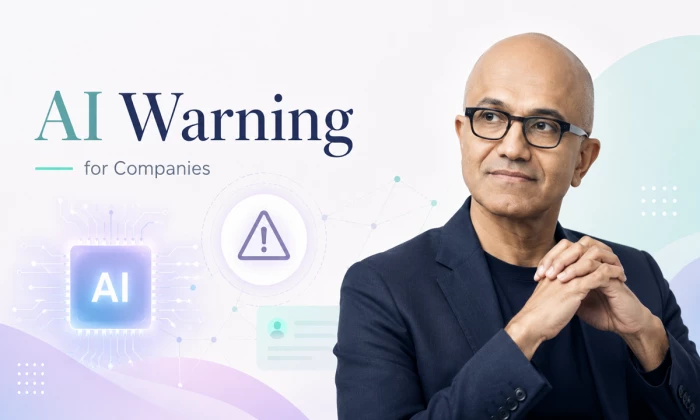
Microsoft CEO Satya Nadella has issued a sharp warning to businesses rushing to adopt artificial intelligence: the real cost of AI may be much higher than the subscription or computing bill.
According to Nadella, companies may also be handing over proprietary knowledge, employee expertise, internal workflows and business insights every time their teams interact with an external AI system.
He described the problem as the “Reverse Information Paradox,” arguing that companies effectively pay for AI twice—first with money and then with the knowledge required to make the technology useful.
The Warning Is About More Than Confidential Documents
Most corporate AI policies focus on stopping employees from uploading sensitive documents, customer records or unreleased financial information into public chatbots.
Nadella believes the risk goes much deeper.
AI systems can also learn from the everyday traces created when employees:
- Write detailed prompts
- Correct inaccurate answers
- Rate model outputs
- Refine internal workflows
- Connect AI agents with business tools
- Create evaluations to test model performance
Nadella referred to these traces as “intelligence exhaust.” Individually, one prompt or correction may appear insignificant. Collectively, however, they can reveal how a company operates, makes decisions, serves customers and solves difficult problems.
Companies May Be Paying to Reveal Their Own Expertise
Nadella connected his argument to economist Kenneth Arrow’s Information Paradox.
Arrow’s original idea described the difficulty of selling information: a buyer cannot judge its value until the seller reveals it, but once the information has been revealed, the buyer may already possess it.
Nadella argues that AI reverses this relationship.
The company buying AI is now the party that must reveal valuable information. The more accurate and customised the business wants the model to become, the more internal context it must provide.
That can include product knowledge, negotiation strategies, customer-support practices, coding standards, legal reasoning, operational decisions and specialised employee expertise.
AI Creates Knowledge Every Time Employees Use It
The issue is not limited to whether an AI provider trains its foundation model on customer data.
Companies also create new organisational intelligence while using AI.
For example, an employee may repeatedly correct an AI assistant until it understands the company’s preferred way of responding to a customer complaint. Another team may build a detailed evaluation system to determine which sales recommendations are most likely to succeed.
Those corrections and evaluation methods can become more valuable than the original documents supplied to the AI.
Nadella’s central argument is that businesses should own the knowledge created through these interactions. Otherwise, the company may improve an outside AI system without building a comparable internal learning advantage of its own.
The Five Principles Nadella Wants Companies to Follow
Nadella proposed five priorities for enterprises adopting AI. Together, they are intended to help organisations retain control of the learning generated through AI use.
| Principle | Practical meaning for companies |
|---|---|
| Control | Retain ownership of internal memory, feedback, evaluations, decisions and business context |
| Capability | Create private environments where models can be trained, adapted or customised securely |
| Choice | Avoid becoming dependent on one model provider or AI platform |
| Cost | Select different models and infrastructure according to performance and expense |
| Compound | Build a learning system in which organisational knowledge grows more valuable over time |
The broader goal is to create an enterprise-controlled learning loop rather than allowing prompts, corrections and model improvements to remain scattered across third-party platforms.
The Comments Add Pressure on AI Model Providers
Nadella also questioned the balance between the rights claimed by AI developers and those available to customers.
AI companies often defend their ability to train models using publicly available internet content. At the same time, some providers restrict customers from using model outputs to train or improve competing systems.
Nadella argues that this can create a one-sided arrangement: the AI provider may learn from customer activity while the customer has limited freedom to reuse the resulting intelligence.
His comments come as technology companies continue debating model distillation, training-data rights, intellectual property and whether customers should be allowed to build smaller or specialised models from the outputs of larger systems.
AI Adoption Is Moving Faster Than Corporate Governance
Many organisations are already using generative AI across marketing, software development, finance, customer service, research and human resources.
However, internal governance often remains limited to basic instructions such as “do not upload confidential information.”
Nadella’s warning suggests companies need more detailed controls covering:
- Where employee prompts are stored
- Whether customer interactions are used for model training
- Who owns customised models and evaluation data
- Whether AI memory can be exported
- Which external tools agents are allowed to access
- How model decisions and corrections are audited
Without these controls, a business may not know where its organisational intelligence is accumulating or who can use it.
The Risk Is Different for Every AI Product
Not every AI service handles customer data in the same way.
Some enterprise products offer contractual promises that customer content will not be used to train shared models. Others provide private deployments, regional data storage, retention controls and administrative audit tools.
Consumer AI products may operate under different terms.
Businesses therefore need to examine the actual contract, privacy policy, retention settings and technical architecture of each service instead of assuming that all AI tools provide the same protections.
The biggest risk often appears when employees adopt unauthorised tools independently, creating a form of “shadow AI” outside the organisation’s approved systems.
Companies Need to Protect Learning, Not Just Data
Nadella’s warning marks an important change in how businesses may need to think about AI security.
During the cloud-computing era, the main concern was where data was stored and who could access it.
In the AI era, companies must also consider who owns the learning created from that data.
Prompts, corrections, evaluations, customised workflows and adapted models can gradually become a record of how an organisation thinks. That accumulated intelligence may eventually represent a major part of its competitive advantage.
The companies that benefit most from AI may therefore be those that do more than purchase access to powerful models. They will also need to build systems that allow their own knowledge to remain controlled, reusable and increasingly valuable.
Nadella’s message is clear: AI can make a company smarter, but only when the intelligence created through its use continues to belong to the company.