U.S. Grid Rules Shift for AI Data Center Boom
by Vesper Barnes - 3 months ago - 6 min read
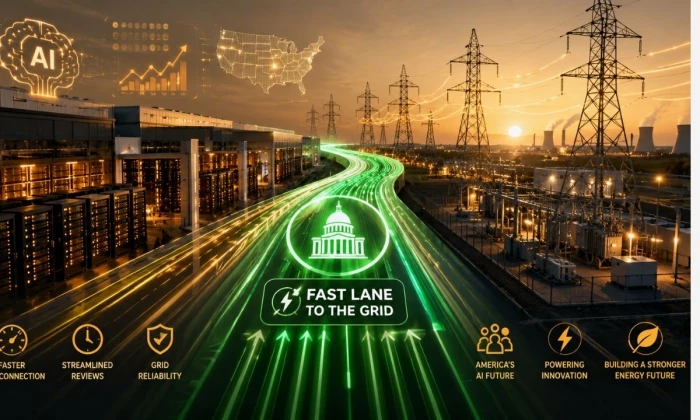
AI data centers are getting a faster route to electricity.
The U.S. Federal Energy Regulatory Commission, known as FERC, has ordered regional grid operators to speed up the process for connecting large electricity users, including AI data centers, to the transmission grid.
The decision comes as the AI boom puts new pressure on America’s power system. Large data centers can consume as much electricity as small cities, and many projects have been delayed because they cannot get grid connections fast enough.
This new order does not magically create more power. But it does force grid operators to review their connection rules, explain delays, and make room for the huge electricity demand coming from AI infrastructure.
The Policy Move
FERC’s order tells major U.S. grid operators to review how they handle large-load connection requests.
These requests usually come from projects that need massive amounts of electricity, including AI data centers, chip plants, industrial facilities and advanced manufacturing sites.
Reuters reported that FERC directed grid operators, excluding Texas, to either defend their current rules or propose changes within 60 days. The agency also asked them to look at areas such as interconnection procedures, cost allocation and grid reliability.
In simpler terms, FERC is telling grid operators: stop letting large energy users sit in a slow queue without clear answers.
Timeline of the New Grid Push
| Requirement | What It Means |
|---|---|
| 30-day report | Grid operators must report how much available generating capacity they have |
| 60-day response | Operators must defend or revise rules for large-load interconnections |
| Cost responsibility | Data centers may have to pay for needed grid upgrades |
| Behind-the-meter power | FERC wants operators to be more open to on-site or private power solutions |
| Main goal | Faster grid access without weakening reliability |
The order is designed to make interconnection rules clearer and faster, but it also keeps pressure on data center developers to cover the cost of upgrades required by their projects.
Data Centers Have Become a Grid Problem
AI has turned data centers into one of the biggest new sources of U.S. electricity demand.
Training and running large AI models requires enormous computing power. That means more chips, more cooling, more servers and more electricity.
AP reported that the U.S. already has more than 4,000 data centers in operation and around 3,000 more planned. Some large data centers now need power loads similar to small cities.
This is creating a new bottleneck. AI companies may have money, chips and land, but without a grid connection, they cannot run the infrastructure.
The Fast Lane Does Not Solve the Power Shortage
The important point is that faster paperwork does not create new electricity.
TechCrunch noted that FERC’s order gives data centers a faster path to interconnection, but it does not directly solve the shortage of generating capacity. Grid operators still need enough power available, and many regions are already under stress.
This means data centers may get clearer answers sooner, but they may still face hard limits if local grids cannot support their electricity demand.
That is why FERC is also encouraging more flexibility around behind-the-meter power. This can include on-site generation, private power arrangements or energy systems connected directly to a facility instead of relying only on the public grid.
Texas Is Taking Its Own Route
Texas is not covered by the same FERC order because most of its grid operates separately through ERCOT.
But Texas is facing the same data center pressure. Reuters reported that Texas regulators approved ERCOT’s “Batch Zero” framework to manage large power requests from data centers and other big users. ERCOT is reviewing more than 438,000 MW in large-load requests, with about 89% coming from data centers.
This shows that the grid challenge is not limited to one region. It is becoming a national infrastructure issue.
Local Resistance Is Growing
The federal government wants faster AI infrastructure. Many local communities are not convinced.
Data center projects are increasingly facing opposition over electricity bills, water use, noise, land use and environmental impact. Tom’s Hardware reported that more than 75 data center projects worth about $130 billion were blocked or delayed in the first quarter of 2026, matching the total for all of 2025.
This tension is becoming one of the biggest conflicts in the AI buildout: Washington wants speed, but local communities want control.
Cost Protection Will Be a Major Fight
One of the biggest questions is who pays for grid upgrades.
If a data center needs new transmission lines, substations or other infrastructure, regulators do not want ordinary electricity customers to absorb those costs. AP reported that FERC’s order says data centers should bear the full cost of necessary grid upgrades.
That sounds simple, but in practice it can be complicated. Grid upgrades often benefit more than one customer, and costs can be spread across utilities, regions and ratepayers.
This is where future disputes are likely to happen.
AI Infrastructure Enters the Energy Policy Era
The FERC order shows that AI is no longer just a software story.
The next stage of AI depends on electricity, land, cooling, transmission lines, fuel supply and regulatory approval. Data centers are now part of national energy planning.
A recent academic study estimated that U.S. hyperscale data centers consumed around 68 to 99 TWh of electricity between May 2024 and April 2025, depending on load assumptions, and were linked to about 37 to 54 million metric tons of CO₂.
That level of demand explains why regulators are treating AI data centers as a strategic infrastructure issue.
Industry Impact
For AI companies, the order is good news because it may reduce uncertainty.
A faster interconnection process can help companies plan data center projects, negotiate power deals and move infrastructure online sooner. This matters for firms racing to train larger models and serve more enterprise customers.
For utilities and grid operators, the order creates pressure. They must balance fast growth with reliability and affordability.
For consumers, the question is whether this can happen without raising electricity bills.
Final Take
AI data centers now have a government-backed fast lane to the grid, but the road is still crowded.
FERC’s order may speed up connection reviews and force grid operators to modernize outdated rules. That could help AI infrastructure expand faster.
But the harder problems remain: not enough power in some regions, rising local opposition, environmental concerns and disputes over who pays for grid upgrades.
The AI race is becoming an electricity race. The companies that secure power, grid access and community approval may have the biggest advantage in the next phase of AI.