Nvidia Invests $1.5B in SoftBank’s OpenAI Data Center Project
by Nitin - 1 month ago - 5 min read
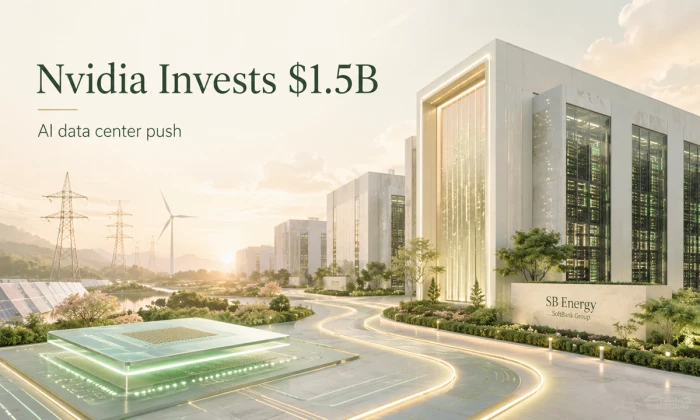
Nvidia is putting another major financial piece behind the AI infrastructure boom, investing $1.5 billion in SB Energy, the SoftBank-backed energy and data-center developer building a massive Ohio computing campus for OpenAI.
But the equity investment is only one part of the deal. Nvidia has also agreed to provide credit support for the initial 4.25 gigawatts of IT capacity at SB Energy’s PORTS-Pike Technology Campus in Pike County, Ohio. According to Nvidia’s SEC filing, its aggregate obligation under the initial guarantees is capped at $105 billion, making the agreement one of the chipmaker’s most significant infrastructure commitments to date.
OpenAI Signs Up for 20 Years of AI Capacity
SB Energy will build, own and operate the PORTS-Pike data center, while OpenAI will lease the infrastructure under a 20-year agreement.
The initial deployment is designed for roughly 4.25 IT-GW, but Nvidia has an option covering another approximately 3.75 GW, potentially taking the campus to around 8 IT-GW of AI computing capacity. Nvidia will also be the exclusive AI compute infrastructure provider for the facility, with OpenAI expected to deploy Nvidia’s full-stack DSX platform, including GPUs, CPUs and networking equipment.
The first 800 megawatts of capacity are expected to become available in 2028, largely using existing AEP infrastructure. Later phases will require additional generation capacity, transmission lines and other infrastructure.
That scale puts PORTS-Pike well beyond the typical data-center project. For perspective, Reuters noted that one gigawatt of electricity is roughly enough to power about 750,000 average U.S. homes.
Nvidia Is Protecting More Than a Chip Sale
The structure of the agreement shows how far Nvidia is willing to go to secure future demand for its AI hardware.
Under Nvidia’s SEC filing, the company has entered into residual-value guarantees connected with approximately 4.25 GW of leases. If OpenAI becomes insolvent or fails to make required lease payments, Nvidia could become responsible for the shortfall between the guaranteed minimum value of the property and what SB Energy can recover by re-leasing or selling it.
OpenAI has, however, agreed to reimburse and indemnify Nvidia for amounts the chipmaker actually has to pay under those guarantees. Nvidia’s obligations can also end under several conditions, including the expiration of the leases or OpenAI reaching a satisfactory credit rating.
The arrangement therefore does not mean Nvidia is simply handing SB Energy another $105 billion. It is primarily a financial backstop designed to make the enormous infrastructure project easier to finance.
The Economics Could Be Huge for Nvidia
There is a clear commercial reason for Nvidia to help make the project happen.
CEO Jensen Huang told Reuters that the initial 4.25-GW deployment could contribute as much as $200 billion in Nvidia revenue. Across its wider relationship with OpenAI, Huang said Nvidia could potentially generate around $600 billion in revenue by 2030 by supplying approximately 16 GW of computing capacity.
That helps explain why Nvidia has increasingly moved beyond simply selling GPUs and into financing the ecosystem that buys them. Just days before the SB Energy announcement, Nvidia unveiled partnerships with six major financial institutions aimed at mobilizing more than $500 billion of third-party capital for AI infrastructure.
The strategy has also raised questions about circular financing in the AI industry, where chip suppliers, AI developers, infrastructure companies and investors increasingly fund one another. Huang rejected that characterization of the PORTS-Pike deal, arguing that Nvidia is using its financial strength and visibility into future compute demand to secure long-lived infrastructure.
Ohio Project Brings a Massive Power Buildout
Compute is only half of the project. Supplying enough electricity is another major challenge.
SB Energy and SoftBank plan to develop at least 10 GW of new power generation and invest at least $4.2 billion in regional grid infrastructure through a partnership with AEP Ohio. The campus is being developed partly on the former Portsmouth Gaseous Diffusion Plant site and involves both private and federal land.
OpenAI estimates the six-year construction program could support around 35,000 construction jobs through 2032 and roughly 2,500 permanent operating jobs. SB Energy previously committed $40 million to a community benefits fund, with OpenAI adding another $40 million. OpenAI has also announced up to $84 million in Codex credits for approximately 844,000 eligible Ohio students during the 2026–2027 academic year.
AI’s Bottleneck Is Moving From Chips to Infrastructure
Nvidia’s $1.5 billion investment in SB Energy shows how the AI race is evolving. Having the best accelerator is no longer enough. Companies increasingly need to secure land, electricity, transmission capacity, financing and buildings years before the computing hardware is installed.
For Nvidia, supporting those projects can lock in enormous future hardware demand. For OpenAI, it helps secure the computing capacity required for frontier-model training and rapidly growing products such as ChatGPT and Codex. And for SoftBank and SB Energy, PORTS-Pike could turn a power-and-data-center developer into a central infrastructure provider for the AI economy.
The $1.5 billion headline therefore captures only a small part of the deal. The more important number may be the 8 gigawatts of AI capacity sitting behind it, and the hundreds of billions of dollars in future infrastructure and Nvidia hardware sales that such projects are beginning to represent.