OpenAI’s First AI Speaker Reportedly Priced at $300–$400
by Vivek Gupta - 1 month ago - 4 min read
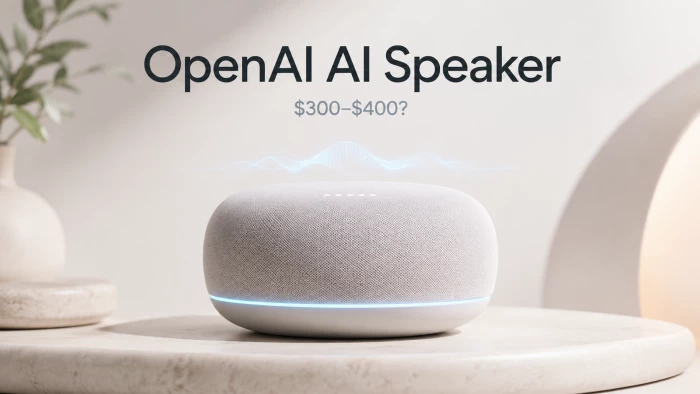
OpenAI’s first major consumer hardware product is becoming much less mysterious. New reporting suggests the company is developing a small, screenless AI speaker that could cost between $300 and $400 when it reaches consumers in 2027.
According to reporting from Bloomberg cited by The Verge and TechCrunch, the device is expected to be battery-powered, doughnut-shaped and roughly the size of a hockey puck. It is being designed as a portable AI companion rather than a conventional stationary smart speaker, allowing users to carry it between rooms and interact with ChatGPT without opening a phone or computer.
Premium hardware, no screen
The device reportedly will not include a traditional display. Instead, OpenAI appears to be building the interaction around voice, cameras, environmental sensors, lights and physical movement.
Some of its components could move automatically while the AI is responding, giving the device a more expressive or lifelike presence. Bloomberg’s sources also described a premium metal construction, while the portable design is intended to make it easy to pick up and move around the home.
The software experience is expected to resemble ChatGPT’s existing voice mode, but with more advanced contextual awareness. Cameras and sensors could give the assistant information about the room, objects and people around it, potentially allowing it to answer questions based on more than just spoken instructions.
That could turn the device into something closer to an ambient AI computer than another Alexa-style speaker.
Price expectations are moving upward
The latest $300–$400 estimate is particularly notable because earlier reports pointed to a lower price.
Reuters reported in February that OpenAI was considering a price of approximately $200 to $300 for its first speaker. That means the midpoint of the reported pricing range has moved from roughly $250 to $350, an increase of about 40%, although development-stage pricing can change significantly before launch.
At $300 to $400, OpenAI would also be positioning the device well above much of the mainstream smart-speaker market. TechCrunch noted that Amazon’s smart-speaker lineup generally ranges from around $40 to $240, making OpenAI’s product a distinctly premium proposition.
The higher price suggests OpenAI may be trying to sell the device as an entirely new category of personal AI hardware rather than compete directly with inexpensive Echo or Nest speakers.
A $6.5 billion hardware bet
The speaker is part of a much larger hardware strategy.
OpenAI announced in 2025 that the team from io Products, the hardware company associated with former Apple design chief Jony Ive, would merge with OpenAI. Ive’s independent design company LoveFrom continues to handle major design and creative responsibilities for the project.
The transaction was valued at roughly $6.5 billion, making the hardware initiative one of OpenAI’s biggest strategic bets outside its core AI software business.
Reuters previously reported that more than 200 employees were working on OpenAI’s family of AI devices. Beyond the speaker, the company has explored products including smart glasses and a smart lamp, although some of those concepts may never reach consumers. Smart glasses reportedly are not expected to enter mass production before 2028.
OpenAI and Ive have also described their collaboration more broadly as an effort to build a family of AI products, rather than a single experimental gadget.
A 2027 launch puts the focus on execution
OpenAI’s first hardware product is not expected to ship before 2027. Earlier court filings indicated that customer shipments would not begin before February 2027, while the latest reports continue to point generally to a 2027 release.
That gives OpenAI time to refine both the hardware and its pricing, but the company will also have to prove that consumers need a dedicated ChatGPT device when similar AI capabilities already exist on smartphones.
The history of standalone AI hardware provides a warning. Humane launched its AI Pin at $699, but the product struggled commercially and the company later sold key technology and intellectual property to HP for $116 million. Humane’s cloud services for the Pin were shut down in February 2025.
OpenAI enters the market with a far larger user base, stronger AI models and Jony Ive’s design team behind the project. But a $300–$400 price means the speaker will need to offer something meaningfully better than simply running ChatGPT Voice on a phone.
If OpenAI succeeds, the device could mark the company’s transition from being primarily an AI software provider into a consumer electronics company. If it does not, the speaker could become another reminder that creating a popular AI model and creating a device people want on their kitchen counter are two very different challenges.