Runway Launches AI Model Router for Generative Media
by Michael Hicklen - 7 hours ago - 5 min read
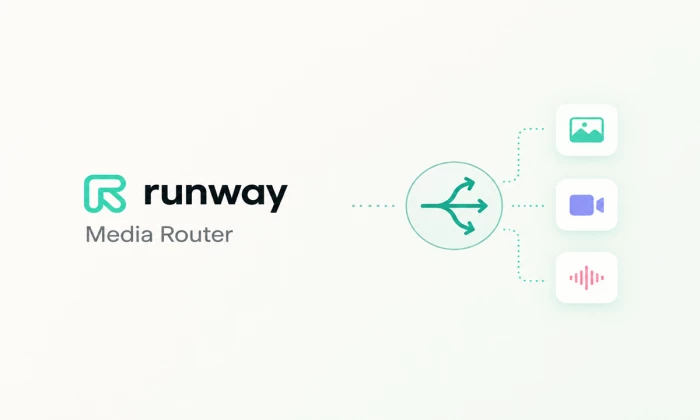
Runway is expanding beyond building its own AI video models with the launch of Media Router, a developer tool that automatically selects an image, video or audio model based on cost, quality and processing speed.
Released on July 23, 2026, Media Router is built into Runway Dev, the company’s recently launched platform for integrating generative-media models through a single API. Instead of requiring developers to select a specific model for every request, the router evaluates the available options and sends the job to the model that best matches the developer’s requirements.
The product decision Runway wants to automate
The number of specialised media models has increased quickly. One model may perform better at realistic motion, another at image composition, while a separate system may offer faster or cheaper audio generation.
That creates an ongoing evaluation problem for developers. A model selected when an application launches may become slower, more expensive or less capable than a newer alternative, forcing teams to repeatedly test models and update their integrations.
Media Router is designed to make that decision automatically.
| Routing control | What developers can set |
|---|---|
| Cost | A maximum price per image or per second of video |
| Quality | Preference for models expected to produce stronger results |
| Latency | Priority for faster generation |
| Provider controls | Allow or block particular providers |
| Model controls | Allow or block individual models |
| Testing | Preview the selected model without paying for a generation |
The router first removes models that cannot handle the requested task or fail the developer’s price and provider restrictions. It then scores the remaining models against the selected cost, quality and latency preferences. The completed request includes metadata explaining which model was used and why it was chosen.
Runway also provides a dry-run option that shows which model would be selected without generating content or creating a usage charge. When no model satisfies the configured limits, the system returns an error explaining which restriction eliminated the available choices rather than silently reducing the requested quality.
Runway is routing its own models and competitors
Media Router does not exclusively direct requests to Runway technology. Runway Dev includes the company’s Gen-4.5, Aleph 2.0 and Act-Two models alongside third-party systems such as Seedance, GPT Image 2 and ElevenLabs.
This means Runway is positioning itself as an access and orchestration layer rather than asking developers to rely entirely on its own models.
Runway Dev launched on July 8 and is already being used by teams at Adobe, ElevenLabs, Shutterstock, Figma Weave, Gamma and Silverside. According to Runway, these customers have generated millions of videos, images and other creative assets through the platform.
TechCrunch also identified Cloudflare, Expedia and Quora among the companies using Runway’s developer infrastructure to add media generation directly to their products.
Quality routing is harder for media than text
Model routing is already common in language-model applications, where developers may send simple queries to cheaper models and reserve more expensive systems for difficult requests. Media routing is more subjective because visual quality cannot always be measured through a single benchmark.
A video model may produce realistic movement but struggle with character consistency. An image model may generate strong compositions but perform poorly when asked to reproduce text or product details. Audio models can also vary in voice realism, timing and lip-sync performance.
Runway says its quality-ranking system draws on evaluations performed by its internal creative team, including how video models handle motion, how image models structure compositions and how voice systems manage lip synchronization. The underlying routing technology was originally developed for Runway Agent, which coordinates multiple models to create longer videos and marketing campaigns.
However, Runway has not published independent accuracy figures showing how often Media Router selects the model that users would personally judge as the best. Quality routing therefore depends partly on Runway’s own evaluation criteria.
Small savings could matter at production scale
Runway is targeting developers and enterprises that generate media at high volume. For a single image or short video, a small price or latency difference may have little impact. Across hundreds of thousands or millions of requests, those differences can become a significant infrastructure expense.
Developers can create separate routing configurations for different workflows. A free in-app preview could prioritise speed and low cost, while a paid final export could place greater weight on quality.
Runway says its analysis of hundreds of enterprise customers found that AI-assisted media production had reduced some production costs by two to three orders of magnitude. These figures were reported by customers and compared with their previous production spending, so they should be treated as company-supplied case-study data rather than independently audited industry averages.
The router reduces Runway’s dependence on winning every model race
Runway helped establish the commercial AI-video market, but it now competes with models from Google, ByteDance, Alibaba and other heavily funded companies. Its latest dedicated frontier video-generation model, Gen-4.5, was released in December 2025, while newer competitors have continued entering benchmark rankings.
Media Router gives Runway a different way to remain central to generative-media development. When another provider releases a faster or more capable model, Runway can potentially add it to its platform rather than compete with it only through a new in-house model.
The strategy carries a trade-off. By routing customers to third-party systems, Runway is acknowledging that its own model may not always be the best option. At the same time, controlling the API, routing logic and developer relationship could be more durable than temporarily leading an AI-video benchmark.
Media Router is now available for image, video and audio generation through Runway Dev. Its long-term value will depend on how accurately it evaluates subjective media quality, how quickly it adds new models and whether developers trust Runway to make model-selection decisions on their behalf.