SpaceX Officially Closes $60 Billion Cursor Acquisition
by Vivek Gupta - 1 month ago - 4 min read
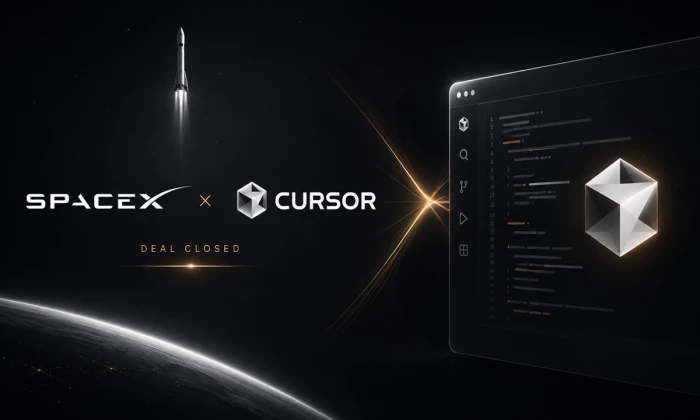
SpaceX has officially completed its acquisition of Cursor, bringing one of the fastest-growing AI coding platforms under Elon Musk’s expanding technology empire.
Cursor confirmed on August 14 that it is now part of SpaceX, closing an acquisition process that began with a compute partnership in April. The transaction values Cursor maker Anysphere at about $60 billion and became effective on August 14, according to a regulatory filing reported by Bloomberg Law.
The deal is unusually large even by Silicon Valley standards and gives SpaceX a direct position in the increasingly valuable market for AI-powered software development.
From compute partnership to $60 billion takeover
The relationship between the two companies moved quickly.
Cursor announced a partnership with SpaceXAI on April 21, saying its internal model-development efforts had been constrained by access to computing power. Through the agreement, Cursor gained access to SpaceXAI's Colossus infrastructure to scale model training.
By June, SpaceX had agreed to acquire Anysphere for $60 billion in an all-stock transaction. Reuters reported that SpaceX would not use proceeds from its IPO to fund the deal and initially expected it to close during the third quarter of 2026.
That process is now complete.
Cursor said the acquisition gives its team access to what it describes as the world's largest fleet of GPUs, potentially allowing it to train more capable AI models while reducing their operating costs.
Cursor brings a rapidly growing AI business
SpaceX is not simply acquiring another coding interface. Cursor has developed into a significant enterprise AI business since Anysphere was founded in 2022.
Reuters reported in June that Cursor had reached approximately $2.6 billion in annualized business-to-business revenue, while enterprise sales were growing rapidly. The startup had also reportedly been discussing a financing round that could have valued it at around $50 billion before the SpaceX deal.
Its investors have included Andreessen Horowitz, Thrive Capital, Nvidia and Google's parent company Alphabet.
That combination of enterprise distribution, developer usage and proprietary coding models gives SpaceX something that would have been difficult to build quickly from scratch: a direct channel into professional software-development workflows.
More compute could reshape Cursor's AI models
Compute appears to be one of the biggest strategic drivers behind the acquisition.
Cursor said earlier this year that Composer 1.5 increased reinforcement-learning scale by more than 20 times, while Composer 2 introduced continued pretraining. The company said further model improvements were being restricted by its available compute before the SpaceX partnership.
That constraint changes considerably inside SpaceX.
Cursor now says it expects the combined infrastructure to help it build stronger models that are cheaper to operate. It pointed to Grok 4.6 as an early example of technology developed through the companies' closer collaboration.
SpaceX had also previously said it planned to release an AI model through Cursor while jointly developing Grok Build, xAI's coding agent.
AI coding becomes a bigger part of SpaceX's business
The acquisition also shows how far SpaceX has expanded beyond rockets and satellites.
SpaceX incorporated xAI earlier in 2026, and the Cursor transaction gives the company another major position in commercial AI. Reuters reported that SpaceX had presented investors with a theoretical total addressable market of $28.5 trillion, with enterprise AI expected to represent a meaningful part of that opportunity.
Cursor could become particularly valuable because coding is already one of the areas where generative AI has developed clear business demand.
The platform now sits at the intersection of three assets: Cursor's developer distribution, xAI's models and SpaceX's enormous computing infrastructure. That combination puts SpaceX in more direct competition with companies such as Anthropic and OpenAI, both of which are investing heavily in autonomous coding agents.
For Cursor users, the immediate product may still look familiar. But behind the interface, the economics of building its models have changed significantly. With access to far more compute and deeper integration with SpaceXAI, Cursor is moving from an independent AI coding startup into a core part of a much larger AI infrastructure business.