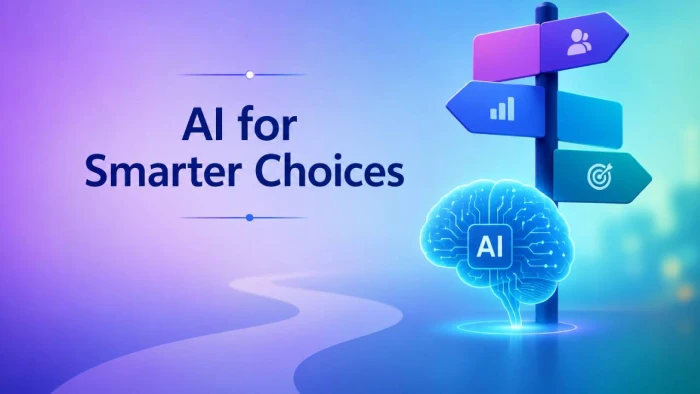
More information does not always make a decision easier. A medical report, loan agreement, insurance letter, or legal notice can contain all the facts and still leave a person unsure about what to do next. The real challenge is often not access to information, but understanding what that information means in a practical, personal situation.
That interpretive gap, the distance between having information and understanding it, is where most people get stuck. It is exactly the gap artificial intelligence has begun to close. The most consequential thing AI is doing today is not writing essays or generating images, it is transforming the earliest stage of any important decision: the moment you are simply trying to understand what your options are.
To appreciate what is changing, it helps to be honest about why this stage was so difficult in the first place. The obstacles were never random; they were structural.
The first is specialized language. Medicine, law, finance, and insurance each developed their own vocabularies, and those vocabularies act as gates. A term like "subrogation" or "deductible excess" or "comparative negligence" carries enormous practical weight, yet means nothing to the person whose outcome depends on it.
The second is expertise asymmetry. In nearly every high-stakes situation, one side of the conversation does this every day and the other side has never done it before. The insurance adjuster has handled ten thousand claims; you are handling your first. That imbalance shapes who feels confident and who feels lost.
The third is conflicting advice. Search the same question twice and you will often find contradictory answers, each delivered with total certainty. Without a way to weigh sources, more input simply produces more doubt.
The fourth, and most underrated, is infrequency. The decisions that frighten people most a major illness, a lawsuit, a mortgage, a serious accident are the ones they encounter rarely, if ever. Because they are rare, no one builds a mental model for them. You walk in cold, without the vocabulary, without a sense of what is normal, and without any way to judge whether what you are being told is reasonable.
Put these four together and you get the familiar feeling that accompanies every big decision: not a lack of data, but a lack of orientation.
A traditional search engine is extractive. You type a query, it returns a list of links, and the genuinely hard work reading, filtering, reconciling, and synthesizing is left entirely to you. The tool finds material; you have to build understanding from it.
Conversational AI inverts that relationship. Instead of handing you raw material to process, it performs a meaningful share of the processing itself. That shift shows up in a handful of distinct capabilities:
● Translation converting specialized jargon into plain language pitched at your level of understanding.
● Synthesis pulling a scattered topic into a coherent explanation rather than ten competing fragments.
● Follow-up reasoning answering the next question that arises the moment you grasp the first, the way a patient expert would.
● Personalization tailoring the explanation to your specific framing instead of a generic average.
● Scenario walk-throughs helping you think through "what happens if I do X versus Y" before you commit to either.
None of this means AI knows more than the open web. It means AI can interpret the web on your behalf and interpretation, not raw access, was always the scarce resource. That distinction is what makes this moment genuinely new rather than just faster.
This new capability is not evenly useful. It matters most in exactly the situations described earlier: high-stakes, unfamiliar, and rare. Across those domains, AI tends to play the same role it helps you understand the landscape, while the final judgment and execution stay with a qualified human.
| Domain | What AI helps you understand | Where you still need a human |
| Health | What a diagnosis or test result generally means; what questions to ask your doctor | Diagnosis, treatment decisions, prescriptions |
| Legal | Your general rights, common processes, what terms mean | Case strategy, representation, formal advice |
| Finance | How products and trade-offs work; what fees and terms imply | Personalized planning, fiduciary advice |
| Major purchases | How to compare options and spot red flags | Inspection, negotiation, contracts |
| Career | How to read an offer, frame a decision, weigh paths | Negotiation leverage, insider context |
The pattern in the right-hand column is the important one. In every case, AI moves a person from confusion to clarity but clarity is the beginning of acting well, not the end. Nowhere is that handoff clearer than in one of the most stressful situations an ordinary person can face.
Some decisions build slowly; others land in an instant. A sudden diagnosis, an unexpected legal notice, an accident, a financial emergency these share a particular cruelty. They are high-stakes, deeply unfamiliar, and they demand attention right away, before the person has any chance to learn the terrain. It is the exact profile where orientation is hardest and matters most, because confusion and pressure arrive together.
In that fog, AI has become a genuinely useful first point of orientation. A person can describe, in plain words, what they are facing and receive a calm explanation of the general shape of their situation: how the process typically unfolds, what documentation tends to matter, which questions are worth asking, and what rights or choices people in similar circumstances often have. This does not replace expert judgment but it lowers the panic. It turns a bewildering experience into something a person can begin to reason about, rather than something that is simply happening to them.
What it cannot do is take the next step. And recognizing where that next step begins is the most important part of using these tools well.
It is tempting to oversell what AI does here, so it is worth being precise about its limits because those limits are exactly what make it trustworthy.
AI cannot access your specific records, your contract, your medical file, or the particular facts that determine the outcome of a real case. It cannot be held accountable for the advice it gives. It cannot represent you, negotiate on your behalf, or stand behind a recommendation with professional responsibility and licensure. And it can, on occasion, deliver an answer that is confident and wrong a failure mode that is especially dangerous in domains where the stakes are high and the user has no way to spot the error.
For that reason, in genuinely consequential matters legal, medical, financial AI should never be the last stop. The healthiest framing is simple: AI is for informed questions, not final answers. Its proper job is to get you to the point where you understand a situation well enough to know who to ask, what to ask, and whether the answers you receive actually make sense. The decision, and the responsibility for it, remain with you and the qualified humans you turn to. A tool that helps you ask sharper questions is quietly powerful and far safer than one that pretends to settle the matter.
Knowing that AI is an orientation tool is only half the battle; using it well is a skill in itself. A few principles separate productive use from risky over-reliance:
1. Ask for understanding, not verdicts. Frame questions around "help me understand how X works" rather than "tell me what to do." The first plays to AI's strength; the second invites overconfidence.
2. Demand the trade-offs. Ask explicitly for the downsides, the counterarguments, and the situations where the usual advice fails. Balanced framing is more useful than a clean recommendation.
3. Verify anything specific. Names, numbers, deadlines, and legal or medical particulars should be confirmed with an authoritative source or a professional. Treat AI output as a draft of your understanding, not a final record.
4. Bring the output to the expert. The goal is not to replace the doctor or lawyer but to arrive better prepared. Use AI to build the list of questions you take into that meeting.
5. Notice when you're out of your depth. The moment a situation becomes high-stakes and fact-specific, that is the signal to hand off to a human not to lean harder on the tool.
Used this way, AI does not make you dependent. It makes you a more informed participant in your own decisions.
Step back, and a larger pattern comes into view. For decades, the people who navigated complex systems most successfully were those with access to advisors, to insiders, to a friend or relative who simply "knew how these things worked." Understanding your options was, to a real degree, a privilege of who you knew.
AI is beginning to dismantle that quiet barrier. The single parent trying to decode a medical bill, the first-generation graduate weighing an unfamiliar job offer, the accident victim trying to grasp their rights each now has a patient, judgment-free way to learn the basics before ever sitting across from an expert.
This does not erase the need for professionals or the advantages of wealth and connections. But it changes the starting line, so that far more people arrive at the important conversations informed rather than intimidated. In a world where confusion has always favored the powerful, that shift is more meaningful than it first appears.
If facts are now abundant and instantly interpretable, the skill that matters most is no longer recall. It is the ability to ask to take a vague sense of unease and turn it into the specific, well-formed questions that unlock real understanding.
This is the new literacy of the AI era. It is not about knowing the answer; it is about knowing how to interrogate a situation: what to probe, what to challenge, what assumptions to test, and when an answer deserves a follow-up. People who develop this habit get dramatically more out of every tool and every expert they encounter, because they drive the conversation instead of passively receiving it. And unlike the specialized knowledge it helps unlock, this skill is teachable to almost anyone which is part of why it may prove to be the most democratizing effect of all.
The current generation of AI mostly answers questions you think to ask. The next will increasingly anticipate them flagging the option you overlooked, the deadline you missed, the question you did not know to raise. As these systems become woven into the everyday tools people already use, orientation will stop being something you seek out and become something quietly available at the moment of need.
What will not change is the division of labor. Anticipation, explanation, and translation will keep moving toward machines. Judgment, accountability, advocacy, and care will remain stubbornly, rightly human. The trajectory is not toward AI replacing the expert, but toward a world where far fewer people face their hardest decisions alone and unprepared.
The most meaningful contribution of artificial intelligence is not the work it does for us, but the understanding it unlocks within us. It is helping ordinary people make sense of situations they were never trained to navigate, at the exact moment they need that clarity most.
It will not make the hard choices, and it should not. But by clearing away confusion and replacing it with orientation, it gives people something they have long lacked the confidence to understand their options and the preparation to act on them well. In a world that has never been short on information, the ability to finally make sense of it may turn out to be the difference that matters most.
Share your thoughts about this article.
Be the first to post a comment!
A single car crash today produces more documentation in ten seconds than a 1990s...
Parveen Verma4 days ago

Would you rather spend an hour taking notes by hand or let AI do all the legwork...
Parveen Verma3 weeks ago
Fireflies.ai crossed a $1 billion valuation in 2026 and has built one of the lar...
Parveen Verma1 month ago

Artificial intelligence is no longer a future experiment. In 2026, businesses ar...
Parveen Verma1 month ago

Building cross-platform digital experiences, shipping software tutorials, or lau...
Parveen Verma1 month ago

Creating a professional presentation is often one of the most time-consuming cho...
Parveen Verma1 month ago