
Ask a renter under 40 how they'd replace a stolen laptop, and most reach for a phone before anything else. You can buy a policy and settle a claim without leaving the screen, and store proof of coverage in the same place, so the app you pick is the difference between that taking two minutes or two days. This guide to the best apps for renters insurance ranks seven carriers on what their software does day to day, from mobile claims and digital ID cards to self-service you can run at midnight.
Renters insurance stays cheap, about $14 to $15 a month on average, according to the Insurance Information Institute, so the gap between policies often comes down to the experience you get when something goes wrong. About 47% of U.S. landlords required coverage in 2025, per property-management platform RentRedi, so plenty of tenants need a policy anyway. Here are the apps worth downloading in 2026, starting with the one built around the claim itself.
● Best overall renters insurance app: Lemonade
● Best app for flexible, subscription-style coverage: Toggle
● Best app for bundling renters with auto: Progressive
● Best app for low-cost coverage: State Farm
● Best app for stacking discounts: Liberty Mutual
● Best app for coast-to-coast availability: Allstate
● Best app for extra coverage options: Nationwide
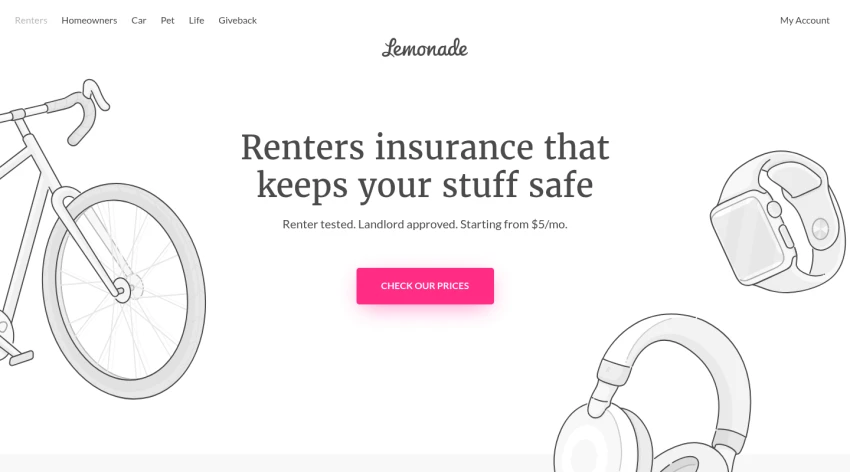
Who's this for? Renters who want to run the whole policy from a phone and skip the agent call. Lemonade built its product around software: you answer a few questions from an AI assistant named Maya, and you can go from download to covered in the length of a short elevator ride. App Store shoppers score it 4.8 stars, among the highest marks any insurer earns.
Standout benefits: Claims run through the app as a short video, and Lemonade's AI reviews them on the spot. The company reports its AI clears about 40% of claims with no human involved, paying many within minutes and the fastest in about three seconds. The base plan covers your personal property and personal liability, with loss-of-use costs and guest medical payments on top.
Extra Coverage, the add-on for valuables, schedules jewelry, cameras, bikes and instruments at a zero-dollar deductible and shields them from accidental loss anywhere in the world. Through Giveback, your policy links up with a cause you care about, and you name that cause during signup. Customers can also put local nonprofits forward for support via the Neighborhood Fund, a program that customers and employees drive together. Lemonade, a Certified B Corp set up as a public benefit corporation, has donated upward of $12 million since 2017, funding work on housing and clean water among other causes. You'll find Lemonade writing policies in the majority of states and adding more at a fast clip.
App snapshot
● Platforms: iOS and Android
● Quote and buy in-app: Yes, in about a minute and a half from your phone
● File claims in-app: Yes, with instant AI review
● Digital ID card and documents: In the app
● Standout app feature: AI claims that can pay in minutes
Pros
● Buy a policy in around ninety seconds and file claims by video in the app.
● Extra Coverage that puts a $0 deductible on valuables, plus a Giveback donation to a cause you pick.
● Stack savings: bundling cuts up to 10%, and prepaying a full year takes off up to 5% more.
Cons
● Availability skips some states for now.
● Everything runs through the app and website, which won't suit renters who'd rather hash things out with an agent in person.
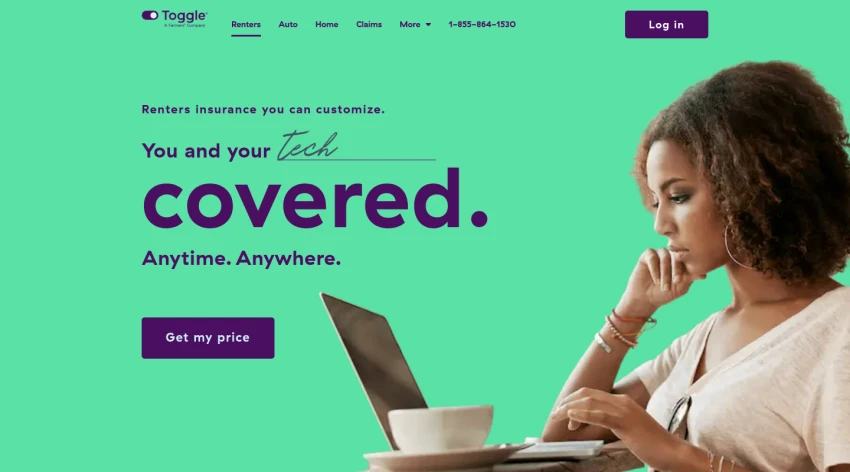
Who's this for? Younger, digital-first renters who'd rather manage a subscription than a traditional policy. Toggle, a company owned by Farmers, sells renters coverage the way a streaming service sells a plan: you sign up online, pick a tier and change it as your life changes. It targets the same phone-first renter as Lemonade.
Standout benefits: Coverage travels with you anywhere in the world, and Toggle layers on add-ons you won't find on a basic policy, including Pet Parent for vet bills, Side Hustle for gig work and Identity Protector. Stay claim-free and your deductible drops each year. Pricing starts around $5 a month, though Toggle describes its tiers with food and streaming analogies rather than firm numbers, so pull a quote to see your rate.
App snapshot
● Platforms: Online self-service (web-first)
● Quote and buy in-app: Yes, online
● File claims in-app: Yes, online
● Digital ID card and documents: In your online account
● Standout app feature: A subscription you can adjust as life changes
Pros
● Subscription model with worldwide coverage and add-ons like Pet Parent and Side Hustle.
● A deductible that shrinks for every claim-free year.
Cons
● No third-party rating or published review exists for Toggle, so you can't check its track record the way you can with an older carrier.
● Toggle won't cover rideshare driving.
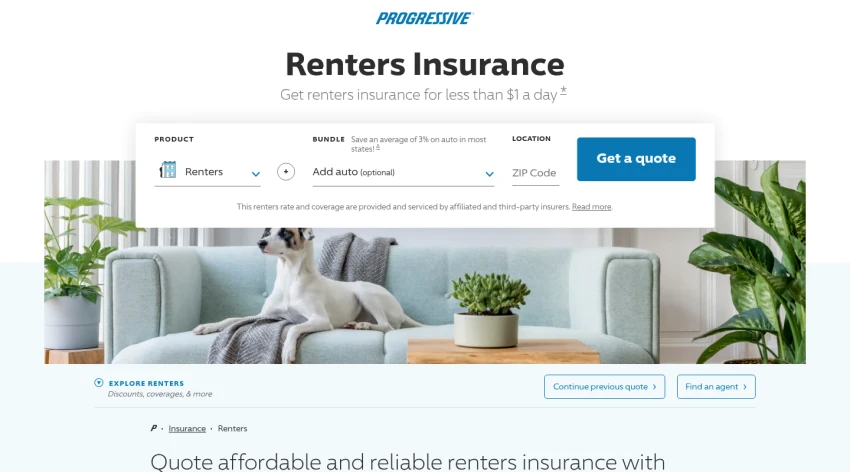
Who's this for? Drivers who already keep a Progressive auto policy on their phone and want renters coverage on the same bill. Progressive gives bundlers a few ways to save, and pairing renters with auto can mean a single deductible when one loss hits both. Picture a break-in that pulls your laptop from a parked car.
Standout benefits: The Progressive app is a mainstay for its auto customers, with ID cards and payments in one place. Renters who bundle can add paperless and pay-in-full discounts on top of the multi-policy savings, so the combined bill drops.
App snapshot
● Platforms: iOS and Android
● Quote and buy in-app: Online quote; renters may come from a third party
● File claims in-app: Varies by underwriter
● Digital ID card and documents: Not in the Progressive app
● Standout app feature: One login for bundled auto and renters savings
Pros
● Bundling discounts and a possible single deductible for renters and auto.
● A well-established app for existing Progressive auto customers.
Cons
● You can't manage a Progressive renters policy in the Progressive app.
● Progressive, a car-insurance mainstay, leaves the underwriting to others; your policy comes from Progressive Home or from Homesite, an outside company, so who handles your claim isn't always clear.
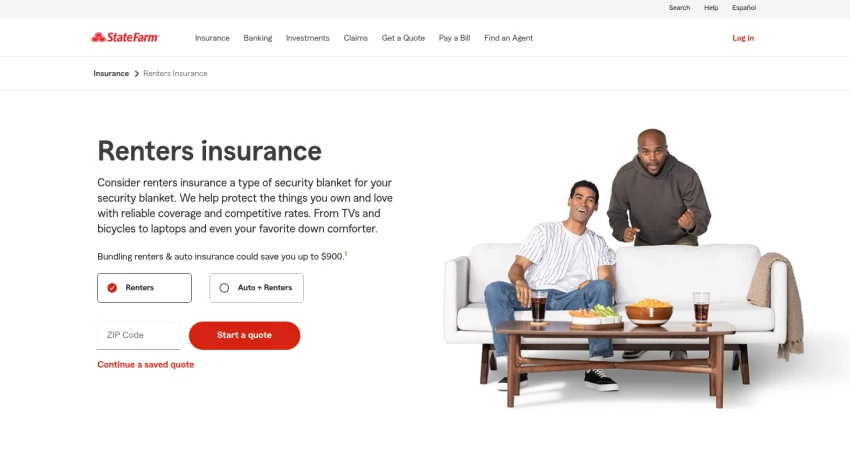
Who's this for? Budget-minded renters who still want a big-name carrier with a real app and the option of a local agent. State Farm posted the cheapest average renters rate of any large national insurer in NerdWallet's latest analysis, close to $110 a year.
Standout benefits: State Farm pairs low rates with a strong app and website, so you can pay bills, view your policy and start a claim from your phone, or hand it to an agent if you'd rather talk to a person. Pair the policy with State Farm auto coverage or install safety devices in the home and the price drops further.
App snapshot
● Platforms: iOS and Android
● Quote and buy in-app: Yes, in-app, online or via an agent
● File claims in-app: Yes
● Digital ID card and documents: In the app
● Standout app feature: Manage the policy your way, by app, web or agent
Pros
● Cheapest average of the big-name national carriers.
● Strong app and website, plus local agents if you want one.
Cons
● State Farm doesn't sell renters policies in a handful of states.
● Its complaint count runs about what a carrier its size draws, not below it.
Who's this for? Renters who want to lower the premium with a stack of discounts and manage it from a user-friendly app. Liberty Mutual offers a wide set of savings, from bundling with auto to going claim-free and setting up autopay.
Standout benefits: The Liberty Mutual app and website let you handle quotes, payments and claims without a phone call. Because the discount list runs long, from multi-policy credits to autopay to claim-free savings, you can knock down the premium at signup and keep managing it from the app.
App snapshot
● Platforms: iOS and Android
● Quote and buy in-app: Yes, online or in-app
● File claims in-app: Yes
● Digital ID card and documents: In the app
● Standout app feature: A deep discount menu you can apply at signup
Pros
● Wide range of discounts, including bundling, autopay and claim-free savings.
● Smooth app and website for self-service.
Cons
● Liberty Mutual, a big national name, placed under average in a recent J.D. Power customer-satisfaction study.
● Its complaint count runs about what a carrier its size draws.
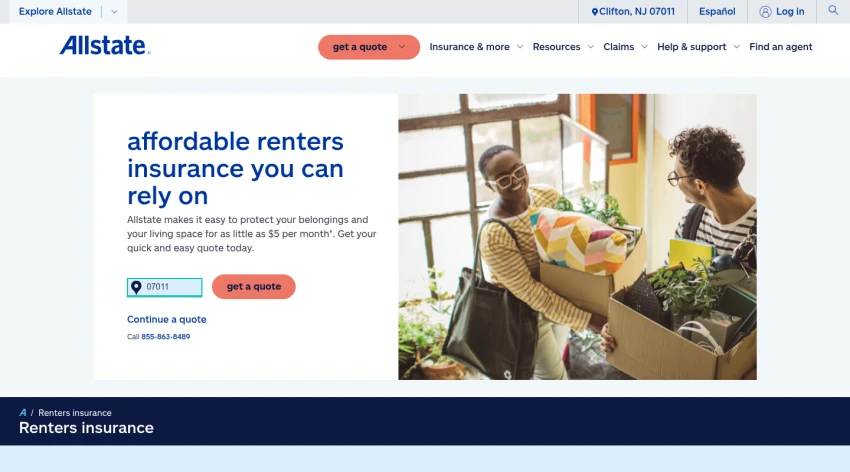
Who's this for? Renters who move often or live where smaller insurers don't reach. Allstate writes renters policies in every state plus Washington, D.C., with below-average rates and a user-friendly digital experience.
Standout benefits: You can quote, buy and manage an Allstate renters policy online or in the app, then pull up proof of coverage whenever a landlord asks. Because Allstate operates everywhere, you can carry the same policy and login through a cross-country move without switching carriers.
App snapshot
● Platforms: iOS and Android
● Quote and buy in-app: Yes, online or in-app
● File claims in-app: Yes
● Digital ID card and documents: In the app
● Standout app feature: The same coverage and login in every state
Pros
● Coverage in every state plus Washington, D.C.
● Below-average rates and a tidy app and website.
Cons
● Allstate, a coast-to-coast carrier, landed under the customer-satisfaction bar in the 2025 J.D. Power study of U.S. home insurers.
● Its complaint count lands where its size predicts, not below it.
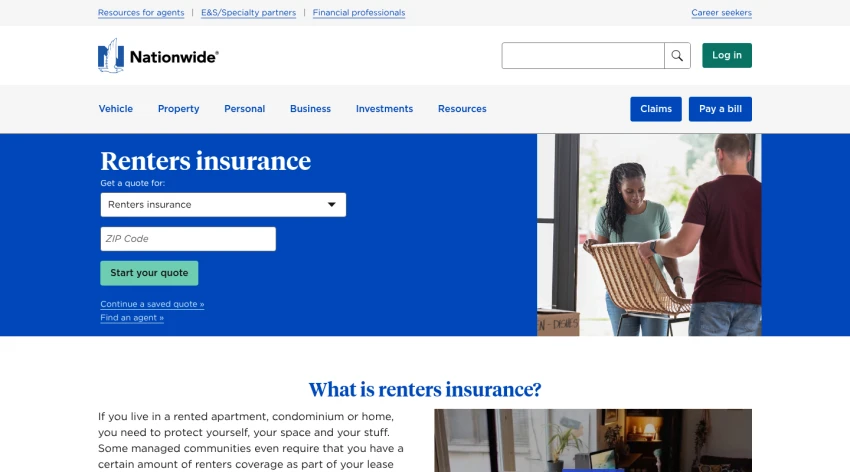
Who's this for? Renters after richer coverage than a stripped-down policy, plus an app to manage the extras. Nationwide goes further than a starter policy, offering optional protections many renters add, backed by digital tools that stay simple to run.
Standout benefits: You can build out a policy with optional coverage, then handle payments, documents and claims from the Nationwide app. Its digital tools make it painless to store proof of coverage and check your limits before a lease signing.
App snapshot
● Platforms: iOS and Android
● Quote and buy in-app: Yes, online or via an agent
● File claims in-app: Yes
● Digital ID card and documents: In the app
● Standout app feature: Add-on coverage you can manage in one place
Pros
● Optional protections a bare policy skips.
● A clean app and website.
Cons
● Nationwide averages about $193 annually, higher than NerdWallet's average among large national carriers, near $151.
● It isn't sold in every state, and its complaint count runs about what its size predicts.
Every app on this list lets you buy coverage and file a claim online, so the differences show up in the details. Four things separate a good renters app from a forgettable one.
Start with claims. The reason you carry renters insurance is the bad day, so check whether you can file in the app with photos or video and track the payout without a phone call. Lemonade sits at the front here, with AI that can approve a straightforward claim in minutes.
Then check the app-store rating before you download. A 4-star-plus score on the App Store or Google Play, backed by thousands of reviews, tells you the software holds up in daily use. Lemonade's 4.8 stars lead the field, and a low rating with few reviews is a reason to pause.
Look for a digital ID card and instant proof of coverage. A landlord or leasing office often wants proof before you get the keys, and a good app lets you email or screenshot it in seconds. One catch: you can't manage a Progressive renters policy in its app, so proof of coverage lives elsewhere.
Last, weigh the self-service tools, like paying a bill or adding a roommate. The more you can finish without calling, the less a policy costs you in time.
A renters policy covers four core areas, whatever app you use to buy it.
| Coverage | What it does
|
|---|---|
| Personal property | Rebuilds or replaces your stuff after covered perils like theft and fire. |
| Personal liability | Picks up legal costs when you hurt someone or wreck their property. |
| Loss of use | Foots the hotel and food bill while repairs run at your rental. |
| Medical payments | Takes care of small guest injuries at your place. |
Renters insurance runs about $14 to $15 a month on average, or close to $180 a year, according to the Insurance Information Institute. App-first carriers can undercut that: Lemonade, an app-first insurer, opens at five dollars a month and averages about $118 annually in NerdWallet's rate work, and State Farm posts one of the lowest averages among national carriers, near $110 a year. Your own price tracks your ZIP code and chosen limits, with the deductible pulling the other way, so gather a few quotes at identical limits before settling on an app. A bargain premium stops feeling like one when the app leaves you waiting a week to reach a human.
This list ranks each carrier on the strength of its app and digital tools, not on brand size or ad budget. Four measures carried the most weight. Mobile claims came first: whether you can file in the app, add photos or video and get paid without a call. App quality came next, judged on App Store and Google Play ratings and the range of self-service tasks you can finish on a phone. Coverage mattered too, with credit for replacement cost and add-ons that protect valuables. Cost and availability rounded out the picture, using NerdWallet's rate analysis where a published figure exists. Ratings and complaint data come from NerdWallet's renters insurance reviews and the National Association of Insurance Commissioners. No single app wins for everyone, so choose the pick that fits what you'll use most.
The best renters insurance app comes down to your priorities, and each pick above answers a different one. On raw price, State Farm's average near $110 is tough to beat. If you want coast-to-coast reach, Allstate covers every state plus D.C. Most renters, though, will judge the choice on claim day, where Lemonade separates itself: signup in less time than a kettle takes to boil, no-deductible Extra Coverage for valuables, and an app that can settle a simple claim in minutes. Its 4.8-star App Store rating and Giveback model keep the focus on paying claims, not fighting them. Download two or three of these apps, quote the same coverage in each and see which one you'd trust at 2 a.m. If fast, phone-based claims top your list, price it out with a Lemonade renters quote first.
Either works, and with most carriers it's the same account behind both. An app wins for the things you do on the move: filing a claim with photos, pulling up proof of coverage at a leasing office or paying a bill from a bus. A desktop site can be easier for reading policy documents or comparing coverage limits side by side. Lemonade lets you do the whole job, quote, buy and claim, in the app or the browser, so you can start on one and finish on the other.
With an app-first insurer, filing takes a few minutes: you open the app, answer a few prompts and attach photos or a short video of the damage. Payout speed is the real gap. Lemonade reports its AI clears about 40% of claims with no human review, paying many within minutes, while a traditional carrier may route your claim to an adjuster and settle over several days. Complex claims take longer at any company, since a person has to review them.
In most cases, yes. Once your policy is active, the carrier's app stores your declarations page and a digital proof of coverage you can email or screenshot for a landlord in seconds. The main exception here is Progressive, which doesn't let you manage a renters policy in its app, so your proof of coverage lives with the underwriter instead. Check the app before you commit if a leasing office needs proof on short notice.
Share your thoughts about this article.
Be the first to post a comment!