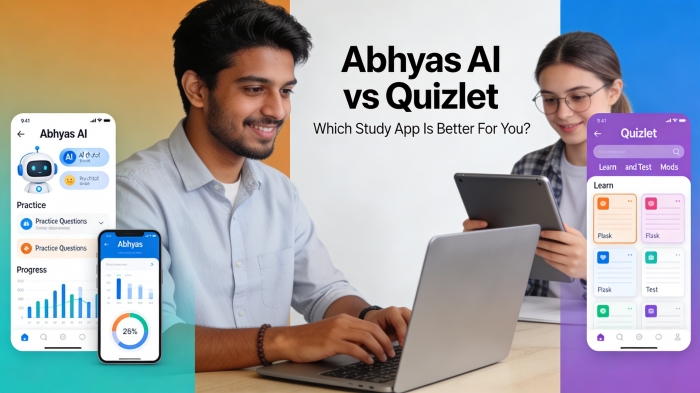
If you have spent even an hour searching for an online study tool in 2026, you have probably stumbled across both Abhyas AI and Quizlet. On the surface, they sound like cousins. Both promise smarter studying, both lean on AI, and both want a slice of your monthly subscription budget. But once you actually use them, you realise they are built for very different kinds of learners.
I have been digging through their websites, pricing pages, and a fair stack of user reviews on G2, Capterra, and Trustpilot to figure out who genuinely benefits from which platform. Here is the honest comparison, no fluff.
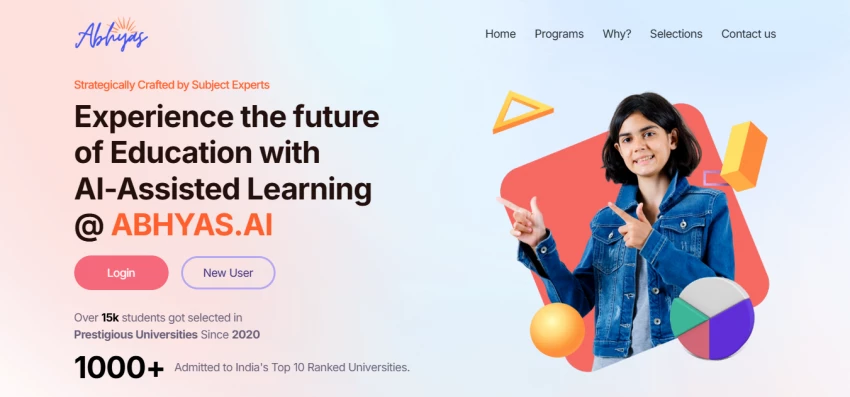
Abhyas AI is an Indian edtech platform built specifically for students preparing for JEE and NEET, the two most competitive entrance exams in the country. It was developed in partnership with Aditya Educational Institutions, a name many students in Andhra Pradesh and Telangana already know. The platform uses machine learning to analyse why a student is making certain mistakes and then nudges them toward the topics they need to revisit.
It is not a flashcard tool. Think of it more like a structured coaching program packaged into an app, with over 3 lakh practice questions, more than 1,000 hours of video lessons, and an Ask-a-Tutor system where actual subject experts answer doubts.
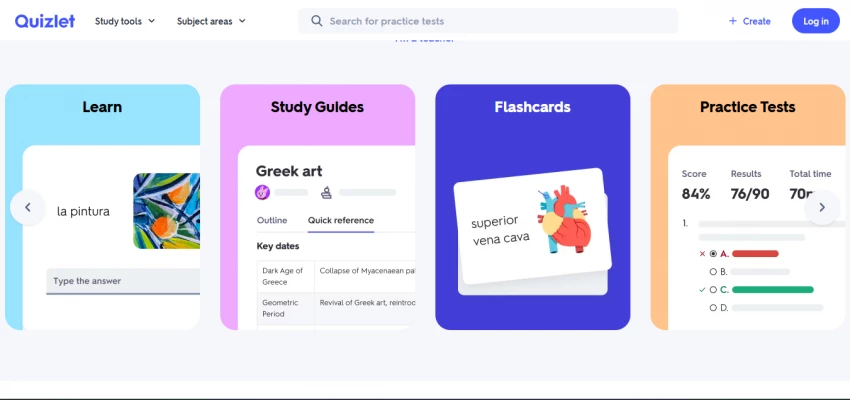
Quizlet is the older, far more global player. It launched back in 2005 as a simple flashcard website created by a high school student, and it has grown into one of the most-used study platforms in the world. According to its own data, around 60 million people use it every month, including roughly two in three high school students and one in two college students in the US.
Over the years it has added a lot more than flashcards: practice tests, Learn mode, Match games, expert-written textbook solutions, and AI-driven tools like Magic Notes that turn your uploaded notes into ready-to-study material. One thing worth flagging upfront: Q-Chat, the AI tutor that Quizlet heavily marketed in 2023 and 2024, was officially shut down in June 2025. So if you read older reviews praising Q-Chat, that feature is no longer available.
Let me break down what each platform actually offers, because the marketing pages can make them sound more similar than they really are.
| Feature | Abhyas AI | Quizlet |
| Primary use case | JEE / NEET / competitive exam prep | Flashcards, vocabulary, general study |
| Question bank | 3+ lakh curated JEE/NEET questions | Hundreds of millions of user-made sets |
| Video lessons | 1,000+ hours of conceptual videos | None natively (relies on flashcards) |
| AI-driven personalisation | Yes, identifies weak areas and adapts study plan | Yes, Learn mode and Magic Notes |
| Human tutor support | Yes, Ask-a-Tutor messaging system | No human tutors |
| Note-to-flashcard conversion | Yes, can scan handwritten notes/PDFs | Yes, via Magic Notes (paid) |
| Mock tests / practice exams | Full-length JEE/NEET-style mocks | Practice tests (capped on free plan) |
| Mobile app | Android (Aditya Abhyas); web app | iOS, Android, web |
| Offline study | Limited; needs internet | Yes, with Quizlet Plus |
| Collaborative / classroom features | Institutional plans for coaching centres | Quizlet Live, Classes, teacher dashboards |
| Best suited for | Class 11–12 students aiming at IITs/medical colleges | School and college students across all subjects |
If you are preparing for JEE or NEET, Abhyas AI does things Quizlet was never designed to do. Its question bank is curated by subject experts and segregated by difficulty to mirror real exam patterns. The Ask-a-Tutor feature is genuinely useful when you are stuck on a tricky organic chemistry mechanism or a rotational dynamics problem at midnight. And because the platform builds you a weekly study plan based on your available hours and target exam date, it removes a lot of the guesswork around what to study next.
It also covers material that simply does not exist in good quality on Quizlet, like Indian board syllabi aligned with NCERT and exam-specific shortcuts.
Quizlet wins on breadth, polish, and global subject coverage. Whether you are memorising Spanish vocabulary, anatomy terms for a nursing exam, AWS certification keywords, or French verb conjugations, there is almost certainly a study set already made for you. The Learn mode uses spaced repetition to drill what you keep forgetting, and Magic Notes can turn a messy lecture PDF into clean flashcards in seconds, which saves a real amount of setup time.
The mobile experience is also noticeably more refined. Quizlet has had years to iterate on its app, and most reviewers single out its smooth interface and offline mode (on the paid tier) as standout features.
Quizlet has shifted firmly into a freemium model, and the free tier has gotten noticeably tighter over the past two years. Here is what the current pricing looks like:
| Plan | Cost | What You Get |
| Free | $0 | Flashcards, basic Match game, ad-supported, capped Learn mode |
| Quizlet Plus | $35.99 / year (~$2.99/mo) or $7.99/month | Ad-free, 3 practice tests/month, 20 Learn rounds/month, Magic Notes, offline study |
| Quizlet Plus Unlimited | $44.99 / year (~$3.74/mo) or $9.99/month | Everything in Plus, plus unlimited practice tests and Learn rounds |
| Quizlet Plus for Teachers | $35.99 / year (30-day free trial) | Class management, Quizlet Live, student progress tracking |
| Family Plan | Around $96 / year (annual only) | Quizlet Plus Unlimited shared with up to 4 additional members |
A few things worth knowing: the 7-day free trial only applies to annual plans (not monthly), and it auto-renews unless you cancel. Some users on Trustpilot have flagged that they were charged after forgetting to cancel, so set a reminder if you sign up.
This is where things get a little frustrating, and it is one of the bigger differences between the two platforms. Abhyas AI does not publish its pricing publicly. Independent review sites, including AIChief and ToolInsidr, confirm that you have to either sign up on the platform or contact them directly to get a quote.
From what is documented across review sites, here is the general structure:
• Free trial access with a limited library of video lessons and practice problems.
• Paid tiers come in monthly, quarterly, and annual options.
• The full plan unlocks all 3+ lakh questions, complete video library, full-length mock tests, AI analytics, and the Ask-a-Tutor messaging.
• Institutional plans are available for coaching centres and schools, with custom pricing.
The lack of transparent pricing is a real downside if you like to compare options before committing. For context, similar India-focused platforms like Unacademy Plus, Vedantu, and PhysicsWallah typically charge anywhere from ₹4,000 to ₹35,000 per year for JEE/NEET coaching, so Abhyas AI likely sits somewhere in that range. But you will need to ask them directly to be sure.
Quizlet is far cheaper and more transparent, especially for casual studying. At roughly $36 a year, it is genuinely affordable. Abhyas AI is more expensive and less upfront about cost, but it is also doing more specialised work, and the value calculation is different when you are paying to crack a national entrance exam.
I pulled reviews from Capterra, G2, Trustpilot, and a couple of independent review sites to get a balanced picture. Here is what stood out.
Quizlet sits at a 4.6 / 5 average on Capterra (across more than 540 reviews) and 4.5 / 5 on G2. The most common praise lines up around three things: the size of the user-generated content library, how intuitive the interface is, and how well the Learn mode works for memorisation.
One Capterra reviewer wrote: “I love Quizlet and recommend it to everyone. I've used it for about a decade now and it was as great when I first downloaded it as it is now.”
A G2 reviewer described it as their go-to before exams: “It tracks my progress, so I know where I am falling short… it integrates well with other learning platforms I use like Canvas LMS.”
StudyDrome's hands-on 2025 review gave Quizlet 8/10, calling out that Magic Notes accurately generated about 85% of flashcards from uploaded notes without needing edits - a huge time-saver for students juggling multiple subjects.
Trustpilot tells a noticeably more critical story. Quizlet's rating there is much lower, with the bulk of complaints clustering around three issues:
• Aggressive paywalls - features that used to be free, like full Learn mode rounds, are now limited.
• Heavy ads in the free tier that interrupt study sessions.
• Difficult-to-cancel subscriptions and confusing billing.
One long-time user on Trustpilot put it bluntly: “The whole site used to be free and almost every student I knew used it. To still call yourself a website for studying is a stretch.”
So the short version: most paying users on G2 and Capterra are happy. Many free users on Trustpilot feel like the platform has shifted away from them.
Abhyas AI is much smaller and does not have the volume of reviews you find for Quizlet on G2 or Capterra. Most of what is publicly documented sits on review aggregator sites and the Aditya Abhyas Google Play page.
On its own website, Abhyas AI features student testimonials from those who reportedly cracked NEET and JEE Advanced - including admissions to AIIMS Delhi and IIT Bombay. Those should be read with the usual caution that comes with on-site testimonials. More balanced coverage from third-party reviewers like AIChief, OpenAIAgent, and AISuperSmart consistently calls out three strengths:
• The personalised study plan genuinely adapts to weak areas instead of just showing the same content.
• Conceptual videos break down JEE-level physics and chemistry topics in a way coaching textbooks often do not.
• The Ask-a-Tutor feature provides expert-led help that is missing from most AI study apps.
The most consistent criticisms across review sites:
• Pricing is not publicly listed, which is genuinely annoying.
• The platform is narrow - useful only if you are preparing for JEE or NEET (with some support for IIT, UPSC, and CAT, depending on the program).
• It needs a stable internet connection; offline mode is limited or absent depending on the version.
• The mobile app is not as polished as Quizlet's, and updates are not always rolled out across devices uniformly.
Independent reviewers have noted that AIChief currently lists no public user ratings or written reviews on its Abhyas AI page, which suggests the platform's user base, while growing, is still relatively small compared to global names. Traffic data from AIPure noted Abhyas AI saw a 61.4% growth in monthly visits in mid-2025, hitting around 51,000 visits - solid for a niche platform but a fraction of Quizlet's global footprint.
Pros:
• Hyper-focused on JEE / NEET - the syllabus, question style, and difficulty mirror the real exam.
• Combines AI personalisation with real human tutor support.
• Detailed mistake analysis that goes beyond just "you got this wrong."
• Designed by Aditya Educational Institutions, which has decades of coaching experience.
• Mock tests simulate real exam pressure and timing.
Cons:
• Pricing is opaque - you have to ask.
• Useless if you are not preparing for an Indian competitive exam.
• Smaller community and less third-party content than global platforms.
• Mobile app polish lags behind Quizlet.
Pros:
• Massive library of pre-made study sets across virtually every subject.
• Affordable and transparent pricing (around $36/year for Plus).
• Magic Notes saves serious setup time by auto-generating flashcards from PDFs and notes.
• Polished apps on iOS, Android, and web with offline study on paid plans.
• Quizlet Live makes group studying genuinely fun.
Cons:
• Free tier has shrunk significantly - many features now sit behind a paywall.
• Ads in the free version interrupt study flow.
• User-generated content quality varies; some sets contain errors.
• Q-Chat AI tutor was discontinued in June 2025, so reviews praising it are out of date.
• Not designed for structured exam prep at the level of JEE or NEET.
Pick Abhyas AI if: you are a Class 11 or 12 student in India, you have a clear target of cracking JEE, NEET, or a similar competitive exam, and you want a structured program that combines video lessons, expert-curated questions, and human tutor support. The opaque pricing is annoying, but if it gets you into a top engineering or medical college, the math works out.
Pick Quizlet if: you study a wide variety of subjects, you mainly need to memorise terms, definitions, formulas, or vocabulary, and you want an affordable, polished tool that works across your phone and laptop. It is also the better choice for language learners, professional certification candidates (AWS, CPA, MCAT prep through user-generated sets), and teachers who want classroom games.
Use both if: you are preparing for JEE or NEET but also want a flashcard tool to drill formulas, biology terms, or organic chemistry reactions during short breaks. They actually complement each other reasonably well - Abhyas for the heavy lifting, Quizlet for quick recall practice.
Comparing Abhyas AI and Quizlet is a bit like comparing a specialist coaching institute to a global library. Both are useful, but they are not really competing for the same student. Abhyas AI is a deep, exam-focused platform built for a very specific Indian audience that needs structured help cracking some of the world's toughest entrance exams. Quizlet is a broad, accessible study tool that millions of learners around the world rely on for everything from learning Spanish to passing nursing boards.
If you are a JEE or NEET aspirant, Abhyas AI almost certainly offers more relevant value, even with the pricing transparency issue. If you are studying anything else, Quizlet's combination of price, polish, and content library is genuinely hard to beat in 2026.
The smart move? Use the free trial that each platform offers, spend a real week with each one, and see which one fits the way your brain actually wants to learn. That is the only test that matters.
Share your thoughts about this article.
Be the first to post a comment!

Meta’s artificial intelligence business may be accelerating, but the company is...
Suraj Malik5 months ago
QUICK ANSWER - Why AI Chatbots Break After 10 MessagesMost AI chatbots brea...
Suraj Malik5 months ago
Abhyas AI vs. Gauth AI: which is better?Abhyas AI is better for Indian students...
Suraj Malik5 months ago
Civitai vs. Midjourney: which is better?Midjourney is better for beginners and f...
Suraj Malik5 months ago
Cohere’s decision to merge with Germany-based Aleph Alpha is not just another AI...
Suraj Malik5 months ago
Google is preparing one of the largest AI investments to date, committing up to...
Suraj Malik5 months ago