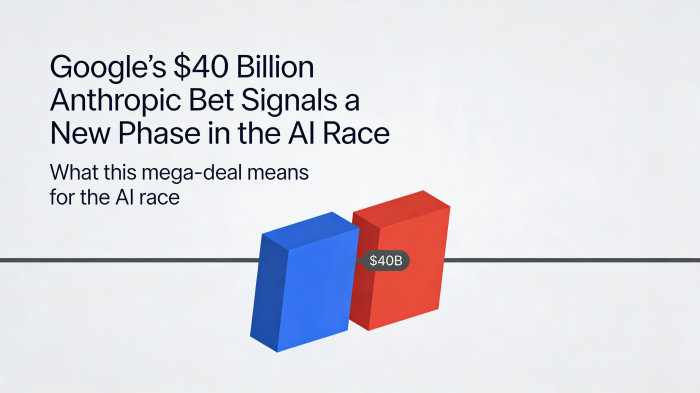
Google is preparing one of the largest AI investments to date, committing up to $40 billion to Anthropic in a deal that blends capital with massive computing power. The move reflects a deeper shift in the industry, where access to infrastructure is becoming as decisive as model innovation.
Reports indicate that Google will invest an initial $10 billion into Anthropic at a valuation of around $350 billion. An additional $30 billion is expected to follow, tied to performance milestones and long term growth targets. Alongside direct funding, Google will expand Anthropic’s access to its cloud infrastructure, particularly its Tensor Processing Units, which are optimized for large scale AI training and deployment.
This is not a traditional investment. It is a hybrid arrangement where capital and compute are intertwined. For AI companies, compute access has effectively become currency.
Anthropic has positioned itself as one of the few credible challengers to OpenAI. Its Claude models have gained traction for enterprise use, especially in areas like long form reasoning, coding assistance, and safer AI deployment.
The company recently introduced a new model, referred to as Mythos, which reportedly has strong cybersecurity capabilities. Access has been tightly controlled due to concerns around misuse. That alone signals how advanced models are beginning to blur the line between helpful tools and high risk systems.
At the same time, Anthropic faces a scaling problem. As usage grows, so does the demand for compute. Training frontier models now requires billions of dollars in infrastructure. Without strong backing, even well positioned labs struggle to keep up.
Google’s investment is not just about backing Anthropic. It is about securing a dominant position in the AI infrastructure layer.
Even though Google competes directly with Anthropic through its own Gemini models, it benefits if Anthropic grows. More usage means more demand for cloud services, chips, and long term contracts. In effect, Google is positioning itself as both a competitor and a supplier.
This dual role is becoming common in AI. Companies are no longer just building products. They are building ecosystems where they can profit regardless of which model wins.
Anthropic’s relationship with Google is only part of the picture. The company has also secured major backing from Amazon, including a fresh $5 billion commitment this week. Reports suggest that the broader compute partnership between Anthropic and Amazon could scale up to $100 billion over time.
This creates a unique dynamic where Anthropic is supported by two of the world’s largest cloud providers. It also reflects how cloud companies are aggressively aligning themselves with leading AI labs to secure long term demand.
For Anthropic, this reduces dependency risk. For Google and Amazon, it ensures they remain deeply embedded in the AI growth cycle.
The scale of this deal highlights a clear shift in how the AI race is being fought.
A few years ago, the focus was on model quality and research breakthroughs. Today, the limiting factor is infrastructure. The companies that can secure the most compute, energy, and capital are the ones that can push the boundaries further.
This has three immediate implications:
Anthropic’s reported valuation and the scale of backing it is receiving suggest that investors are betting heavily on a small group of AI leaders. The possibility of a future IPO adds another layer of momentum.
At the same time, smaller AI startups may find it harder to compete unless they specialize or build on top of existing platforms. The barrier to entry at the frontier level is rising rapidly.
Google’s planned $40 billion investment in Anthropic is less about a single company and more about the structure of the AI industry going forward.
AI is no longer just a software story. It is a capital intensive, infrastructure heavy race where partnerships, compute access, and long term bets define who stays relevant.
In that landscape, deals like this are not outliers. They are becoming the blueprint.
Share your thoughts about this article.
Be the first to post a comment!

Meta’s artificial intelligence business may be accelerating, but the company is...
Suraj Malik5 months ago
QUICK ANSWER - Why AI Chatbots Break After 10 MessagesMost AI chatbots brea...
Suraj Malik5 months ago
Abhyas AI vs. Gauth AI: which is better?Abhyas AI is better for Indian students...
Suraj Malik5 months ago
Civitai vs. Midjourney: which is better?Midjourney is better for beginners and f...
Suraj Malik5 months ago
If you have spent even an hour searching for an online study tool in 2026, you h...
Suraj Malik5 months ago
Cohere’s decision to merge with Germany-based Aleph Alpha is not just another AI...
Suraj Malik5 months ago