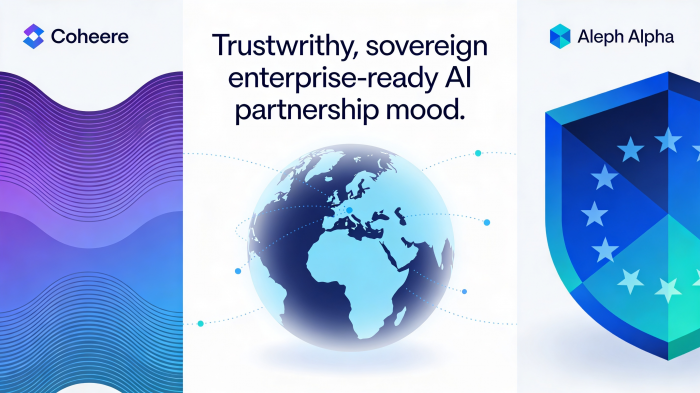
Cohere’s decision to merge with Germany-based Aleph Alpha is not just another AI deal. It is a calculated move to build a new kind of AI company focused on control, compliance, and regional independence at a time when the market is dominated by U.S. tech giants.
Canadian AI company Cohere is merging with Aleph Alpha, a German AI firm, with support from both governments and major European backers. The combined entity will operate under the Cohere name and is expected to focus heavily on enterprise and government AI use cases.
Cohere will take a dominant stake in the merged company, while Aleph Alpha’s investors retain a smaller share. The deal is also backed by Schwarz Group, which is committing significant funding and infrastructure support.
This is less about consolidation and more about positioning. The goal is to create a transatlantic AI company that can compete with the scale and influence of U.S. players like OpenAI, Google, and Microsoft.
At the center of this merger is a concept that is quickly gaining traction: sovereign AI.
Sovereign AI refers to systems that are built, deployed, and governed within a specific region, ensuring that data, infrastructure, and control stay local. This matters especially in sectors like finance, healthcare, defense, and public services, where data privacy and regulatory compliance are critical.
Cohere and Aleph Alpha are aligning around this exact demand. The combined company aims to provide AI solutions that meet strict European data laws while still delivering competitive performance.
In simple terms, they are trying to answer a growing question from enterprises and governments: how to use advanced AI without relying entirely on foreign technology providers.
The timing of the deal reflects a deeper shift in the AI market.
European organizations increasingly want AI systems that operate within local legal frameworks. This is not just a preference, but often a requirement in regulated industries.
Most leading AI platforms today are controlled by U.S. firms. That creates dependency concerns, especially for governments and critical infrastructure sectors.
Building advanced AI models requires enormous resources. Aleph Alpha had already shifted toward enterprise solutions due to the high cost of competing at the frontier level.
By merging, the companies can pool talent, infrastructure, and funding to stay competitive.
The logic of the merger becomes clearer when looking at what each side contributes.
Aleph Alpha has already worked with major European institutions and enterprises, which gives the combined company immediate credibility in markets where trust matters as much as technology.
Cohere, on the other hand, has focused on building deployable AI systems for businesses, including tools for search, generation, and automation.
Together, they are aiming to create a more complete enterprise AI stack that is both powerful and compliant.
One of the most important pieces of the deal is the involvement of Schwarz Group, the parent company behind Lidl.
Schwarz is not just investing money. It is also providing infrastructure through its STACKIT cloud platform, which will serve as the backbone for the company’s sovereign AI offerings.
This matters because sovereignty is not just about policy. It requires actual infrastructure that can host AI systems within regional boundaries. Without that, the concept does not hold.
Unlike many AI companies chasing consumer applications, this merger is clearly focused on enterprise and government markets.
The combined company plans to target sectors such as:
These are industries where AI adoption is growing, but where requirements around security, auditability, and compliance are significantly higher.
That makes this deal less about competing on chatbot features and more about becoming a trusted infrastructure layer for AI deployment.
This merger highlights a broader trend in the AI space: fragmentation along geopolitical and regulatory lines.
Instead of a single global AI ecosystem, the market is starting to split into regional blocs where companies build solutions tailored to local rules and expectations.
Europe, in particular, is emerging as a key battleground. The demand for sovereign AI could represent a significant share of the overall AI market in the coming years.
That makes this deal not just a company-level move, but part of a larger shift toward regional AI ecosystems.
While the strategy is clear, execution will be difficult.
The combined company will need to:
There is also the question of whether enterprises will prioritize sovereignty over performance and cost. If U.S. platforms continue to move faster and cheaper, that could limit adoption.
Cohere’s merger with Aleph Alpha is a strategic attempt to redefine how AI is built and deployed outside Silicon Valley.
It is not just about creating another AI company. It is about building an alternative model where control, compliance, and regional trust are as important as model capability.
If that approach gains traction, this deal could mark the beginning of a more divided, but also more locally controlled, AI landscape.

Meta’s artificial intelligence business may be accelerating, but the company is...
Suraj Malik5 months ago

QUICK ANSWER - Why AI Chatbots Break After 10 MessagesMost AI chatbots brea...
Suraj Malik5 months ago

Abhyas AI vs. Gauth AI: which is better?Abhyas AI is better for Indian students...
Suraj Malik5 months ago

Civitai vs. Midjourney: which is better?Midjourney is better for beginners and f...
Suraj Malik5 months ago

If you have spent even an hour searching for an online study tool in 2026, you h...
Suraj Malik5 months ago
Google is preparing one of the largest AI investments to date, committing up to...
Suraj Malik5 months ago