Somebody in your city just typed "best budget gym" into Instagram instead of Google. If your account was not built for that search, they found your competitor.
That single behavior shift is what Instagram search query optimization is about. It is the practice of shaping your profile, captions, and content so that Instagram's search engine, and since 2025 Google itself, can match you to what people are actually typing.
This guide skips the recycled advice and sticks to what the data supports. Every statistic is sourced, every tactic maps to a documented ranking signal, and the parts where the evidence is thin are labeled as exactly that.
The trend started showing up in Google's own research back in 2022, when a senior Google executive revealed that nearly 40 percent of young Americans were going to TikTok or Instagram, not Google Maps or Search, when they wanted somewhere to eat lunch. That was Google admitting it, on stage, about its own core product.
Four years later, the picture is sharper and, for Instagram, even stronger:
• A SOCI survey of 1,002 US consumers found that among 18 to 24 year olds, Instagram is now the single most used search platform for local discovery at 67 percent, ahead of TikTok at 62 percent and Google itself at 61 percent, as reported by Forbes.
• Bernstein Research data shows the share of Gen Z using social platforms as their primary search engine for brands and products climbed from about 40 percent in 2016 to roughly 52 percent by 2023, and the habit is persisting as that generation ages into peak spending years.
• The behavior is layered rather than either-or. Analysts reviewing the 2026 data note that the same person searches "best skincare routine" on Instagram and "dermatologist near me" on Google within the same hour, which means brands now need to rank in both places for the same customer.
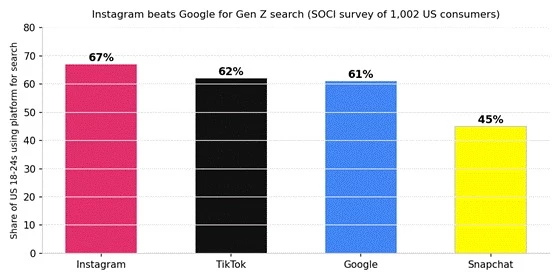
Figure 1: Share of US 18 to 24 year olds using each platform for search, per the SOCI consumer survey reported by Forbes. Respondents could pick multiple platforms.
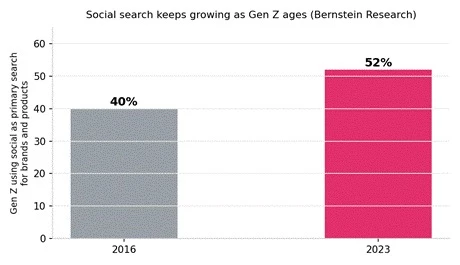
Figure 2: Gen Z reliance on social platforms as their main search engine for brands and products, 2016 versus 2023, per Bernstein Research.
Until mid 2025, Instagram SEO meant one thing: ranking inside the app's search bar and Explore page. Then Meta flipped a switch that changed the job description.
On 10 July 2025, Instagram began allowing Google, Bing, and other engines to index public content from professional accounts, covering photos, carousels, videos, and Reels posted since 1 January 2020, as documented by PPC Land and confirmed across the industry press. The setting is on by default for eligible accounts and can be toggled off under account privacy.
Then in July 2026 Google closed the loop. Its new platform properties feature in Search Console lets creators verify an Instagram account directly, with no website required, and see exactly which Google queries send people to their posts, as covered by Tech Times. Instagram became a measurable SEO channel in its own right.
The practical consequence is simple and slightly brutal. Your caption is now doing two jobs. Inside the app it feeds Instagram's matching engine. Outside the app it functions like the title and body copy of a tiny webpage competing against blog posts and YouTube videos on Google's results page. Write it accordingly.
Eligibility for the Google side is worth pinning to your wall, because plenty of accounts silently fail it. Your account must be professional (business or creator), public, and run by someone over 18, and only feed content qualifies, since Stories and highlights are excluded from indexing.
Instagram has never published a complete ranking formula, but between official creator guidance, platform announcements, and large-scale studies, the signal picture for 2026 is fairly consistent. Think of it as three stacked layers.
Instagram's search engine reads your handle, your name field, your bio, your captions, your alt text, and even the on-screen text in your Reels. When a query comes in, it looks for matches across all of those surfaces. The single highest-leverage move in all of Instagram SEO is putting the words people search into the name field and bio, because those surfaces carry the most weight for profile search.
When fifty accounts all match the query, Instagram ranks them by demonstrated interest. Saves, shares, watch time, and comments consistently outrank raw likes in every credible study of the current algorithm, because they signal that content answered the searcher's intent rather than just catching their eye.
Posting consistency, topical focus, and past interactions between the searcher and your account all shape where you can rank. An account that posts about fifteen unrelated topics dilutes its subject authority, in the same way a website covering everything ranks for nothing.
You cannot optimize for queries you have not identified, and this is where most accounts guess. Three free research methods cover almost everything:
• Type your broad topic into the Instagram search bar and write down every autocomplete suggestion, because those suggestions are drawn from real query volume and are the closest thing to a free keyword tool Instagram offers.
• Open the top five accounts already ranking for your target search and study the exact phrasing in their name fields and first caption lines, since whatever text they share is what the algorithm matched.
• Mine your own DMs, comments, and reviews for the words customers naturally use, because search queries mirror speech, and people type "budget wedding photographer delhi" rather than whatever elegant phrase sits on your website.
It also pays to check what the surrounding Google demand looks like, since your posts now compete there too. I pulled the core keyword cluster for this article's own topic from Ahrefs, and the numbers explain why this niche is worth writing for:
| Keyword | US volume | Global volume | Difficulty |
| instagram search | 30,000 | 71,000 | 44 |
| instagram seo | 1,600 | 4,400 | 14 |
| instagram keywords | 600 | 1,900 | 7 |
| instagram seo tips | 150 | 200 | 13 |
| instagram search queries optimization | 80 | 6,400 | 1 |
Table 1: Search demand for the Instagram SEO keyword cluster, pulled from Ahrefs on 21 July 2026. Note how "instagram search queries optimization" is tiny in the US but carries 6,400 global monthly searches, with demand concentrated outside America and a difficulty score of just 1.
Once you know your queries, the work becomes placement. Each surface has its own rules and its own weight.
Your handle should contain your most important keyword if it can do so without looking like spam, and your name field absolutely must, because the name field is separately indexed and does not need to match your handle. A bakery called Rosie's ranks far better as "Rosie's | Custom Cakes Mumbai" than as "Rosie's" alone. You get 30 characters, so spend them on what people type, not on emoji.
The bio feeds both profile search and the snippet Google displays. Lead with a plain-language sentence describing who you serve and what you do, work in your two or three core keywords naturally, and name your city if location matters to your business. Save the personality for line two.
Since Instagram started indexing caption text for keyword search, the caption has become the most important metadata you write. The first sentence carries the most weight in both Instagram search and Google snippets, so front-load it with the query you want to win. One-emoji captions are dead weight in 2026. Write 2 to 4 sentences of genuinely descriptive text, then let the personality follow.
Instagram auto-generates alt text with AI, and its guesses are mediocre. Writing your own 100-character description under advanced settings guarantees the algorithm understands the image and hands you one more keyword surface, and it doubles as an accessibility win. Keywords stuffed into comments, by contrast, are indexed far less effectively than caption text, so critical terms must live in the caption itself.
Instagram transcribes speech and reads on-screen text. Saying your target phrase out loud in the first three seconds and reinforcing it with a text overlay gives the system two more matching signals, which is partly the reason talking-head Reels with captions dominate search results.
The loudest debate in Instagram SEO has a data answer now. Metricool's 2026 Instagram study found that posts relying on hashtags see 32 percent fewer views and 34 percent fewer interactions than posts that do not, a gap the study is careful to call correlation rather than proven cause, but a gap large enough that hashtag-first strategies clearly belong to a previous era.
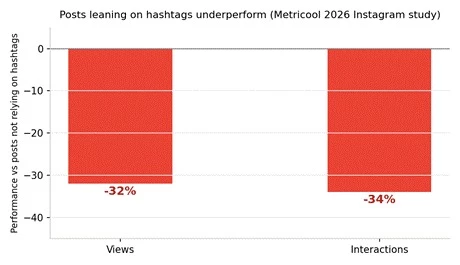
Figure 3: Performance of posts relying on hashtags versus those that do not, per Metricool's 2026 study of Instagram accounts. The study notes this is a correlation, not proven causation.
The sensible 2026 posture treats hashtags as light categorization rather than a reach engine:
• Use roughly three to five genuinely specific tags per post, because current guidance across studies converges on small, relevant sets outperforming walls of thirty.
• Choose tags that describe the content literally, since the algorithm uses them for classification, and skip generic monsters like #love that classify nothing.
• Keep them in the caption rather than the first comment when search matters to you, because caption text is scanned first and now also feeds Google indexing.
Instagram SEO stopped being a faith-based practice in 2026, and you should hold it to numbers:
• Inside Instagram, open your professional dashboard and track the share of reach coming from non-followers, plus the accounts reached from Explore and search, because those lines rising is the direct signature of search optimization working.
• For the Google side, verify your Instagram account as a platform property in Search Console and watch which queries surface your posts, which finally lets you treat individual Reels like landing pages with real query data.
• Give profile-level changes a few days and content-level changes several weeks before judging, since ranking for competitive queries builds with consistency rather than arriving with a single optimized post.
• Keeping a personal account for a business locks you out of Google indexing entirely, since only public professional accounts qualify, and it hides the analytics you need.
• Stuffing the name field or captions with comma-separated keyword lists reads as spam to both humans and the ranking systems, and natural sentences containing the same terms outperform it.
• Posting across unrelated topics fragments the account authority that search ranking leans on, so an account about everything ranks for nothing.
• Ignoring alt text hands your keyword surface to an AI guess, and skipping location tags throws away the local queries where Instagram search demand is strongest.
• Chasing engagement bait works against you now, because saves and shares from people who searched for the topic count for more than likes from people who scrolled past it.
Instagram search optimization does not require rebuilding your entire content strategy overnight. Start by updating the parts of your account that influence every post.
During the first week, review your name field, bio and account category. Make sure they clearly describe your service, subject and location using language that potential customers are likely to search.
In the second week, identify five to ten priority queries using Instagram autocomplete, competitor profiles, customer comments and Google keyword data. Group closely related terms together rather than creating separate content for every minor keyword variation.
Use the third week to publish content around those query groups. Include the main phrase naturally in the opening line of the caption, on-screen text, spoken audio and manually written alt text where relevant. Each post should fully answer the search intent instead of simply repeating the keyword.
During the final week, review non-follower reach, profile visits, saves, shares, watch time and search-related discovery. Keep the formats and topics producing meaningful engagement, and improve or replace content that attracts impressions without profile actions.
The goal is not to optimize one post perfectly. It is to create a consistent relationship between the searches you target, the subjects you publish and the value people receive after finding your content.
Instagram search query optimization has moved beyond adding keywords to a bio or placing hashtags beneath a post. In 2026, it involves building a clear topical identity, understanding how people describe their needs and creating content that satisfies those searches.
The biggest change is that Instagram content can now be discovered across more than one platform. A public professional account may appear inside Instagram search, Explore and external search results. That makes every caption, Reel and carousel part of a wider search strategy rather than a temporary social post.
Businesses and creators should prioritize descriptive profiles, focused subject coverage, useful captions, accessible alt text and content that earns saves, shares and meaningful watch time. Hashtags can still support categorization, but they cannot compensate for weak content or unclear positioning.
The accounts most likely to benefit will not be those repeating the largest number of keywords. They will be the ones that consistently provide the clearest and most useful answer to a specific search.
Instagram SEO should therefore be treated as a long-term visibility channel. Optimize for what people genuinely search, publish material worth discovering and measure whether that visibility produces profile visits, enquiries, leads or sales. That is the difference between appearing in search and turning search visibility into business value.
Share your thoughts about this article.
Be the first to post a comment!
A great photo with a lazy caption is a wasted post. In 2026, with average Instag...
Pritam Singh1 month ago

The moment you try scaling influencer marketing beyond 5–10 creators, everything...
Sakshi Dhingra5 months ago
Writing captions consistently is one of the most underestimated challenges in so...
Sakshi Dhingra6 months ago
Starting a YouTube Shorts channel in 2026 is no longer about simply uploading ve...
Sakshi Dhingra6 months ago

Creating content no longer means spending the entire day switching between resea...
Sakshi Dhingra6 months ago
Ever captured a great photo and later noticed an annoying distraction—maybe a st...
Sakshi Dhingra11 months ago