
In today’s fast-paced digital life, conversations have become shorter, faster, and often forgettable.
You reply, you scroll, you move on.
But somewhere in between, a new category quietly emerged, AI companions. Not tools for work, not assistants for productivity, but something more personal. Something that listens, remembers, and responds without interruption.
And once you step into this space, three platforms keep showing up: Dippy AI, Nastia AI, and ThotChat AI.
At first, they feel similar. All of them let you chat, customize, and interact. But once you spend time with them, the differences are not in what they offer, but in how they behave.
Before comparing features, it’s important to understand what each tool is trying to become.
Dippy AI is designed to feel like a companion that grows with you. It focuses on continuity, memory, and emotional consistency.
Nastia AI positions itself as an open conversation space. It removes restrictions and allows more expressive interaction.
ThotChat AI takes a different route. It behaves more like a customizable environment, where the experience depends entirely on how you shape it.
This distinction is subtle, but it defines everything.
| Core Intent | Dippy AI | Nastia AI | ThotChat AI |
| Product Direction | Companion | Expression | Sandbox |
| User Role | Participant | Explorer | Controller |
| Experience Goal | Retention | Freedom | Customization |
When you begin with Dippy AI, the environment feels controlled and intentional. There are fewer distractions, fewer choices upfront. You are guided toward conversation rather than exploration.
The interaction starts simple, but it feels stable. There is no rush to impress.
Nastia AI gives you more freedom from the beginning. Conversations feel fluid, and you are not limited in tone or direction. It feels more open, more reactive.
The system adapts quickly, which creates a sense of responsiveness early on.
ThotChat AI does not guide you much. It gives you the space to define the interaction yourself.
For some users, this feels empowering. For others, it can feel slightly unstructured at the beginning.
This is the most important part of the comparison, because these tools are not designed for one-time use.
After a few days of usage, Dippy AI begins to show its core strength.
The AI starts:
It feels like the system is not just responding, it is remembering and adapting.
This creates a sense of continuity, which is rare in most AI tools.
With Nastia AI, the experience remains flexible.
You don’t necessarily build a long-term thread in the same way as Dippy, but you gain something else, freedom of direction.
You can:
The experience stays dynamic rather than consistent.
ThotChat AI is the most dependent on user input.
If you invest time in shaping characters and conversations, it can feel deeply immersive.
If you don’t, it can feel scattered.
That’s because the platform is not trying to guide you, it expects you to define the experience.
Memory is one of the biggest differentiators in this category.
| Memory & Interaction | Dippy AI | Nastia AI | ThotChat AI |
| Memory Strength | High | Moderate | Low–Moderate |
| Conversation Continuity | Strong | Flexible | Variable |
| Emotional Consistency | High | Medium | Low |
| Learning Behavior | Adaptive | Reactive | Minimal |
Dippy clearly focuses on building continuity.
Nastia focuses on flexibility.
ThotChat leaves it open-ended.
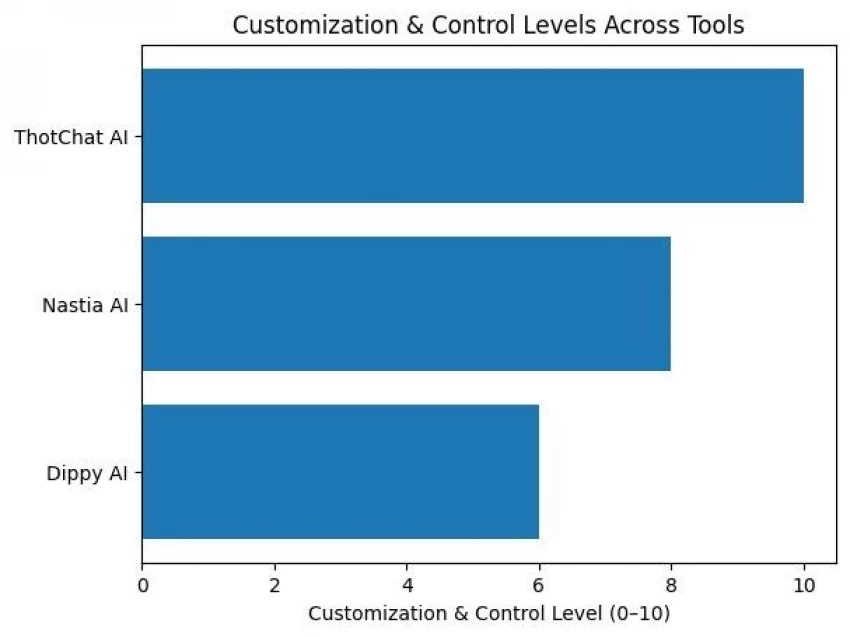
Customization is where Nastia and ThotChat become more prominent.
Dippy allows customization, but within a structured system.
Nastia expands that flexibility, letting you shape personality and tone more freely.
ThotChat goes further by giving you almost complete control over interaction style, direction, and behavior.
| Customization Depth | Dippy AI | Nastia AI | ThotChat AI |
| Personality Control | Moderate | High | Very High |
| Scenario Flexibility | Moderate | High | Very High |
| User Control Level | Medium | High | Maximum |
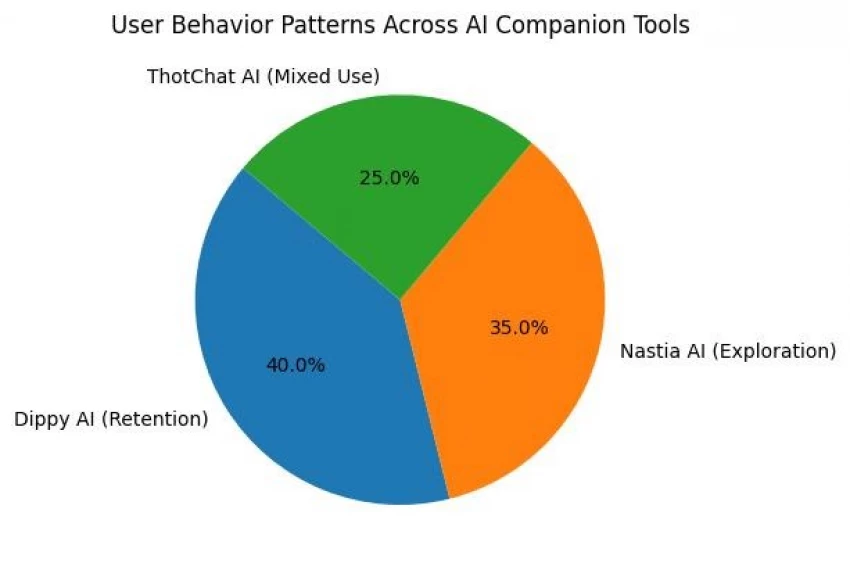
Looking at how users interact over time reveals a clear pattern.
Dippy users tend to stay longer in conversations. They revisit, continue, and build.
Nastia users tend to explore more. They shift contexts, try different conversation styles, and experiment.
ThotChat users behave differently depending on intent. Some use it deeply, others use it occasionally.
| Experience Type | Best Tool |
| Daily companion | Dippy AI |
| Expressive interaction | Nastia AI |
| Full customization | ThotChat AI |
| Long-term engagement | Dippy AI |
| Flexible conversations | Nastia AI |
| User-driven experience | ThotChat AI |
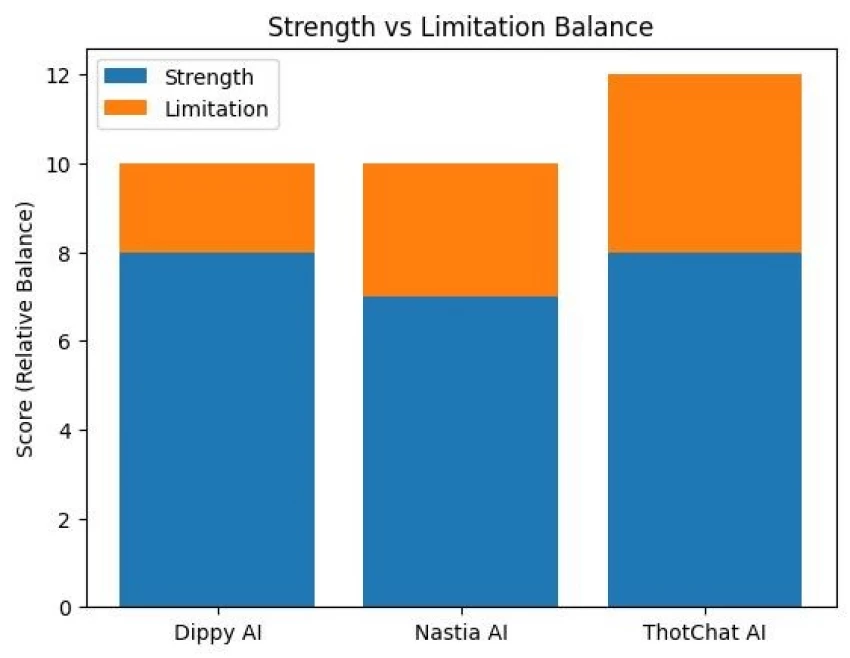
One thing most comparisons miss is this, every AI companion looks impressive in the first few interactions. The real difference only shows up when you use them repeatedly.
Instead of listing features, it makes more sense to understand where each tool genuinely performs well and where it starts to struggle.
Dippy AI’s biggest strength is how stable it feels over time.
Once you start using it regularly, the system begins to reflect your tone, remember patterns, and continue conversations in a way that feels connected. That consistency is what makes it stand out. It doesn’t try to impress you instantly, but it keeps improving the longer you use it.
However, that same structure becomes its limitation.
Because the system is designed to stay consistent, it doesn’t always adapt well to sudden changes in conversation style. If you try to shift tone or direction too quickly, the responses can feel slightly rigid. Over time, some users also notice repetition in behavior, especially in longer conversations.
To simplify this:
| Aspect | Dippy AI |
| Core Strength | Memory + consistency |
| Real Limitation | Less flexibility in conversation shifts |
| Best For | Long-term interaction |
Nastia AI takes a very different approach.
Its biggest advantage is how open it feels. You are not restricted in how you talk, what you explore, or how the conversation evolves. This makes it far more expressive than most AI tools.
You can switch tone, explore different styles, and push conversations in multiple directions without friction. That’s where it feels powerful.
But this freedom comes at a cost.
Because the system prioritizes flexibility, it doesn’t always maintain strong continuity. Conversations don’t always build on each other in a structured way, and long-term interaction can feel less connected compared to Dippy.
Here’s how that plays out:
| Aspect | Nastia AI |
| Core Strength | Expressive + flexible conversations |
| Real Limitation | Weak long-term continuity |
| Best For | Dynamic interaction and roleplay |
ThotChat AI is the most different among the three.
Its biggest strength is control. You can shape the interaction, define the tone, and customize the experience in a way that feels almost unrestricted. For users who want complete freedom, this is a major advantage.
But unlike the other two, ThotChat does not guide the experience.
That means the quality of interaction depends heavily on how much effort you put in. If you actively shape conversations, it can feel immersive. If you don’t, it can feel inconsistent or even directionless.
This creates a very different kind of limitation — not technical, but experiential.
| Aspect | ThotChat AI |
| Core Strength | Full customization and control |
| Real Limitation | Depends heavily on user input |
| Best For | Advanced users who want full control |
If you remove all features and look at intent:
Dippy AI is solving for connection and continuity.
Nastia AI is solving for expression and freedom.
ThotChat AI is solving for control and customization.
That’s why comparing them purely on features doesn’t work.
If you want something that feels stable and grows over time, Dippy AI is the better choice.
If you want flexibility and expressive conversations, Nastia AI offers more freedom.
If you prefer complete control and customization, ThotChat AI stands out.
These tools may belong to the same category, but they are not built for the same type of user.
Some users want consistency.
Some want flexibility.
Some want control.
And once you understand which one you are, the choice becomes obvious.
Be the first to post comment!

There was a time when editing a video meant sitting in front of a timeline for h...
Sakshi Dhingra1 hour ago
Why most comparisons get this wrongIf you just look at features, Promptchan AI a...
Sakshi Dhingra2 hours ago

There’s a phase every writer eventually reaches where effort stops being the pro...
Sakshi Dhingra1 day ago

The first time my younger brother mentioned these apps, I didn’t think much of i...
Sakshi Dhingra1 day ago

There was a phase last year when my younger brother was genuinely struggling. No...
Sakshi Dhingra1 day ago

A client message comes in.“Can you share a presentation in 10 minutes?”There’s n...
Sakshi Dhingra2 days ago