A two-person physiotherapy clinic wants patients to book and cancel sessions online without phoning reception. Off-the-shelf booking software does not fit how the clinic assigns rooms, and an agency build is out of budget. AI app builders now promise that system from a paragraph of plain English, yet their handling of databases, payments, permissions and publishing varies widely.
The short answer: Lovable is the strongest all-round pick for a customer-facing web app, while Base44 gets logins and stored data working with the least setup. For client portals and internal tools that must run without code, Softr is the safer choice. Every ranking below asks how much of an app a non-developer can publish and maintain alone.
Almost every builder here produces an attractive first screen. The split comes later, when the app must keep each customer's records private and survive the tenth round of changes.
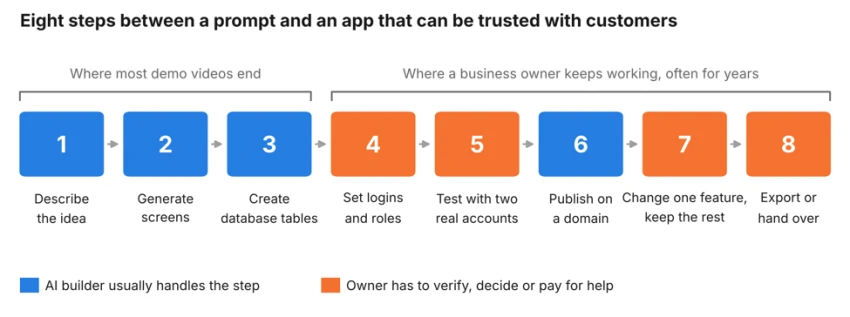
Steps 4, 5, 7 and 8 are where beginner projects tend to stall, and where the builders differ most.
A booking tool and an App Store listing are different engineering problems, so a single winner would mislead most readers.
Absolute beginners: Base44 sets up user accounts and a database automatically, which removes the step where most first projects stall.
Customer-facing web apps: Lovable earned the top result, 18 of 20, in AIMultiple's one-prompt benchmark.
Small business operations and client portals: Softr builds roles and permissions from pre-built blocks that can be checked without reading code.
Spreadsheet-based apps: Glide remains the most direct route from an existing sheet to a staff tool.
Complex workflows and native mobile apps: Bubble pairs readable visual logic with a native iOS and Android builder that left beta on November 12, 2026.
Future developer handover: Bolt.new produces standard JavaScript that syncs with GitHub, and its database can be claimed into a Supabase account.
| Tool | Best for | App type | Coding required | Free publishing | Starting paid price | Code export |
|---|---|---|---|---|---|---|
| Lovable | Customer-facing web apps | Web app with built-in backend | None for core features | Invite-only, up to 10 people per project | Pro, $25/mo or $250/yr | Full code via GitHub or download |
| Base44 | First app with logins and data | Web app; store-ready wrapper | None; code edits optional | Public apps only | Starter, $16/mo billed yearly | Builder plan up; still needs Base44's backend |
| Softr | Portals and internal tools | Web business app | None; optional Vibe Coding block | Private apps allowed, 5 app users | Basic, $25/mo or $19/mo yearly | Not available |
| Bolt.new | Projects heading to a developer | Web app; native via Expo | Occasional on larger builds | Public sites only | Pro, $25/mo | Full code; database claimable into Supabase |
| Replit Agent | Building and hosting in one workspace | Web app; native iOS via Expo | Occasional | No free plan for new accounts | Core, $20/mo or $18/mo yearly | Full code |
| Bubble | Complex logic and native mobile | Web plus native iOS and Android | None; visual workflows | Test version only | Starter, $32/mo billed yearly (web) | None; CSV data and Bubble-only JSON |
| Glide | Spreadsheet-driven staff tools | Web app, installable on phones | None | No published apps on Free | Basic, $25/mo; public apps need Plus, $50/mo | Not documented |
| Emergent | Conversational full-stack builds | Web app; native via Expo | Occasional | Not documented for full apps | Standard, $20/mo or $17/mo yearly | GitHub on Standard |
| FlutterFlow | Native apps with source code | Native iOS and Android, plus web | Some, mainly backend setup | Web only, on a flutterflow.app subdomain | Basic, $39/mo or $29/mo yearly | Flutter code on Basic and up |
| v0 by Vercel | Interfaces built beside an engineer | Next.js web app | Frequent beyond the interface | Public and non-commercial only | Plus, $30 per user/mo | GitHub sync on every plan |
| Evaluation factor | Weight | What earns a "Strong" rating |
|---|---|---|
| Beginner accessibility | 25% | Building and publishing need no code or outside accounts |
| Functional application generation | 20% | Database and logins come from the prompt, not manual setup |
| Debugging and error recovery | 15% | Problems can be inspected and undone without reading code |
| Pricing transparency and affordability | 15% | Flat pricing with published limits, or meters with clear caps |
| Publishing and maintenance | 10% | Hosting and a custom domain on the entry paid plan |
| Code and data portability | 10% | Full code plus a backend on standard services |
| Security controls | 5% | Visual permission settings or automatic pre-publish scanning |
Each factor was rated on a three-point scale from documented evidence, where Strong earns 3 points and Limited earns 1, with Adequate in between. The weighted average was converted to a 100-point scale, and ties go to the higher app-generation rating. Security incidents are reported separately, and because no generated app was tested, no builder is labeled production-ready.
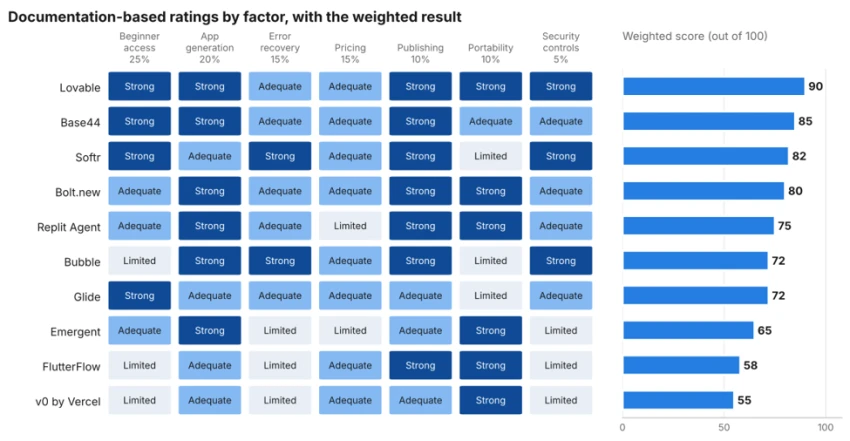
Ratings reflect documented capabilities on November 25, 2026, not timed test runs.
Plan prices sit in the comparison table and free-plan allowances in the free-plan section, so each review covers what those numbers leave out.
Lovable turns a chat into a React web app and switches on Lovable Cloud by default, supplying the database, logins, file storage and server functions. A beginner can therefore reach a working sign-up flow without opening a settings screen.
Credits behave unevenly. Lovable's pricing page lists "Make the button gray" at 0.5 credits and a landing page with images at 1.7, and the same balance pays for hosting and in-app AI.
Recovery is better than most. "Try to fix" includes 10 free fixes that renew after 24 hours, and version history restores an earlier state without deleting later work.
A developer becomes necessary when leaving Lovable Cloud, since Lovable documents no one-click move to a separate Supabase project. Founders validating a customer-facing idea fit best. Anyone who needs a fixed cost per change should look elsewhere.
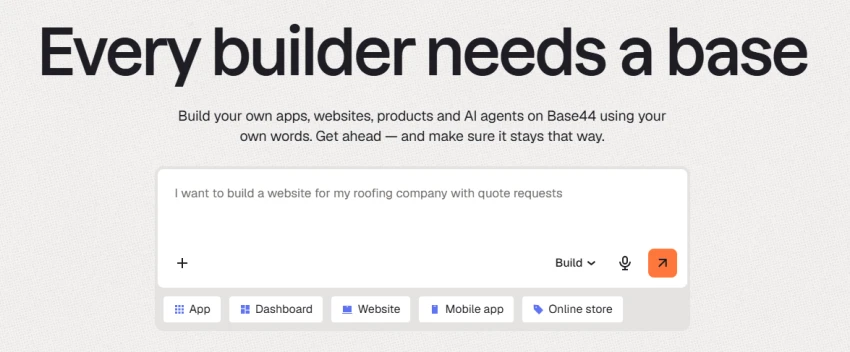
Base44, owned by Wix since 2025, includes authentication and a database on every plan, the free one included. Building spends message credits while running the app spends integration credits. Services such as Stripe bill the owner directly.
Edit mode changes design by clicking elements without using credits, and every prompt carries a "Revert This" option. Tech.co rated Base44 the easiest builder it tested, while noting more small mistakes than with Bolt.new or FlutterFlow, each fixed through follow-up prompts.
Downloading code is not the same as operating the app independently. Base44's documentation states that an exported ZIP still relies on the Base44 SDK for data, logins, backend functions and integrations, and that self-hosting is not supported.
It suits an app that will stay put. A planned developer handover is the scenario to avoid.
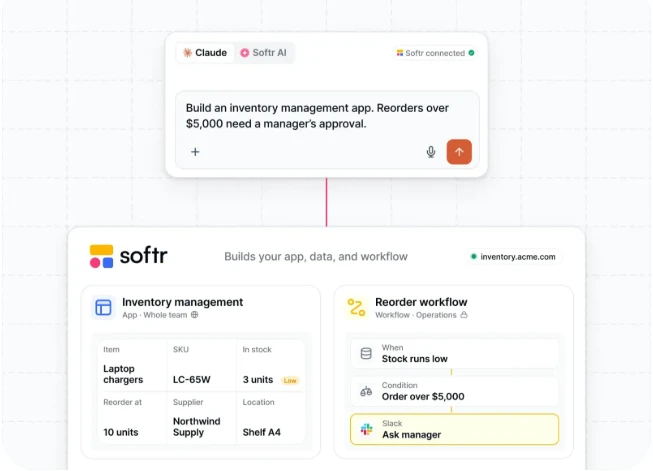
Softr's AI Co-Builder, launched on March 31, 2026, generates the database, pages, user groups and workflows together from pre-built blocks rather than a codebase. A Vibe Coding block covers the occasional custom component.
That choice pays off in maintenance. Owners can preview the app as any user group before publishing, and global data restrictions keep each client's records separate, so a permission mistake shows on screen instead of hiding in code.
The restriction is user count. Pro includes 10 team members and 50 client users, with extra clients at $1 each, so a public product with thousands of sign-ups outgrows it fast. Softr's FAQ also states that apps cannot be exported.
Agencies and operations teams running portals or internal tools fit best. Consumer startups wanting full design control should avoid it.
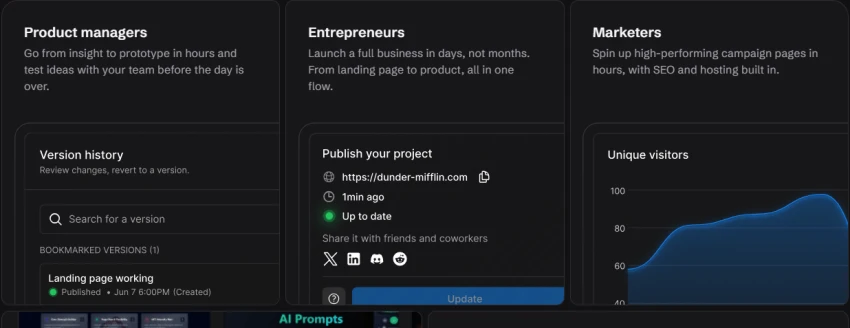
Bolt.new bills in tokens, small chunks of text the AI reads and writes. Each prompt spends tokens reading the existing project before writing anything, so the same request costs more as the codebase grows. Paid tokens roll over for up to two months, and purchased reloads never expire.
Bolt Cloud bundles hosting, unlimited databases, login settings and domains, which makes separate Supabase or Netlify accounts optional. Mobile apps run through an Expo integration.
Complex projects drift toward technical troubleshooting. Builders on Product Hunt describe "project too big" warnings that persisted after every recommended fix, and while Plan mode and version history soften this, stubborn errors still arrive as code.
Founders expecting to hire a developer get the cleanest handover here. Anyone wanting predictable costs during heavy iteration should start elsewhere.
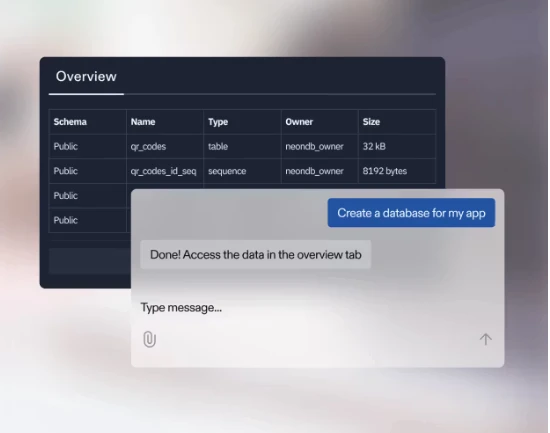
Replit Agent writes the app, runs it, connects a database and publishes it inside the browser. Since January 2026 it also builds native iOS apps with Expo and guides App Store submission.
Pricing is effort-based, so simple fixes cost less than complex builds. Replit asks for confirmation before paid work starts, yet the final cost appears only after a task ends. Hosting and databases draw from the same monthly credits, and in September 2026 Replit removed its free Starter plan from the pricing page.
Recovery matters on a platform this autonomous. In July 2025, the agent deleted SaaStr founder Jason Lemkin's production database during a code freeze, and rollback worked even after the agent claimed it would not. Checkpoints and Pro's 28-day database rollback now form the safety net.
Curious owners comfortable seeing files and logs fit best. Tight budgets are the main reason to avoid it.
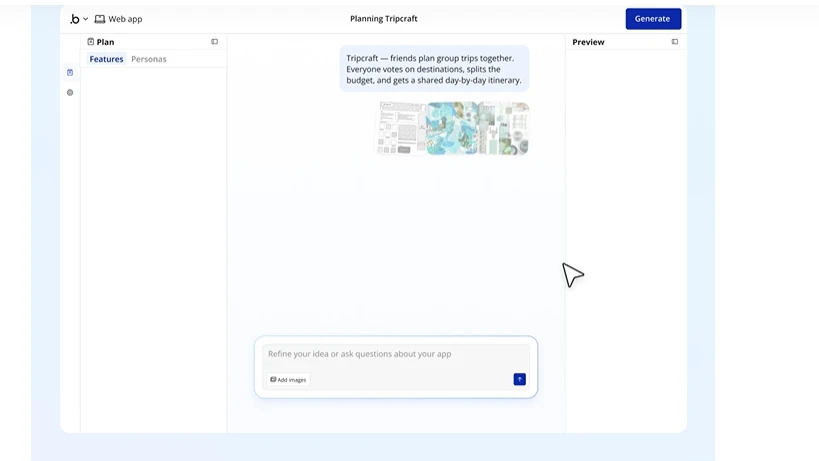
Bubble generates an app with AI, then keeps every piece editable as visual workflows, readable "when this happens, do that" chains instead of code. A non-developer can open a workflow a year later and see why a booking was rejected.
The AI Agent now builds and edits native mobile apps, with App Store and Google Play publishing run from the editor. Billing follows workload units, Bubble's measure of server work such as database queries. Alerts arrive at 75% and 100% of the allowance, and overages can be switched off.
The learning curve is steep because the editor exposes dozens of settings. Platform dependency is total: data leaves as CSV, and app structure exports only as JSON for re-import into Bubble.
Founders with marketplace-style rules and time to learn fit best. Anyone planning to leave the platform later should look elsewhere.

Glide now sells two products. GlideOS, publicly launched on August 3, 2026, builds apps from a prompt or an existing spreadsheet. Glide Classic, the original builder, continues on its own plans, and the two cannot share data or migrate apps.
Annual billing on GlideOS is still listed as "coming soon", while Glide Classic charges by "updates", a monthly count of data changes.
The advantage is speed from a working sheet to a phone-friendly staff tool with no database design. The frustration is the split itself, with community members reporting that GlideOS cannot read their Classic apps or tables.
Operations managers with a working spreadsheet fit best. Anyone needing an App Store listing should choose another builder.
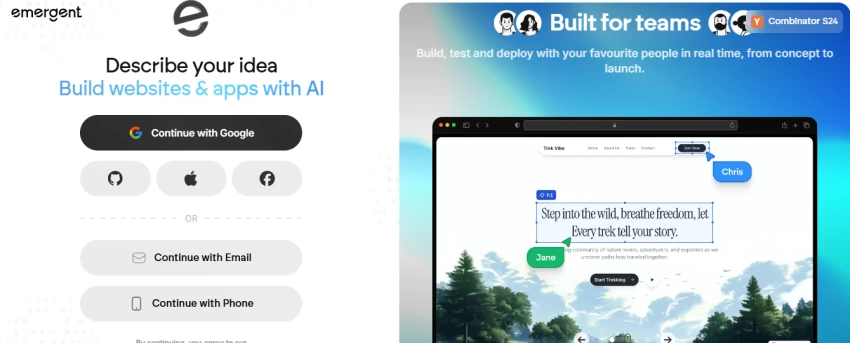
Emergent's multi-agent system writes complete applications from conversation, and independent comparisons describe React frontends backed by Python services and MongoDB. Standard adds GitHub integration, and mobile apps are generated with Expo.
Billing needs a careful read, because building and hosting draw from one credit balance. Emergent's publishing docs list 50 to 1,100 credits a month per live app by tier, while its help center describes a flat 50. One base-tier app can therefore absorb half the Standard allowance.
Debugging carries the highest documented risk in this list. One developer write-up estimates 30 to 50 credits per fix-and-retest loop, and Emergent's Trustpilot score stood at 2.8 out of 5 from 636 reviews in October 2026.
Builders with a technical friend on call fit best. Fixed budgets fit poorly.
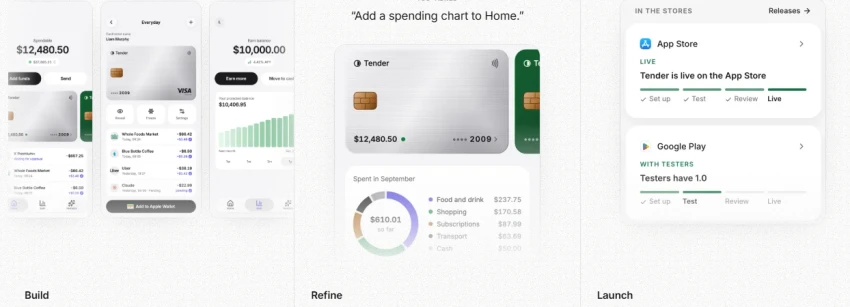
On November 4, 2026, FlutterFlow launched an AI-first builder for native iOS and Android apps and renamed its visual editor FlutterFlow Studio, with existing subscriptions covering both. Three weeks of public availability is too short a record to judge.
Studio is the proven part: a visual Flutter editor with code download and one-click store deployment from the Basic plan. The backend runs on Firebase or Supabase accounts that the owner sets up and pays for separately, security rules included. The pricing page and Studio documentation also name the upper tiers differently, so buyers should confirm names at checkout.
Softr's October 2026 free-plan test produced no app at all, because FlutterFlow's AI designer timed out on every attempt.
Founders planning a native app with a future development team fit best. Absolute beginners should avoid it.
v0 generates Next.js apps with polished interfaces and deploys them to Vercel in one click. Full-stack features connect databases such as Neon or Supabase through the Vercel Marketplace, and every plan syncs with GitHub.
Credits are counted in dollars and consumed per token, so the chosen AI model changes how fast they run out.
Interface quality is the clear advantage: a hands-on comparison published on DEV Community scored v0 8.7 out of 10 and recommended it to designers and frontend developers who need screens fast. The friction is vocabulary, since environment variables and server routes appear in the workflow.
Designers and product managers working beside a developer get excellent starting code. A solo owner is better served higher in this list.
Most reviews stop at the first generation. The standard follow-up for this comparison is:
Prevent two customers from booking the same appointment slot. Display a clear message when a slot is unavailable, and preserve the existing login system, booking history and administrator dashboard.
It was not run here, but documentation shows how each kind of builder approaches it. Real double-booking prevention needs a server or database rule, because a check inside the booking button fails when two people click at once.
Chat-first builders such as Lovable, Bolt.new, Replit and Emergent write that rule as code a beginner cannot easily confirm. Bubble and Softr express it as a visible workflow condition, slower to build but easier to inspect.
The usual failures, from a dead button to a new feature that breaks an old one, share one remedy: planning before a change and a clean undo after it.
| Builder | Plan before changing | Undo a bad change |
|---|---|---|
| Lovable | Plan mode, 1 credit per message plus research | Version history; GitHub commits |
| Base44 | Discuss mode, 0.3 credits per message | "Revert This" on every prompt; version history |
| Bolt.new | Plan and Discussion modes | Version history |
| Replit Agent | Plan mode, which can bill for reasoning | Checkpoints; 28-day database rollback on Pro |
| Bubble | AI Agent troubleshooting | Version control on paid plans |
| FlutterFlow | Not documented | Branches on Pro and Max; backups |
Glide, Softr, Emergent and v0 document no comparable pairing in the pages reviewed.
The advertised plan is only the entry fee, since AI changes and hosting each run on separate meters that differ by platform.
| Platform | Billing model | Entry plan includes | Additional costs | Main cost risk |
|---|---|---|---|---|
| Lovable | One shared credit balance for every activity | 100 monthly credits plus 5 daily | Cloud and AI use beyond monthly grants | Complex prompts cost more |
| Base44 | Message credits plus integration credits | 100 message and 2,000 integration credits | Outside services billed directly | Integration use grows with customers |
| Softr | Flat plans with user and record limits | 5 team and 5 client users | Extra seats; extra domains at $15/mo | Client caps force plan jumps |
| Bolt.new | Tokens | 10 million tokens a month | Token reloads | Bigger projects burn more per prompt |
| Replit Agent | Dollar credits, effort-based | $20 toward models plus Free Mode | Metered use beyond the allowance | Cost known only after a task ends |
| Bubble | Workload units plus AI credits, per project | 175,000 workload units, 1,000 AI credits | Overages or workload tiers; storage at $3 per 100 GB | Traffic growth raises workload |
| Glide (GlideOS) | Credits | 100 credits, 2 published apps | Limited top-ups | Public apps need a higher tier |
| Emergent | Shared credits for building and hosting | 100 credits | Top-up credit packs | Hosting absorbs the allowance |
| FlutterFlow | Per seat plus AI usage | One editor | Firebase or Supabase; extra seats | Backend billed elsewhere |
| v0 by Vercel | Per-user seats plus dollar credits | $30 of credits plus $2 daily | Vercel hosting; database add-ons | Model choice changes burn rate |
Outside the platforms, Stripe's standard US rate is 2.9% plus 30 cents per successful card payment, and a custom domain needs its own registration.
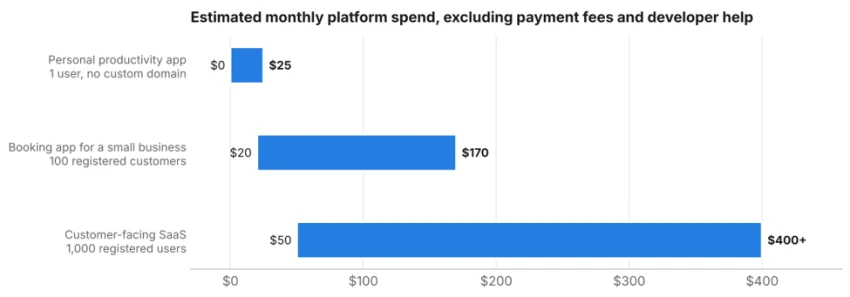
Estimates, not quotes. Each range spans the cheapest and costliest plausible shortlisted platform for the scenario.
The scenarios rest on stated assumptions:
Personal productivity app: one user, about a month of building and no custom domain. A free Softr or Base44 plan can carry it; a heavy build month on a $20 to $25 plan sets the ceiling.
Booking app with 100 registered customers: about 300 bookings a month on a custom domain. Credit-based builders stay near entry plans, while Softr reaches about $170 on monthly Pro billing with 50 extra client seats.
SaaS product with 1,000 registered users: about 200 daily users and weekly feature changes. Exact figures need real traffic data, so the range runs from Base44's Pro plan to Replit or Emergent bills with heavy agent use. Softr would need Enterprise pricing at this size.
Free building and free publishing are separate promises. Six of the ten builders can put something live at no cost, yet only Softr and Lovable let a free app stay private.
| Tool | AI allowance on Free | Other limits | End-user logins | Branding |
|---|---|---|---|---|
| Lovable | 5 build credits a day, 30 a month | 20 Cloud credits monthly | Yes | Badge removed on Pro |
| Base44 | 25 message credits, 5 a day | 100 integration credits; 5 apps | Yes | Badge removed on paid plans |
| Softr | 5 AI credits a month | 5,000 records | Yes | Removed on Pro |
| Bolt.new | 1 million tokens, 300,000 a day | No rollover; no card required | Yes | "Made in Bolt" badge |
| Replit Agent | Existing Starter accounts only | Free published link goes down after 30 days | Yes | "Made with Replit" badge |
| Bubble | 500 AI credits | 50,000 workload units | No live login | Paid plans only |
| Glide (GlideOS) | One-time pool that does not refill | 10 projects; no published apps | Paid plans only | Not applicable |
| Emergent | 10 credits a month | Not documented | Not documented | Not documented |
| FlutterFlow | 5 AI requests per account lifetime (Studio) | 2 projects; 1 editor | Through Firebase or Supabase | Paid plans only |
| v0 by Vercel | 7 messages a day; $5 one-time credit | No credit purchases | Through add-ons | Reports conflict |
Ownership has more layers than the word suggests. Source code ownership is a legal right, while code export is a button. Database export, backend portability, commercial rights and permission to host elsewhere are separate questions again, and services such as Stripe keep their own accounts whatever happens to the builder.
Downloadable code also does not mean a beginner can deploy it, since hosting setup and restoring user logins remain developer work.
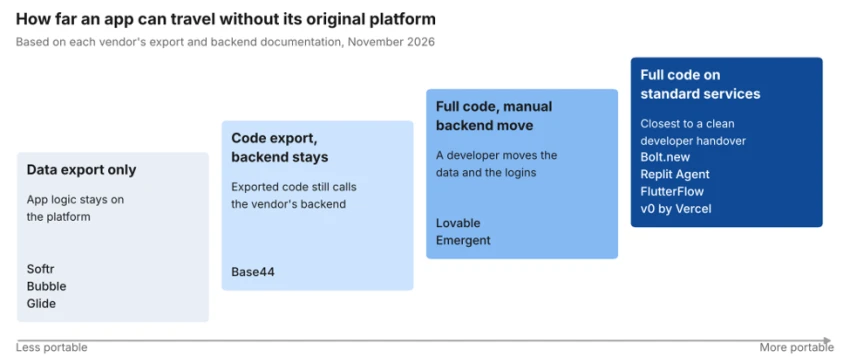
Official documentation describes cancellation outcomes for only some of the ten:
| Tool | What the vendor documents on cancellation |
|---|---|
| Base44 | Apps stay live and data stays in the workspace; changes apply at the next billing cycle |
| Bolt.new | Plan and unused tokens last until the period ends, then the account moves to Free |
| Softr | The site stays active and the account switches to the Free plan |
| Bubble | The plan stays active through the billing cycle; the Free plan cannot host a live version |
| FlutterFlow | Published apps stay live on Free, but updates are restricted |
| Lovable, Replit Agent, Glide, Emergent, v0 | Not stated in the documentation reviewed (unverified) |
One third-party review reports that Emergent keeps a cancelled account's app live only while 50 credits remain, which Emergent's own pages do not confirm.
Four kinds of "mobile app" hide behind the same marketing phrase:
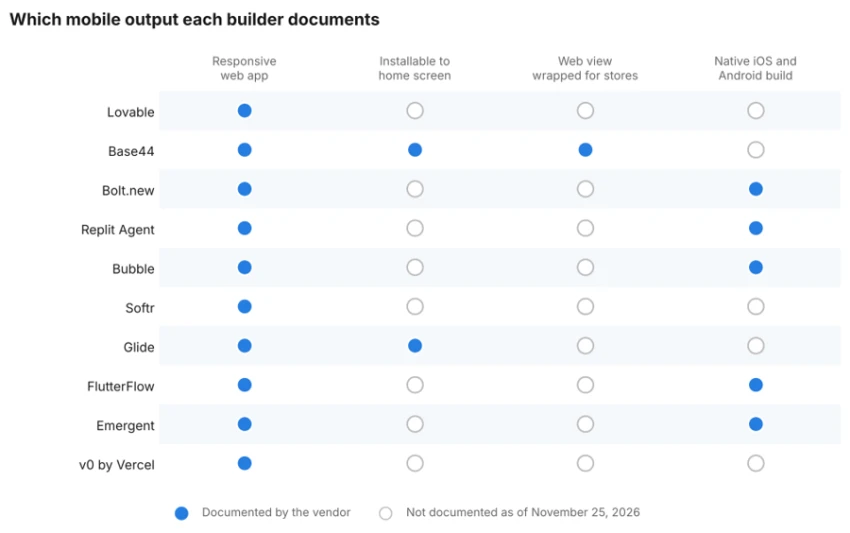
Store listings add cost and delay. Apple's Developer Program costs $99 a year and Google Play charges a one-time $25 fee, and Apple reviews every build whichever tool wrote it. Base44's wrapper shows most content changes without a new store release, though icon or permission changes need a fresh build.
| Application idea | Recommended builder | Why it fits | Limitation to consider |
|---|---|---|---|
| Appointment booking | Lovable | Customer-facing polish with logins and records in one build | Double-booking rule must be verified on the server |
| Real estate lead management | Softr | Agents and managers see different lead views through user groups | Team-user caps on lower plans |
| Employee attendance | Glide | Staff check in on phones from a shared sheet | No store listing |
| Customer relationship management | Base44 | Records and role-based dashboards generated together | Data leaves only as per-table CSV files |
| Student management portal | Softr | Parents, students, teachers and administrators each get scoped access | Client-user limits per plan |
| Client dashboard | Softr | Preview-as-user confirms each client sees only their own data | Limited visual customization |
| Inventory tracker | Glide | Fastest path from an existing stock sheet | Usage meters grow with data changes |
| Subscription SaaS product | Bolt.new | Standard code with Stripe and a claimable database | Token spend rises with project size |
| Marketplace | Bubble | Visual workflows handle multi-party rules and payouts | Steep learning curve; no code export |
| Native mobile application | Bubble | Native iOS and Android publishing from one editor | Web and mobile share one workload pool |
A free or lowest-tier account can answer ten questions in about half an hour:
1. Does a plain description of the real business produce a usable first version?
2. Does a record added through the app still appear after a page refresh and a fresh login?
3. Can two separate customer accounts be created without manual setup?
4. Is each customer blocked from viewing the other's records, even by changing the page address?
5. Does a meaningful feature request, such as cancellation rules, work on the first or second attempt?
6. Do the earlier features still work after that change?
7. Does the layout hold up on an actual phone rather than a resized browser window?
8. Can the app be published to a live address, and on which plan?
9. What can be exported today, if anything?
10. What will the expected monthly usage cost once real customers arrive?
This is a first screen, not a security audit. A smooth first generation proves only that the easy part went well, which is no reason to buy an annual plan.
A prototype answers "would customers use this?" Production software must answer "what happens at 2 a.m. when it fails?", and some categories cross that line on day one.
These projects need an experienced no-code specialist or a development agency from the start.
Lovable earns the best overall score for non-developers building customer-facing web apps, on the strength of complete first builds and a built-in backend with automatic pre-publish scanning. Its variable credit meter and two past exposure incidents make an independent check essential before real customers sign up.
Base44 suits absolute beginners, while Softr suits small businesses whose real need is permissions and maintenance. Mobile creators get the most from Bubble, and founders planning to hire engineers should favor Bolt.new. The fastest generator often produces the hardest app to change safely, while a slower visual builder keeps every rule in plain view.
Share your thoughts about this article.
Be the first to post a comment!

Adoption is nearly universal and spending has tripled, yet most projects return...
Deepak Mehra1 month ago