Amazon Will Train AI on Twitch Streams by Default
by Nitin - 1 month ago - 5 min read
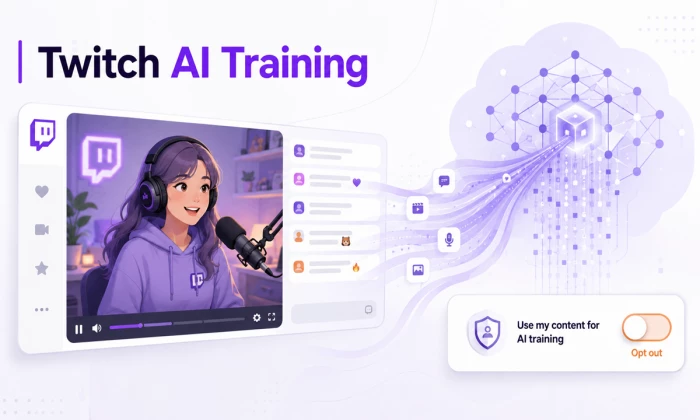
Amazon is gaining access to one of the internet’s largest continuously produced sources of video, voice and conversational data after Twitch confirmed that creators’ channel content can be used to train Amazon’s generative AI models.
The controversial part is the default. Twitch creators are automatically included unless they manually disable a new “Training for Generative AI” setting. The change was announced on August 12 and quickly drew criticism from streamers who argue that Amazon should have asked creators to opt in rather than making them responsible for opting out.
Twitch Streams, VODs, Clips and Chats Can Be Used
Twitch says the training permission can cover a broad range of material associated with a creator’s channel, including livestreams, VODs, clips, stream chats, pictures and text.
Turning the setting off prevents that channel content from being used in the future training of Amazon generative AI models designed to generate or synthesize text, audio, images or video.
There is an important distinction, however. Opting out of generative AI training does not stop Twitch or Amazon from processing channel content for other purposes described in Twitch’s privacy policies.
AI-supported Twitch functions such as recommendations, AutoMod, safety systems and tools designed to help creators with growth, discovery or sponsorship opportunities can continue to operate even when generative AI training is disabled.
There is another unusual detail involving chat. If someone posts a message in another streamer’s chat, Twitch says the channel owner’s preference, rather than the individual chatter’s own AI-training preference, determines whether that chat can be used for training.
Twitch Says an Opt-In System Would Attract Few Volunteers
Twitch Chief Product Officer Mike Minton and Head of Community Mary Kish addressed the decision during an official Twitch livestream watched by nearly 3,000 people.
When viewers repeatedly asked why Amazon had chosen an opt-out model, Minton gave a surprisingly direct explanation: “If this was opt-in, nobody would opt in.”
That answer helps explain the backlash. The debate is less about whether AI can technically learn from public Twitch content and more about who should be responsible for giving permission.
Twitch itself appears to have anticipated resistance. Rather than presenting the change primarily as Amazon gaining access to creator data, the company announced it as a new setting allowing creators to opt out of generative AI training.
Twitch Represents an Enormous AI Training Dataset
The attraction for Amazon is easy to understand when the scale of Twitch is considered.
Data from livestream analytics service SullyGnome shows Twitch generated roughly 1.5 billion hours watched during the latest 30-day period, with about 2.1 million average concurrent viewers and approximately 82,200 channels live on average. More than 20.5 million streams were recorded during that period.
Across 2026 so far, viewers have watched more than 11.1 billion hours of Twitch content, according to the same dataset.
That does not mean Amazon will use all of those hours as AI training data. Amazon has not disclosed the size, composition or filtering process of the Twitch dataset being used. But the platform potentially gives the company access to a particularly valuable type of multimodal information: long-form human speech combined with video, gaming activity, text chat, reactions and real-time conversations.
Amazon has owned Twitch since acquiring the company in 2014 in a deal valued at approximately $970 million in cash.
The AI Connection Did Not Appear Overnight
There had been signs that Twitch could eventually become part of Amazon’s AI data strategy.
Back in April 2024, Minton said Twitch had a “role to play” in training Amazon AI, while characterizing the work at that point as being in a prototyping rather than production-scale phase.
What remains unclear is exactly how much Twitch content Amazon may have used before the new setting appeared. During this week’s discussion, Minton said he did not know what Amazon had previously used for model training.
Twitch therefore appears to be offering creators more explicit control over future generative AI training without providing a complete picture of historical use.
Creators Can Opt Out, but They Have to Find the Setting
Streamers who do not want their channel content included can open their Twitch account settings, select Security and Privacy, scroll to Training for Generative AI, and turn the option off. The setting is located in account/channel settings rather than the Creator Dashboard.
The bigger question now is whether Twitch’s approach becomes normal across creator platforms. AI companies increasingly need large volumes of high-quality text, video, audio and conversational data, while platforms already sit on enormous archives created by their users.
Twitch is effectively testing where that boundary lies. Amazon gets access to a potentially valuable stream of multimodal training material, while creators get an opt-out switch, but only if they know it exists and choose to use it.
For many streamers, that distinction between permission by default and permission by choice is likely to remain the most contentious part of Twitch’s new AI policy.