Meta Rolls Out Muse AI Image Generator for Instagram and WhatsApp
by Vivek Gupta - 3 months ago - 6 min read
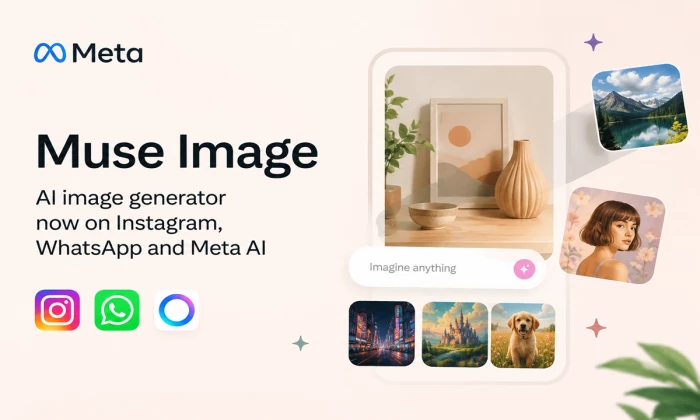
Meta has launched Muse Image, a new AI image generation model built by Meta Superintelligence Labs, as the company pushes deeper into consumer-facing generative AI. The tool is now available through Meta AI and is being added across Instagram and WhatsApp, with wider expansion planned for Facebook, Messenger and advertising tools.
The launch marks an important step in Meta’s AI strategy because Muse Image is not being introduced as a separate creative tool only. Instead, it is being woven directly into the apps people already use for messaging, stories, content creation and social sharing.
Muse Image Enters Meta’s Main Apps
Muse Image is designed to create and edit images from text prompts, uploaded photos and visual references. Meta says the model can understand more complex prompts, blend multiple photos, make direct image edits and produce visuals that users can download or share to chats, stories and feeds.
The model is already powering creative tools inside Meta AI, Instagram Stories and WhatsApp. According to Reuters, Muse Image will support more than 30 new AI effects for Instagram Stories and image generation inside direct chats with Meta AI on WhatsApp, initially in select countries.
| Feature | Details |
|---|---|
| Product name | Muse Image |
| Developer | Meta Superintelligence Labs |
| Main use | AI image generation and editing |
| Availability | Meta AI app, meta.ai, Instagram Stories, WhatsApp in selected markets |
| Coming next | Facebook, Messenger and Meta advertising tools |
| Cost | Basic use is free; extra creation capacity may require Meta subscription plans |
| Related model | Muse Video, currently previewed by Meta |
Designed for Everyday Social Creation
Meta is positioning Muse Image as a creative assistant for normal users, not only designers or marketers. People can type a prompt, start from an existing photo, use suggested presets or sketch directly on an image to request changes.
Examples shared by Meta include removing unwanted objects from photos, creating images in front of landmarks, restoring old family photos, trying new hairstyles, making character-style portraits and generating visual guides with readable text.
The company is also adding presets, which are ready-made prompt ideas meant to help users generate images faster. This matters because many users do not know how to write detailed AI prompts, and presets reduce the effort needed to test the tool.
Instagram and WhatsApp Are the First Big Test
The strongest part of the rollout is Meta’s distribution. Unlike standalone AI image tools, Muse Image will appear inside platforms where users already create and share visual content.
On Instagram, Muse Image powers new AI effects for Stories. These effects can modify existing photos and create stylized versions of user images. On WhatsApp, users can generate images inside chats with Meta AI.
This gives Meta a major advantage because Instagram and WhatsApp already have massive user bases. If the tool works smoothly, Meta can make AI image generation feel like a normal part of posting, messaging and editing rather than a separate workflow.
Public Instagram Photos Raise Privacy Concerns
The most controversial part of Muse Image is its connection with Instagram profiles. Meta says users can @-mention Instagram accounts in Meta AI to bring public profile photos into AI creations. This could be used for invitations, collaborative concepts or personalized graphics.
However, this feature has already triggered privacy concerns. The Verge reported that users can mention other Instagram accounts in prompts, allowing Muse Image to include public Instagram content in generated visuals. Meta says users have controls to limit how their content is reused, but the feature has still raised questions about consent, notification and misuse.
WIRED also reported that public Instagram profiles may need to opt out if they do not want their content used in AI-generated images, and noted that users may not be notified when their content is used in this way.
Business and Advertising Use Cases
Muse Image is not only for casual image creation. Meta is also connecting it to shopping, creators and advertising.
One example Meta highlighted is room redesign. A user can upload a room photo and ask Meta AI to redesign the space using real products from the web or Facebook Marketplace. This could make Muse Image useful for home decor, product discovery and shopping inspiration.
For businesses, Meta plans to bring Muse Image into Advantage+ creative, its advertising automation system. This suggests that brands may eventually use Muse Image to create or adapt ad visuals more quickly across Meta’s platforms.
Muse Image Uses Agentic AI Capabilities
Meta describes Muse Image as more than a simple text-to-image generator. According to Meta’s AI research blog, the model can use tools, search the web for context, improve its own output and work with Muse Spark, Meta’s reasoning model.
This means Muse Image can plan before generating, use references and refine its result when needed. Meta says this helps with more accurate images, better prompt following, multi-reference composition and image editing.
Meta also claims Muse Image ranks No. 2 on Arena human-preference benchmarks for text-to-image, single-image editing and multi-image editing as of July 5, 2026, though this is Meta’s own reported benchmark summary.
Content Seal Added for AI Image Detection
Meta is adding a hidden watermarking system called Content Seal to images created with Muse Image in the Meta AI app and on meta.ai. The company says the invisible signal is designed to remain detectable even after cropping, compression, resizing or screenshots.
Meta is also previewing a detection tool that can check whether an image carries the Content Seal watermark. This is important because AI-generated images are becoming harder to identify, especially when they are shared quickly across social platforms.
Muse Video Is Also Coming
Alongside Muse Image, Meta previewed Muse Video, a video generation model built on the same broader media-generation effort. Meta says Muse Video is designed for prompt adherence, visual fidelity and temporal consistency, with native audio support also mentioned in its AI blog.
Reuters reported that Meta has announced an early preview of Muse Video, but the company has not yet fully rolled it out to general users.
The Bigger Picture
Muse Image shows how Meta wants to compete in AI: not just by releasing models, but by embedding them into Instagram, WhatsApp, Facebook, Messenger and its advertising business.
The rollout could help Meta attract creators, casual users and advertisers who want faster visual content creation. At the same time, the Instagram photo reuse feature may become a major trust issue if users feel their public images can be pulled into AI creations without clear consent or notification.
For now, Muse Image gives Meta a stronger position in the AI image race. Its success will depend not only on image quality, but also on how clearly Meta handles privacy controls, creator permissions and AI-generated content transparency.