Apple Removes MiniMax’s Talkie AI Over Child Safety Concerns
by Nitin - 26 minutes ago - 4 min read
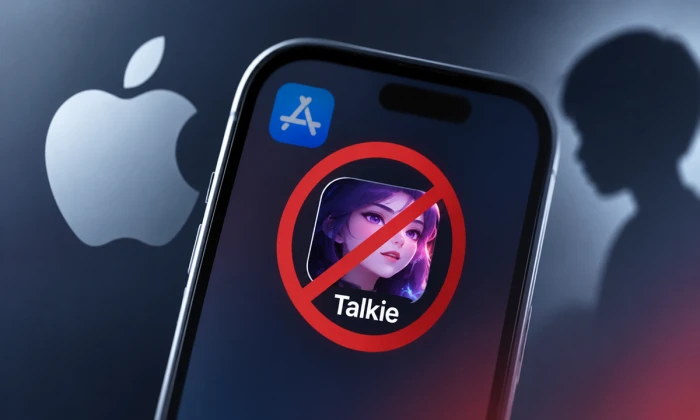
Apple has removed Talkie, the AI companion app from Shanghai-based MiniMax, from its App Store across every market this week. The takedown followed media reports that the app's AI-generated characters had sent sexualised messages to children.
The move strikes one of MiniMax's best-known consumer products at a point when platforms and regulators are rethinking how far AI companions should be allowed to go.
The reporting that triggered it
A joint investigation by ABC News and the Bureau of Investigative Journalism, published midweek, found that Talkie characters had sent sexually inappropriate and abusive messages to underage users. That reporting preceded Apple's decision to pull the app globally rather than in a single region.
The allegations cut at the heart of how these products work. Talkie's draw is open-ended, emotionally charged roleplay, and the same flexibility that makes a character feel responsive also makes its output hard to contain.
That is the recurring flaw in the companion model.
Talkie and its reach
Launched in 2023, Talkie offers a catalogue of AI companions that users chat with, often with romantic undertones. MiniMax runs a separate Chinese version called Xingye.
The app had built a sizeable audience before the takedown.
| Detail | Figure |
| Launched | 2023 |
| App Store and Google Play rating | 18+ |
| Monthly active users (Oct 2026) | About 11 million across app and website (Unique) |
| Leading markets | United States, Philippines, Mexico (Sensor Tower) |
| Share of MiniMax's 2024 income, with Xingye | More than 60 percent |
Those numbers explain why the removal lands hard. Talkie ranked among the more successful consumer exports of China's AI sector, and its audience stretched well beyond the home market.
The age-rating gap
On paper, Talkie carries an 18+ label on both the Apple App Store and Google Play. Depending on the country, the app also states that children under 14, or under 16, cannot create an account.
The weakness sits in enforcement. Age is self-reported, so a child can clear the gate with a false birth date, a loophole child-safety advocates have flagged for years. An 18+ badge does little when nothing verifies who is actually using the app.
A familiar pattern of removals
MiniMax did not immediately respond to requests for comment, and Apple declined to detail its reasoning. The company's record with comparable cases points to a conditional removal rather than a permanent ban. In August 2026 it briefly pulled Telegram worldwide over one user's child-abuse content, then restored the app once the material and the account were gone.
A similar route would put the burden on MiniMax to show stronger safeguards before Talkie is allowed back.
Not the first flashpoint
Talkie has been here before. Apple removed it from the US App Store in late 2024, and it later returned under the name Talkie Lab, listed through a Singapore-registered developer. The difference now is scope, since the current action reaches every market at once.
The decision also fits a broader tightening at Apple. Through November 2026 the company began requiring 18+ ratings for apps built around romantic AI interaction, and several companion apps including Linky AI and PolyBuzz dropped off the US store in the same period.
A broader reckoning for companion AI
The scrutiny reaches well past Apple.
China moved early. In July 2026 its regulators cracked down on domestic companion apps, Xingye among them, with rules banning intimate relationships for minors and demanding guardrails against emotional dependency and addiction. ByteDance and Alibaba responded by switching off humanlike interactive agents on their platforms, a change that irritated users who had grown attached to virtual characters.
Western platforms face their own version of the problem. Grok, the chatbot from Elon Musk's xAI, drew government criticism this year after being used to generate sexualised images of women and minors, and Character.AI is contesting several US lawsuits over how its bots spoke with young users. Regulators have tended to treat companion apps as a category apart from general assistants such as ChatGPT and Gemini, which sell productivity rather than relationships.
Where it leaves MiniMax
For MiniMax, the timing is awkward but far from fatal. The company has spent the past year steering toward enterprise coding and multimodal systems such as MiniMax M1 and Hailuo-02, and it listed in Hong Kong in January. Talkie weighed heavily on its 2024 accounts and much less on its current ones.
The harder problem belongs to the platforms. Age ratings and self-declared birthdays were designed for static software, and they map poorly onto systems that improvise intimate conversation on demand. Until verification catches up with what these models can say, blunt takedowns will stay the main lever Apple holds.