Facebook Launches AI Assistant for Creators Across Its Platforms
by Deepak Mehra - 3 months ago - 5 min read
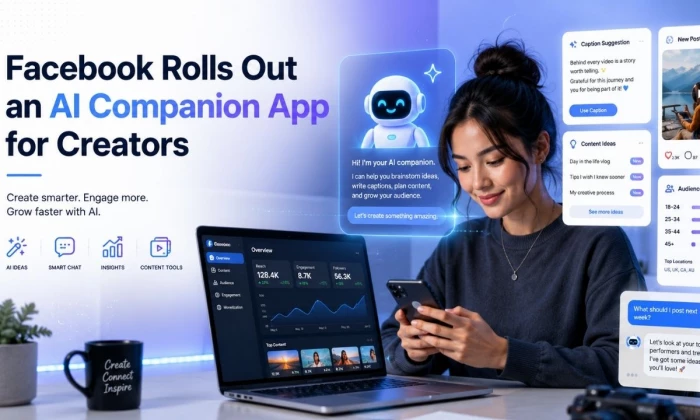
Meta is expanding its AI tools for Facebook creators with a new Creator Assistant that can analyse account performance, suggest content ideas and help users understand changes in audience engagement.
The assistant is available through Facebook’s professional dashboard and is initially rolling out to creators in the United States, Canada and India. Meta says the recommendations are personalized using a creator’s content style, performance history, community activity and stated goals.
The launch gives Facebook creators a conversational alternative to manually studying analytics charts and deciding what to publish next.
Creators Can Ask Questions About Their Accounts
Creator Assistant allows users to ask direct questions about their content, audience and monetization performance.
Instead of opening several reports, a creator could ask why one Reel generated more engagement than another, which topics attracted the most viewers or whether their audience has changed over the past month.
A food creator, for example, might ask whether short recipe videos perform better than restaurant reviews. A fitness creator could compare home-workout Reels with gym-based content, while a technology reviewer could identify which product categories generate the strongest comments or watch time.
The assistant can also recommend future topics using previous account performance, popular Facebook formats, trending audio and cultural moments.
This makes the tool more useful than a general AI chatbot that has no direct access to the creator’s Facebook data. However, Meta has not published detailed accuracy results showing how reliably the assistant can determine the exact reason a post performed well.
Its explanations should therefore be treated as recommendations rather than definitive conclusions about Facebook’s algorithm.
Facebook Revives Creator Studio as an AI App
Meta has also revived Creator Studio as a standalone AI-powered companion app for Facebook creators.
The original Creator Studio was discontinued in 2023 as Meta directed users towards Meta Business Suite. The redesigned version centres on Creator Assistant and is intended to help creators track performance, strengthen audience relationships and grow their Facebook presence.
The app can highlight important audience comments and draft replies that attempt to match the creator’s usual voice. This could help creators managing large communities respond to valuable questions without manually reviewing every comment.
For example, the system may prioritize a detailed product question, a recurring complaint or a comment from a highly engaged follower instead of simply displaying responses in chronological order.
The new Creator Studio app is currently being tested with selected creators, and Meta has not confirmed when it will become widely available. Interested creators can join a waitlist for early access.
AI Is Moving From Creation to Decision-Making
Most early creator-focused AI tools concentrated on generating captions, images or videos. Facebook’s approach is different because it brings AI into the decision-making stage.
Creator Assistant is designed to help users decide which topics to cover, which audience signals deserve attention and which content patterns may be worth repeating.
This could be particularly valuable for smaller creators who have access to performance data but lack the time or expertise to interpret it. A conversational assistant may turn a complex dashboard into simple actions, such as shortening introductions, revisiting a successful subject or responding to a growing audience segment.
The advantage for Meta is equally clear. Creators currently use external chatbots, spreadsheets and analytics platforms to plan content. By placing AI recommendations inside Facebook, Meta can keep more of that workflow within its own ecosystem.
Personalized Advice May Also Create Repetitive Content
The assistant’s access to account-level data gives it an advantage over standalone AI tools, but it also introduces a creative risk.
When recommendations are based heavily on previous performance and current trends, creators may be encouraged to repeat formats that already work rather than experiment with new ideas.
If many creators are directed towards the same popular sounds, video structures and cultural moments, Facebook could receive more content without necessarily gaining more originality.
The most effective way to use Creator Assistant may therefore be as an analytics partner rather than an automatic content manager.
Creators can use it to identify patterns and generate hypotheses, but those recommendations should still be tested. For instance, a creator could publish two similar Reels with different opening hooks rather than changing the topic, length and posting time simultaneously. This would make it easier to judge whether the assistant’s suggestion actually improved performance.
Meta Is Increasing Its Focus on Facebook Creators
Creator Assistant arrives as Meta works to attract more professional creators to Facebook.
In March 2026, the company introduced Creator Fast Track, a program offering eligible creators from other platforms monthly payments ranging from $100 to $3,000 for three months. Meta also reported paying Facebook creators nearly $3 billion during 2025, representing a 35% year-over-year increase, with short-form video accounting for around 60% of creator earnings.
The combination of financial incentives and AI-assisted analytics suggests Meta is trying to make Facebook easier to adopt for creators already active on TikTok, Instagram or YouTube.
Creator Assistant could support that strategy by reducing the time required to understand a new platform’s audience and performance system.
Availability
The dashboard-based Creator Assistant is initially rolling out in the United States, Canada and India, while Meta plans to introduce more capabilities and expand availability over time.
The standalone Creator Studio companion app has a more limited rollout and is currently available only to selected testers. Meta has not announced a date for its wider release.
Final Take
Facebook’s Creator Assistant is not simply another caption generator. Its more important role is converting account data into practical content and engagement recommendations.
The feature could make performance analysis more accessible to creators who cannot afford dedicated analytics teams. It may also help users identify valuable comments, understand audience changes and make faster publishing decisions.
However, the assistant’s long-term value will depend on whether its advice produces measurable improvements rather than generic suggestions based on already popular trends.
Meta can show creators which patterns appear to be working. It cannot decide whether repeating those patterns will build a distinctive and sustainable creative identity.