Vocci Puts an AI Meeting Note-Taker on Your Finger
by Vivek Gupta - 17 hours ago - 6 min read

There is no shortage of hardware built to capture your meetings, pendants, pins, clip-on badges and credit-card-shaped recorders have all flooded the market over the past two years. Vocci’s answer is to shrink that idea down to something you would barely notice: a ring.
The Vocci Ring, made by Singapore-based Gyges Labs, records conversations, transcribes them and generates AI summaries, all from a titanium band that weighs less than six grams. It went on sale in the United States on August 4, 2026 for $249, with a $299 Signature Edition. In a hands-on review published September 20, TechCrunch’s Ivan Mehta found the capture impressive and the form factor genuinely new but flagged unfinished software and privacy exposure baked into the design.
From CES stage to your finger
Vocci made its debut at CES 2026 in January, showing at the Eureka Park startup hall in Las Vegas. Gyges Labs pitches itself as a wearable-AI company with a background in optics and electronics; it was the core technology partner behind the Halliday AI glasses, which set a Kickstarter record with more than $3.3 million raised in 2025. Company leadership frames Vocci around a single idea capturing fleeting ideas before they are forgotten.
Our mission is simple: eternalize insights. People talk, and ideas get forgotten fast. We didn’t want another bulky, complicated gadget, we wanted something that feels natural. — JY Jia, CEO, Vocci |
Between its CES reveal and its August on-sale date, the company moved the ring from prototype to a shipping product priced firmly in the premium tier of note-taker hardware.
The ring, in specs
Vocci’s pitch rests on getting a microphone, battery and wireless radio into a band small enough to pass for jewellery. Here is what the device brings:
| Specification | Detail |
|---|---|
| Maker | Gyges Labs (wearable-AI company, founded 2022, Singapore) |
| Product | Vocci Ring — AI note-taking smart ring |
| Debut | CES 2026 (Jan 6–9), Eureka Park, Las Vegas |
| US on-sale date | August 4, 2026 |
| Price | $249 (Standard) / $299 (Signature Edition) |
| Weight | Under 6 grams |
| Build | Titanium on inner and outer surfaces (likely a coating) |
| Controls | Single button: double-tap = start/stop; press-and-hold = ask AI; single press while recording = mark a Highlight |
| Feedback | Inward-facing indicator light + haptic (vibration) motor |
| Battery | Up to 8 hours continuous recording per charge |
| Charging case | Plastic case recharges the ring ~3 additional times (≈32h total) |
| Software | Companion app: Chat (transcript), Highlights, Notes; speaker identification; MCP support for third-party AI |
| Connectivity | Records independently of phone; syncs to app for AI processing |
How you actually use it
Interaction runs through a single button. A double-tap starts recording and a second double-tap stops it; a press-and-hold lets you ask the built-in Vocci AI a question, though that only works while the companion app is open. Pressing the button once mid-conversation marks a Highlight, a flagged moment the app can expand with extra context afterwards.
Inside the app, each session is split three ways: Chat, the full transcript; Highlights, the snippets you flagged; and Notes, the AI summary and insights for the whole conversation. A separate tab called Base collects every transcript, recording and generated artifact in one place.
Capture is the strong suit
On raw recording, the ring delivers. In testing, conversations running longer than an hour including in loud cafés were converted into largely accurate transcripts, and the device can identify and separate different speakers. For sitting through a real meeting and walking away with a usable record, the hardware does its job.
The device captures meetings very well, the ring managed to convert most of the chat into accurate transcripts. But this method is not great if you want to take short notes. — Ivan Mehta, TechCrunch |
The software is the weak link
The disappointment, per the review, is the app. It can feel confusing to navigate, and for short recordings the AI-generated insights sometimes run longer than the note itself. The Base tab that aggregates everything came across as redundant, and there was no obvious way to start an AI chat directly from a session transcript.
Two gaps stand out for anyone building the ring into a workflow. First, there is no direct integration with reminder apps — an odd omission for a device pitched partly at quick voice notes. Second, while Vocci now supports the Model Context Protocol (MCP) to connect the ring’s data to other AI assistants, that option only appeared in the app a few weeks before the review, and the broader platform is not yet built out for the kind of automated insights and workflows rivals are chasing.
The takeaway: the hardware is ahead of the software, and Vocci’s value will hinge on how fast the platform matures.
Price: paying a premium for smallness
At $249, the Vocci Ring is one of the pricier dedicated note-takers on the market. That premium buys miniaturisation rather than raw capability, competitors offering similar record-and-summarise functions cost meaningfully less.
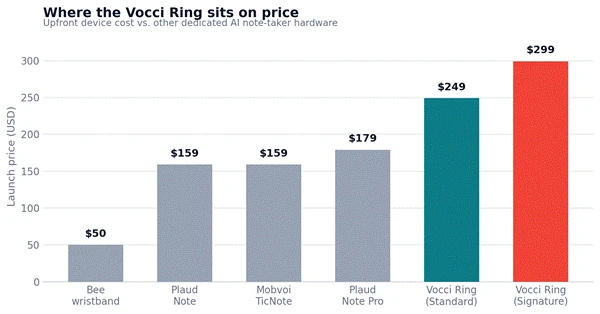
For context on the broader field, here is how the ring lines up against the devices it is competing with:
| Device | Form factor | Price | Positioning |
|---|---|---|---|
| Vocci Ring | Ring | $249 | Meeting note-taking as the core use; discreet, sub-6g |
| Plaud Note | Card | $159 | Sticks to phone back; 300 free transcription min/mo |
| Plaud Note Pro | Card | $179 | AMOLED display, 4 mics, dual in-person/call mode |
| Plaud NotePin | Pin / pendant | ~$179 | Clip, pendant or wristband; hands-free capture |
| Mobvoi TicNote | Card | $159 | 600 free min; real-time translation, 120+ languages |
| Bee | Wristband | ~$50 | Always-listening; daily recaps and to-do lists |
| Pebble Index 01 | Ring | n/a | Hold-to-note reminders, not meeting-first |
Plaud, the category’s most established name, sells its card-shaped Note at $159 and expects to book around $500 million in sales in 2026, a signal of how quickly demand for this hardware is growing. Newer entrants like Pocket reportedly reached tens of millions in annualised revenue within months. Vocci is betting a slice of that market will pay extra to avoid carrying, clipping or sticking on anything at all.
Where this is heading
Vocci’s ring is best understood as an early, promising entry in a market still searching for its default shape. It nails a real problem, the mental load of trying to remember everything said in a conversation with the least intrusive wearable yet. But the software has catching up to do, the price sits above the field, and the privacy trade-offs are not incidental; they are designed in.
The note-taker hardware race is still wide open, with cards, pins, pendants, wristbands and now rings all competing for the same use case. Expect more variety before buyers settle on the formats that actually stick. For now, the Vocci Ring is a compelling proof of concept for people who want capture without carrying a gadget provided they are comfortable with what an invisible recorder means for everyone else in the room.