Harvard Is Letting Founders Pitch to AI Versions of Its Teachers
by Michael Hicklen - 1 month ago - 4 min read
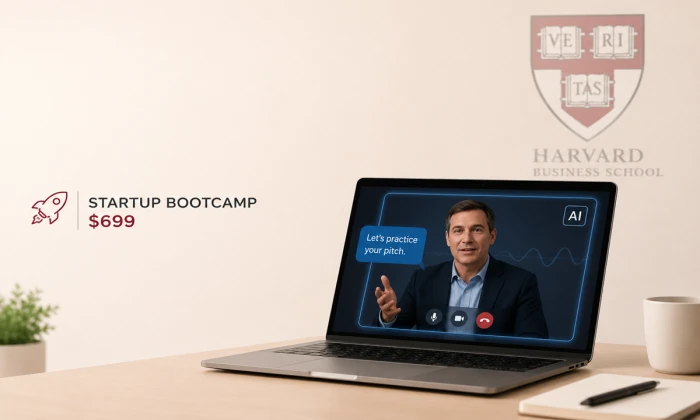
What if an entrepreneur could practice a bad pitch in front of a Harvard Business School instructor without actually taking up that instructor’s time?
Harvard Business School is testing exactly that idea through HBS Foundry, an eight-week startup bootcamp that costs $699 and combines live human teaching with AI-generated versions of its instructors.
The avatars, created using technology from AI video startup HeyGen, are being used for situations where repetition matters most: practice investor pitches, board meetings and other high-pressure founder conversations. Participants still attend live sessions with real instructors each week, but the digital versions can provide additional practice and feedback.
This Is Less About AI Lectures and More About Practice
The unusual part of the experiment is what Harvard is not doing.
It isn't simply turning recorded lectures into AI videos. Instead, Foundry is treating an instructor's digital likeness as a simulation partner.
New York Times reporter Sarah Kessler tested the system by pitching an AI version of Jeff Bussgang, the Flybridge Capital co-founder who teaches at HBS. Her fictional idea was essentially an “Uber for bananas.”
Neither Bussgang nor his AI counterpart was particularly convinced. But the test also exposed one of the technology's remaining weaknesses: Kessler noticed the avatar maintaining an unnaturally frozen smile while listening.
Bussgang himself acknowledged that seeing his digital copy can feel “a little creepy,” although he said his students have responded positively to it.
Why Harvard Wants to Scale Beyond the Classroom
The numbers help explain why HBS is experimenting with this model.
Harvard Business School’s MBA Class of 2027 has 943 students, selected from 9,409 applications. The school reports a 12% acceptance rate for the class. Foundry, by contrast, is being built as a digital workspace for aspiring and early-stage founders beyond the traditional MBA pipeline.
The $699 program is not an MBA substitute, but the price difference illustrates the kind of audience it can reach. HBS says average tuition and fees for the two-year MBA Class of 2026 were about $172,000, with an estimated two-year student budget of roughly $245,000 for a single student.
Foundry also doesn't require participants to arrive with a polished pitch deck or technical background. The program is built around moving an idea through market mapping, customer validation, business-model development and eventually a funding-ready pitch.
AI Is Doing the Repetitive Work
Project director Katharina Rings reportedly began with a much simpler idea: a chatbot.
Feedback from early users pushed the project toward something more guided and interactive. That is where the avatars become important.
A founder can rehearse the same pitch repeatedly, test different answers and experience something closer to a face-to-face meeting without needing another human instructor for every attempt.
HBS says its Foundry platform also uses AI agents for tasks such as market mapping, competitive analysis and customer discovery. The school says participant materials are not sold, shared or used for model training, while founders retain their intellectual property and Foundry takes no equity.
HeyGen Has Become Much More Than an Avatar Demo
Harvard's technology partner is also significant.
HeyGen raised $60 million in a Benchmark-led funding round in June 2024 that valued the AI video company at $500 million, bringing its total funding at the time to around $74 million. The company had more than 40,000 customers and annual revenue of roughly $35 million around that period.
The Harvard deployment shows another possible market for the technology: turning expert knowledge into interactive training that can be repeated at scale.
The Bigger Experiment Comes After the Avatar
Foundry is ultimately testing whether some of the value of expert coaching can be separated from an expert's limited calendar.
Selected founders can progress from the bootcamp into Foundry Catalyst, with HBS advertising an opportunity to eventually compete for up to $100,000 in funding in 2027.
The AI instructor may still smile at the wrong moment, and Harvard has not yet published evidence showing that avatar coaching produces better startups or better fundraising outcomes.
But the model is worth watching. If universities can make professors available once for live teaching and then use their AI counterparts for dozens or thousands of individual practice sessions, AI avatars could become less of a video-generation novelty and more of a new layer in professional education.