Meta Launches Muse Code AI Agent for Large Codebases
by Vivek Gupta - 1 month ago - 5 min read
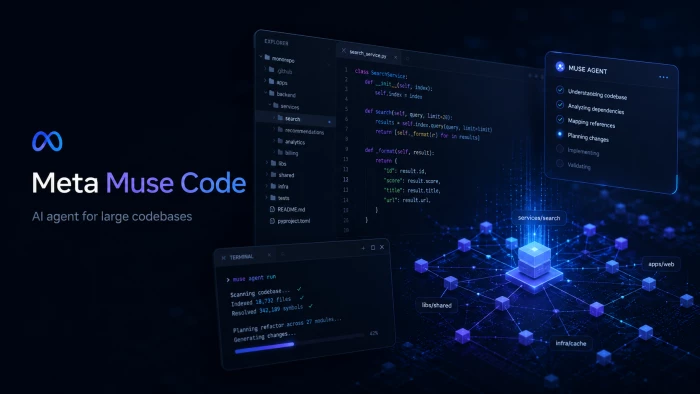
Meta has entered the increasingly competitive AI coding-agent market with Muse Code, a terminal-based assistant designed to complete complex software engineering work across large repositories. Released in beta on August 5, Muse Code is powered by the company’s new Muse Spark 1.2 model and is available for macOS and Linux.
Unlike code-completion tools that mainly suggest individual functions or lines, Muse Code is intended to manage broader development workflows. Meta says the agent can inspect a repository, plan changes, write code, run tools and validate whether its changes work correctly.
Meta Targets Repository-Scale Development
Muse Code operates directly through the terminal and can be installed with a single command. The agent is designed for long-running assignments such as debugging complex systems, implementing features, completing code migrations and making coordinated changes across multiple files.
For larger jobs, Muse Code can distribute work among multiple persistent subagents. These agents continue operating throughout a session instead of being created separately for every small task, reducing repeated repository analysis and allowing several parts of a project to be handled simultaneously.
Meta CEO Mark Zuckerberg said the company tested this approach by asking Muse Code to build six game features at the same time. The subagents worked inside isolated Git worktrees, preventing them from interfering with the developer’s active working copy or colliding with one another’s changes.
Persistent Activity Logs Help Long Tasks Survive Crashes
One of Muse Code’s more practical features is its local, append-only event log. Every model call, tool execution, approval and file edit is recorded as part of the session history.
Meta describes the system as “replay-exact” and restart-safe. When the agent or terminal crashes, Muse Code can resume from the point where it stopped rather than repeating the entire task. This architecture is particularly relevant for development jobs that may require hundreds of tool calls or several hours of testing.
The beta also includes three built-in commands. The /plan skill creates an approval-gated implementation plan, /grill challenges the plan to identify weaknesses, and /goal keeps the agent working toward a defined completion target.
Muse Spark 1.2 Gets a Coding-Focused Upgrade
Muse Spark 1.2 is a coding-focused update released less than a month after Meta opened Muse Spark 1.1 to developers. Meta says it increased the model’s training compute for coding, expanded the variety of training environments and improved its ability to understand large codebases, debug complicated problems and maintain progress across extended workflows.
The model and coding agent were co-trained rather than developed as separate products. Meta incorporated Muse Code’s tools, subagent system, planning process and context-compaction behaviour into the model’s training so that the two could operate more effectively together.
Meta also used Muse Spark 1.1 to generate difficult programming environments and instruction-following challenges. Candidate solutions were then graded against those requirements, creating additional training material for Muse Spark 1.2.
Early Benchmark Numbers Come With Caveats
In Meta’s evaluation, Muse Spark 1.2 running inside Muse Code scored 82.9% on Terminal-Bench 2.1, a benchmark covering 89 terminal-based tasks. The reported result placed it slightly above GPT-5.6 Terra running in Codex at 81.8%, although vendor-run benchmark comparisons should not be treated as definitive proof of real-world superiority.
Meta evaluated each competing model with its associated coding agent rather than using one identical harness. The company acknowledged that its testing setup may not have been optimized for third-party models and therefore may not represent their best possible performance. Its DeepSWE evaluation covered 113 tasks from 91 repositories across TypeScript, Go, Python, JavaScript and Rust.
In a separate GPU-kernel experiment, Muse Spark 1.2 completed more than 1,000 tool calls over sessions lasting up to 24 hours. The agent repeatedly wrote, compiled, profiled and optimized Triton kernels for Nvidia Hopper GPUs, demonstrating the kind of extended technical workflow Meta wants Muse Code to support.
Lower Pricing Becomes Meta’s Main Competitive Lever
Muse Code uses the Meta Model API under a pay-as-you-go model. Standard Muse Spark 1.2 pricing is $1.25 per million input tokens, $0.15 per million cached-input tokens and $4.25 per million output tokens.
Meta is also offering a substantially cheaper contributor tier for users who permit their activity to be used to improve Meta’s products. That option could attract independent developers and startups, but companies working with confidential or proprietary source code will need to review the data terms carefully before enabling it.
Meta Joins the Coding-Agent Race
Muse Code places Meta in direct competition with Anthropic’s Claude Code, OpenAI’s Codex and a growing number of terminal-based development agents. Its strongest differentiators are not basic code generation, which is now widely available, but persistent parallel agents, crash recovery, repository-scale planning and comparatively low usage costs.
The beta still needs independent testing on real production repositories. However, its launch shows that Meta is no longer treating AI coding as a secondary model capability. The company is now building the model, developer interface and agent runtime as one integrated product—and using aggressive pricing to gain ground in one of the fastest-growing segments of enterprise AI.