Social Media’s Next Shift: Feeds Users Can Control
by Cheshta Upmanyu - 3 months ago - 6 min read
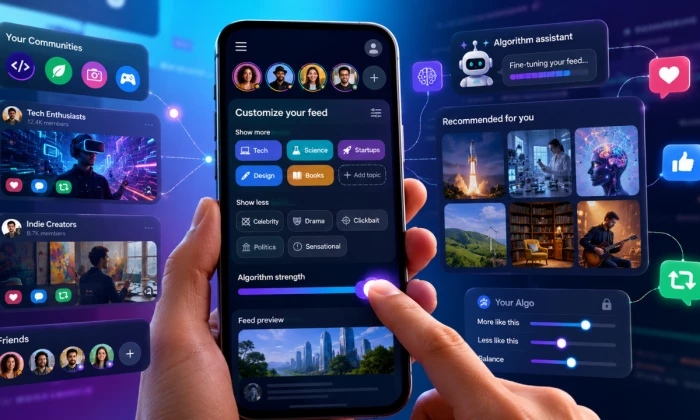
Social media may be entering a new phase where users get more control over what algorithms show them.
For years, platforms decided what appeared in people’s feeds based on engagement, watch time, clicks, likes and predicted interest. Now, apps such as Threads and Bluesky are testing a different idea: letting users actively shape the algorithm instead of only reacting to it.
The shift is still early, but it could change how people discover content, follow communities and manage their online experience.
Threads Moves From Public Prompts to Private Feed Control
Meta’s Threads is one of the latest major platforms to test user-controlled algorithms.
In February 2026, Threads introduced Dear Algo, an AI-powered feature that allowed users to publicly tell the app what topics they wanted to see more or less of. For example, a user could post a request asking the feed to show more sports, books, startups or local news. Meta said the feature was designed to temporarily adjust feed recommendations.
Threads has now expanded that idea with Your Algo, a more private version that lets users shape their feed without posting those preferences publicly. The feature launched as Threads crossed 500 million monthly active users, showing that Meta is combining growth with more personalization controls.
Bluesky Helped Popularize Algorithmic Choice
Before Threads brought the idea to a mass Meta-owned platform, Bluesky had already made algorithmic choice one of its main selling points.
Bluesky’s custom feeds allow third-party developers to build feeds that users can install and choose from. Instead of one central platform algorithm deciding everything, users can follow different feeds based on interests, communities or moderation preferences. Bluesky described this as giving users more choice over one of the most important parts of social media: the feed.
This model is different from traditional platforms because the feed itself becomes something users can select, switch and customize.
From One Algorithm to Many Algorithms
The old social media model was built around one powerful platform-controlled algorithm.
That system worked well for growth because it kept users engaged. But it also created problems: users often felt trapped by content they did not ask for, creators complained about unpredictable reach, and regulators questioned whether recommendation systems were pushing harmful or addictive content.
User-controlled algorithms suggest a different model. Instead of asking people to accept one feed, platforms may offer multiple ways to sort, filter and personalize content.
A user could choose feeds for:
- Close friends
- Breaking news
- Local updates
- Professional topics
- Hobbies
- Positive content
- Long-form discussions
- Posts from smaller creators
- Chronological updates
This would make social media feel less like a black box and more like a personal dashboard.
The Trust Problem Around Feeds
The push toward user control is also connected to growing public concern about algorithmic influence.
Recent lawsuits and proposed regulations in several countries have focused on how recommendation algorithms affect young users, mental health and exposure to harmful content. Reuters recently reported on legal action in Italy against Meta and TikTok over claims that algorithm-driven recommendations contributed to harm among minors.
Governments are also moving toward stricter controls. The UK has announced plans for a social media ban for under-16s, with attention on platforms that use algorithms and user-to-user interaction.
Against that background, giving users more algorithmic control can also be seen as a trust-building move.
Creator Visibility Could Change
User-controlled algorithms may also affect creators.
Today, creators often optimize for platform signals they do not fully understand. They post at certain times, chase engagement patterns and adjust content based on sudden changes in reach.
If users can choose or train feeds more directly, creators may need to focus less on gaming a single algorithm and more on serving specific communities.
This could benefit niche creators. A small expert in AI, finance, books, gaming or fitness might perform better inside a custom feed built around that topic than in a broad algorithm competing with viral entertainment.
The Main Challenge: Controls Must Be Simple
Giving users control sounds good, but it can easily become confusing.
Most users do not want to manually design complex ranking systems. They want simple options that improve the feed quickly.
Recent research on customizable social feeds has found that users want more agency, but usability remains a major barrier. If controls are too technical, people may ignore them. If controls are too vague, they may not feel useful.
This is where AI may help. Instead of making users adjust dozens of settings, platforms can let them describe what they want in plain language.
AI Could Become the Feed Editor
The next version of social media feeds may work more like an AI editor.
A user might say:
“Show me more serious AI news, fewer celebrity posts, more indie creators, less rage-bait and more local events.”
The platform could then adjust recommendations based on that instruction.
This is the direction Threads appears to be testing with Dear Algo and Your Algo. Bluesky’s custom feeds show another path, where developers and communities build feed experiences users can choose from.
Both approaches point toward the same larger trend: the feed is becoming more programmable.
Risks and Open Questions
User-controlled algorithms will not solve every problem.
Platforms still control the design of the tools, the ranking systems, the available data and the business incentives. If advertising and engagement remain the main business model, platforms may still push content that keeps users active.
There is also a moderation risk. Custom feeds could help users find better communities, but they could also create narrower information bubbles if not designed carefully.
The real test will be whether platforms give users meaningful control or only lightweight settings that create the feeling of control.
Final Take
Social media’s next evolution may not be a new app. It may be a new relationship between users and algorithms.
Threads, Bluesky and other platforms are showing that people want more say over what appears in their feeds. They do not want every recommendation decided by invisible systems optimized only for engagement.
User-controlled algorithms could make social media more personal, more transparent and more community-driven. But for this shift to matter, platforms must make the controls easy, honest and powerful enough to change the experience.
The future feed may not be one algorithm for everyone. It may be an algorithm users can finally shape for themselves.