Yope Raises $12.3M for Algorithm-Free Social Networking
by Vivek Gupta - 2 months ago - 5 min read
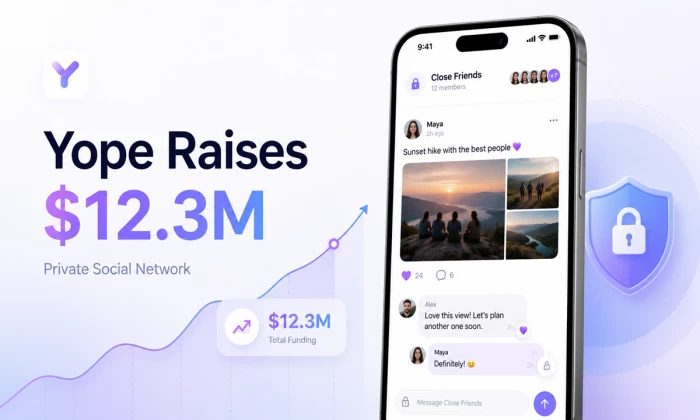
Private social networking app Yope has raised $12.3 million in seed funding to expand its platform built around closed groups, real-life friendships and content sharing without public feeds or advertising.
The round was led by Northzone, with participation from Inovo, Redseed and Geek Ventures. The latest investment brings Yope’s total funding to around $20 million.
Unlike Instagram, TikTok and other major platforms, Yope does not rely on public profiles, follower counts or algorithmically recommended content. Users create private groups and share photos, videos, messages and stickers only with invited friends and family members.
Yope’s funding and growth figures
| Metric | Reported figure |
|---|---|
| Latest funding | $12.3 million |
| Total funding raised | Around $20 million |
| Registered users | Nearly 15 million |
| Weekly content shares | 10–20 million |
| Frequent users | Over 50% use it at least five days weekly |
| Google Play downloads | More than 5 million |
| Current workforce | Around 35 employees |
The company says more than half of its users open the app at least five days per week. Yope users also share between 10 million and 20 million pieces of content weekly.
Google Play separately shows more than five million Android downloads, alongside tens of thousands of user reviews.
A social network designed for smaller groups
Yope positions itself as an alternative to public social media. Accounts are private by default, and users can only interact with people they intentionally invite.
Shared photos and videos appear on collaborative group walls. Content can also be displayed through smartphone home-screen and lock-screen widgets, allowing friends to see updates without scrolling through a conventional feed.
The app includes group messaging, photo chats, streaks, stickers and automated recaps. However, it does not currently offer public discovery, influencer profiles or viral recommendation feeds.
This makes Yope closer to a combination of a private Instagram account, a WhatsApp group and a photo widget app.
Research pointed to growing public-posting fatigue
Yope CEO Bahram Ismailau said the company analysed more than 100,000 interviews about the online behaviour of younger users.
The research suggested that many people still want to share photos and personal moments but are becoming less comfortable posting them publicly. Some users maintain secondary “photo dump” accounts, while others increasingly share through private messages and small group chats.
Yope is betting that this behavioural shift could support a new type of social network focused on existing relationships rather than audience growth.
The current product emerged after a 2024 pivot
Yope was founded in 2021 by Bahram Ismailau and Paul Rudkouski. Before launching its current product, the team experimented with several communication and video-based applications.
The company moved towards private photo sharing in September 2024. By February 2025, it reported 2.2 million monthly active users, 800,000 daily active users and 40% seven-day retention.
Its latest figure of nearly 15 million registered users cannot be directly compared with monthly active users. However, the reported weekly sharing volume indicates that a significant number of users continue to interact after downloading the app.
AI will focus on group activities
Yope describes itself as an AI-native social platform, although it does not plan to centre the experience around AI-generated posts.
Instead, artificial intelligence will be used to create group recaps, personalized mini-games and shared activities based on conversations and user interests.
The company also plans to explore AI tools that could help groups organize offline plans, including finding events, booking tickets or choosing nearby restaurants.
Yope plans to monetize without feed advertising
The app is currently free on Android and iOS. Yope plans to generate revenue through optional premium subscriptions rather than conventional social-media advertising.
Paid features could include deeper profile customization, advanced content tools and additional functionality for highly active groups.
The subscription model will be a major test for the company. Advertising allows large platforms to monetize users without charging them directly, while Yope will need to convince enough users to pay for optional features.
Its legal documents also reserve the right to introduce advertising in the future. This does not mean Yope currently operates an ad-supported feed, but it means the platform’s policies do not permanently guarantee an advertising-free service.
Private sharing still involves data collection
Yope’s privacy-focused positioning mainly refers to content visibility. Posts and group albums are limited to invited users rather than being published publicly.
The app still collects information needed to run the service, including account details, phone numbers, uploaded content, device information, IP addresses and usage data.
Its Google Play disclosure states that user data is encrypted in transit and that deletion requests are supported.
Yope therefore offers a more closed social experience, but private groups should not be confused with zero data collection.
Funding will support expansion and hiring
Yope plans to use the new capital to develop more features, expand its approximately 35-person team and establish an office in the United States.
The company is also trying to grow beyond younger users. Around 20% of active users have reportedly invited an older family member, suggesting that private family groups could become another important market.
Yope’s early engagement figures are promising, but its long-term performance will depend on user retention, subscription adoption and whether private sharing can support a sustainable standalone social network.