WhatsApp Launches Cross-Device Updates for CarPlay and iPad
by Michael Hicklen - 2 months ago - 4 min read
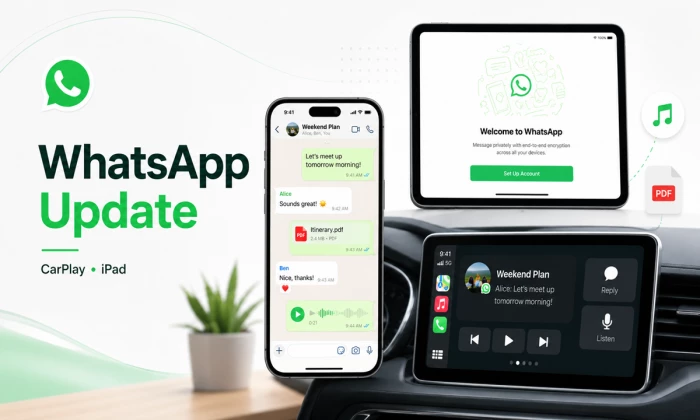
WhatsApp is rolling out a major cross-device update that introduces direct account registration on iPad, redesigned Apple CarPlay and Android Auto experiences, built-in PDF tools, and easier music sharing through Status.
Meta announced the updates on July 22, 2026, describing them as part of a broader effort to make WhatsApp work more smoothly across tablets, cars, computers and third-party applications. The features are already being released globally, although availability may vary as the rollout reaches users gradually.
WhatsApp’s latest updates at a glance
| Feature | Main improvement | Supported platform |
|---|---|---|
| Direct account setup | Create a WhatsApp account without first linking a phone account | iPad |
| In-car redesign | Hear and answer messages, make calls and access favourites | CarPlay and Android Auto |
| PDF integration | Open, review, highlight and annotate documents inside chats | WhatsApp Web and Windows |
| Music sharing | Post songs directly to WhatsApp Status | Spotify and Apple Music |
iPad users can now create an account directly
WhatsApp launched its dedicated iPad application in May 2025, but the original version primarily worked as a linked device connected to an account already established on a smartphone.
The latest change allows users to register and set up WhatsApp directly through the iPad app. This removes one of the largest limitations of the tablet version and makes the iPad a more practical primary device for messaging and calling.
WhatsApp’s iPad app already supports voice and video calls with as many as 32 participants, screen sharing, Apple Pencil, Magic Keyboard and iPadOS multitasking features such as Split View and Stage Manager.
CarPlay and Android Auto receive a fuller WhatsApp experience
WhatsApp has also refreshed its integration with Apple CarPlay and Android Auto.
Drivers can now hear incoming messages, respond hands-free, make WhatsApp calls, view their call history and quickly reach favourite contacts through the vehicle’s screen. The redesign moves the service beyond its earlier, more limited voice-command functionality.
The update is designed to reduce the need to handle a phone while driving. However, users should still rely on voice controls and avoid interacting with complex menus when the vehicle is moving.
Adobe brings PDF tools directly into WhatsApp
WhatsApp Web and the Windows app are receiving Acrobat-powered PDF support through a partnership with Adobe.
Users can open PDF files directly inside a conversation without downloading them first. Documents can be viewed full-screen, zoomed, highlighted, underlined, crossed out or marked with drawings before being shared back into the chat. Password-protected PDFs are also supported.
More advanced tasks, including editing, signing, organising files, applying password protection and using Acrobat’s AI Assistant, require users to open the document in Acrobat. Some of these capabilities require an Adobe subscription.
Adobe said the integration is available globally on WhatsApp Web and Windows. The company also noted that personal documents shared through chats remain protected by WhatsApp’s end-to-end encryption.
Spotify and Apple Music songs can be shared to Status
WhatsApp is also adding direct Status sharing from Spotify and Apple Music.
Users can select a song in either music service and publish it to their WhatsApp Status with a few taps. The feature gives WhatsApp another lightweight social-sharing option while allowing users to show friends what they are currently listening to.
The addition follows Meta’s wider effort to develop WhatsApp Status and Channels alongside its core private-messaging experience. The Updates tab, which contains Status and Channels, was already being used by approximately 1.5 billion people per day as of June 2025.
WhatsApp is becoming less dependent on smartphones
The latest update reflects WhatsApp’s transition from a phone-centred messaging app into a wider communication platform.
Adobe estimates that WhatsApp serves around three billion users worldwide. Adding independent iPad setup, improved in-car controls and deeper desktop document tools allows Meta to increase usage without requiring people to remain inside the smartphone app.
The changes are practical rather than dramatic, but they address several long-standing limitations. Direct iPad registration makes the tablet app more independent, the in-car redesign improves access to calls and messages, and Adobe’s integration turns WhatsApp into a more useful tool for document-based work.
Because the features are rolling out in stages, some users may not see them immediately even after updating the application.