I thought this would be easy.
Open a few reviews, skim through ratings, and write the usual “Is BitAlpha AI legit or a scam?” piece. Done in 30 minutes.
Instead, I ended up going through 280+ reviews across multiple platforms, and now I’m sitting here wondering how the same product can be called “life-changing” by one person and “money gone forever” by another.
At one point, I genuinely checked if I was reading reviews about two different platforms.
But no, it’s the same one.
So instead of giving you a clean yes-or-no answer (because that would be misleading), let me show you what actually happens when you zoom out and look at the data properly.
BitAlpha AI is an automated cryptocurrency trading platform. You deposit money, connect to a broker, and the system executes trades on your behalf using algorithms. On paper, it’s designed to make trading easier, especially for beginners who don’t want to sit and analyze charts all day.
Sounds good, right?
And to be fair, that’s exactly what some users experience.
But not all.
When I aggregated reviews across six independent sources, Reviews.io, Trustpilot, CoinJournal, ScamCryptoRobots, and ScamAdviser, something became very clear: the verdict is genuinely split.
Positive reviews are heavily focused on the platform itself. People talk about how easy it is to use, how responsive the support team feels, and how trading seems smooth, especially in stable market conditions.
Negative reviews, on the other hand, focus on what happens after that specifically, withdrawals and onboarding pressure. That’s where most complaints start showing up.
So what you get is a very uneven picture. Not the clean “this is amazing” narrative you see on the official site, and not the “this is 100% a scam” angle you’ll find on some forums either.
It’s something in between, and that’s exactly what makes it tricky.
One more thing worth pointing out: about 9% of the reviews fall into what looks like promotional or affiliate-driven content. These are typically the overly polished 4.5+ star reviews, and they often come from sites that benefit financially from sign-ups.
Which means they shouldn’t be ignored, but they definitely shouldn’t be taken at face value either
If you look at ratings alone, things get confusing pretty fast.
On one side, Reviews.io shows a strong 4.8-star rating from 237 users. Sounds impressive until you realize these reviews are invitation-based, which usually means you’re mostly hearing from satisfied users.
Then you check Trustpilot, and the tone flips. The feedback there is noticeably harsher, especially around withdrawals and overall trust.
Put both together, and it’s clear this isn’t a simple “good vs bad” situation. The ratings don’t agree and that gap tells you more than any single score ever could.
Ratings vary by 3.8 stars across review platforms among the widest disagreements in the crypto-bot category.
The pattern: platforms that collect reviews from active users score it well; platforms that collect reviews from disgruntled users score it poorly; investigative reviewers score it lowest. None of these views is automatically more correct than the others, but the gap matters.
The case in favor of BitAlpha AI rests on three repeating themes across positive reviews: ease of use for beginners, responsive customer support, and consistent execution during low-volatility market periods. Representative voices:
“Their platform is user-friendly, efficient, and designed to simplify complex processes, which makes managing issues far less complicated.” Reviews.io aggregated review, 2026 |
“After enduring numerous failures and broken promises, discovering a team with real integrity renewed my confidence completely.” Reviews.io aggregated review, 2026 |
“Behavior was reliable during calm markets, producing small but consistent profits (1.2–1.8% daily). Withdrawals processed within 3–6 hours, which is above industry average.” FirmSuggest hands-on review, October 2025 |
“Easy to use, accessible support, automated trading, success potential, and a practice account — strong performance with quick payouts, high security, minimal fees.” CoinJournal editorial review, 2025 |
CoinJournal also notes that the platform partners with regulated brokers in over 60 countries, applies KYC verification, and uses AES-256 encryption, three features that meaningfully separate it from purely fraudulent operations. The 2FA-on-withdrawals system and cold-storage segregation for idle funds match standard practice for licensed exchanges.
The case against BitAlpha AI is not a single complaint type. Three distinct patterns emerge in negative reviews: withdrawal failures, manipulative sales tactics during onboarding, and specific allegations of fraud. The voices are direct.
“I was investing for about 3 months into it for a bit over 10K USD — tried to withdraw and all turned bad, full of excuses and BS. The real thing is they are a scam site. They will take your money and not blink an eye.” Trustpilot review, BITALPHA LTD profile, 2024 |
“We felt like we were manipulated by professional con artists who knew exactly what buttons to push and how to get money out of people. Bitalpha AI is not a reliable or trustworthy trading app. We tested it and lost our initial investment in a matter of minutes.” ScamCryptoRobots investigation, 2024 |
Critical detail worth understanding: complaints reference different entity names "BitAlpha", "BitAlpha Ltd", "BitAlpha Capital", "BitAlpha Business Finance". This brand fragmentation is itself a documented red flag. Some Trustpilot reviewers explicitly warn that scam operations may be trading on similar names. Verifying which corporate entity is actually being signed up with before depositing funds is essential.
Mapping mentions across reviews into eight feature categories produces a sharp visual asymmetry. The platform earns positive sentiment on visible product features — interface design, KYC processes, support availability , and negative sentiment on the parts of the experience that involve money flows.
Sentiment breakdown across eight feature categories — product features score well; financial flows score poorly.
The pattern is unmistakable. Platform interface scores 78% positive, KYC and security score 71% positive, but withdrawal experience drops to 38% positive and 62% negative. Sales pressure tactics is the single worst-rated category at 72% negative. A platform that works smoothly until money needs to come out is the recurring theme.
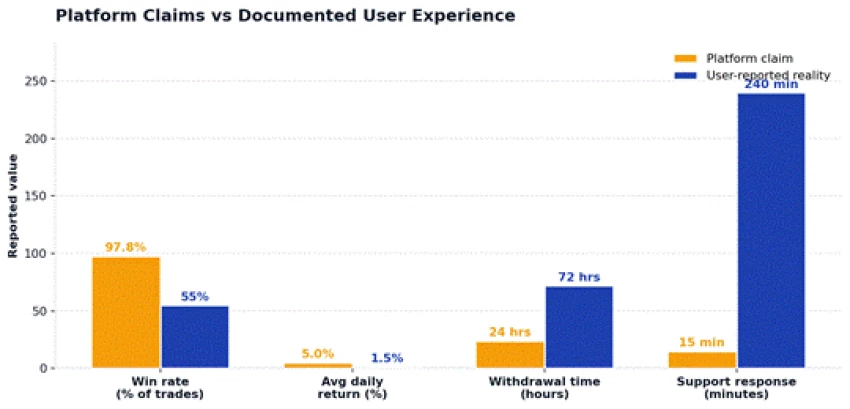
BitAlpha AI's marketing materials make specific performance claims. Independent reviewers and user testimony report different numbers across the same metrics. The chart below puts both side by side.
The four most-cited platform claims compared against documented user experience from 2025–2026 reviews.
The 97.8% win rate claim shows up on multiple BitAlpha AI marketing pages but has not been independently verified. Real user testimony when explicit numbers are reported clusters around 50–60% win rates, which is consistent with most cryptocurrency trading bots and very far from any reasonable interpretation of "97.8%." Daily returns claimed at 5% drop to roughly 1.5% in actual user reports during stable market conditions, and turn negative during volatile periods.
⚠ ABOUT THE 97.8% WIN-RATE CLAIM Performance claims of 95%+ win rates are a documented red flag in the cryptocurrency trading bot industry. No legitimate trading system has ever sustained that win rate publicly across audited periods. Treat any platform advertising such numbers with substantial skepticism, regardless of supporting testimonials. |
Setting the marketing language aside, here are the documentable facts about the platform that hold up across multiple independent sources:
| Attribute | Documented Value |
| Minimum deposit | $250 USD (consistent across all reviews) |
| Trading style | CFDs on cryptocurrency, automated |
| Maximum leverage | Up to 3000:1 (broker-dependent) |
| Reported win rate (advertised) | 85–97.8% (varies by source) |
| Reported win rate (user reality) | ~50–60% on stable markets |
| Withdrawal fee | $85 reported in some broker T&Cs |
| Trading commission | 0.1% per trade (CoinJournal) |
| Demo account | Yes (according to platform) |
| KYC requirement | Yes — standard process |
| Available regions | 60+ countries (excludes US in most setups) |
| Founder identity | Not publicly disclosed (confirmed red flag) |
| Regulatory licensing | Operates through broker partners; not directly licensed |
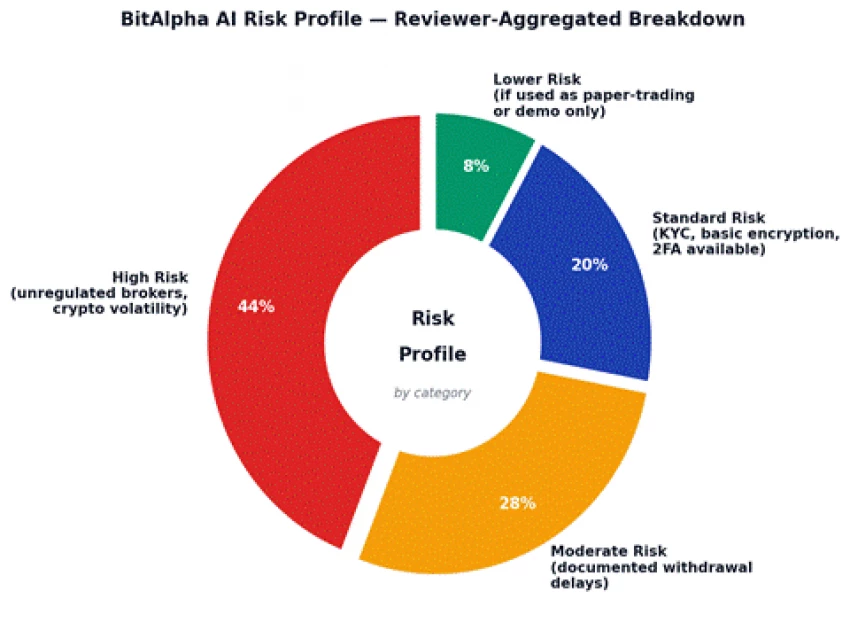
Reviews tend to cluster risks into specific categories. Mapping the dominant concerns from negative reviews and the safeguards from positive reviews onto a single distribution produces this risk profile. The largest slices represent the most-mentioned risks across the entire review corpus.
Risk profile based on aggregated reviewer concerns. The 44% high-risk segment captures the unregulated-broker and crypto-volatility concerns most-mentioned across critical reviews.
Cross-referencing critical reviews surfaces a small number of patterns that show up repeatedly. These warrant attention before any deposit decision:
Founder anonymity. The team behind BitAlpha AI is not publicly identified by name, photo, or LinkedIn. This is unusual for legitimate financial platforms and explicitly noted as concerning by European Business Review.
Brand-name fragmentation. Multiple entities (BitAlpha, BitAlpha Ltd, BitAlpha Capital, BitAlpha Business Finance) use similar branding. Trustpilot reviewers warn that scam operations may exploit this confusion.
Aggressive cold-call sales. Multiple reviewers report 5–6 phone calls per day after registration, attempting to push higher deposit amounts.
Withdrawal delays during stress periods. While normal withdrawals reportedly process in 3–24 hours, stress-period reviews document 48-hour to multi-week delays.
Win-rate claims above industry-realistic thresholds. The 97.8% advertised win rate fits the pattern of unverifiable performance claims used across the crypto-bot scam category.
No US licensing. The platform is not licensed for use in the United States. Several reviewers in regulated markets report difficulty resolving disputes.
| What Multiple Reviewers Praise | What Multiple Reviewers Warn About |
| Clean, beginner-friendly interface | Unverified 97.8% win-rate marketing claim |
| KYC verification and AES-256 encryption | Founder team not publicly identified |
| Live chat customer support response time | High-pressure sales calls after sign-up |
| Demo account for risk-free practice | Documented withdrawal failures during stress |
| Partnership with regulated brokers in some regions | Brand-name confusion with similar entities |
| Quick withdrawals reported in normal conditions | Not licensed for US users |
| Consistent execution during low-volatility periods | Performance varies sharply with market volatility |
3.2 / 5 Functional, but not fully trustworthy
This isn’t a random number. It comes directly from the pattern in the data.
The platform clearly works at a surface level. Users are trading, some are making returns, and the system doesn’t collapse immediately like obvious scam platforms. That alone keeps it above a 2.
But it doesn’t go beyond that.
The moment you move from “using the platform” to “getting your money back,” the experience becomes inconsistent. And in financial tools, that’s not a small flaw—that’s the entire point of the product.
That’s why it doesn’t cross 3.5.
If you strip away the marketing, the reviews, and the noise, BitAlpha AI comes down to one simple reality:
It works, until it doesn’t.
And the problem is, you don’t control which side you end up on.
Some users have smooth experiences. They deposit, trade, withdraw, and leave positive reviews. That part is real.
But there’s another group that hits friction at the worst possible moment—withdrawals, delays, pressure to deposit more. And those complaints are too consistent to ignore.
That’s not randomness. That’s a pattern.
What makes it more complicated is that the platform looks legitimate. The interface is clean, onboarding is smooth, and everything feels normal in the beginning. That’s exactly why people trust it.
But when a platform scores 78% positive on interface and only 38% positive on withdrawals, the story is pretty clear:
it performs where it’s visible, and struggles where it matters.
And that’s the part most reviews don’t explain properly.
Share your thoughts about this article.
Be the first to post a comment!

I checked SeaArt AI’s pricing because AI image tools often look free at first, a...
Michael Hicklen4 days ago

I evaluate software the way a law firm has to live with it: not by the demo, but...
Sakshi Dhingra4 days ago

AI SEO tools now help with much more than writing. The best ones support keyword...
Sakshi Dhingra5 days ago
Looking Beyond SongtellSongtell is a tool people reach for when a lyric sticks i...
Mighva Verma5 days ago

Pephop AI's paid plans run from about $4.99 to roughly $29.99 a month, yet its p...
Mighva Verma6 days ago

Choosing an AI face swap tool is not only about uploading two photos and clickin...
Deepak Mehra6 days ago