Microsoft and Nvidia Bring Nvidia-Powered AI PCs to Windows 11
by Vivek Gupta - 15 hours ago - 7 min read
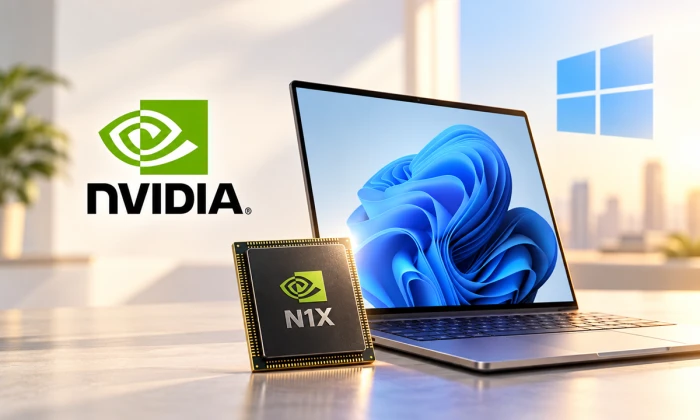
For the first time since the Tegra-powered Surface RT of 2012, Nvidia is back inside a mainstream Windows PC as the main processor rather than an add-in graphics card. At his Computex keynote in Taipei on June 1, 2026, Nvidia chief executive Jensen Huang introduced the N1X marketed to buyers as RTX Spark, an Arm-based system-on-chip co-developed with MediaTek that Microsoft, Dell, HP, Lenovo, ASUS and MSI are using to build a new wave of Windows 11 laptops. The first machines are targeted for the 2026 holiday season, with broader availability slipping into early 2027.
The launch is not just a new chip. It arrives alongside a quietly forked version of Windows 11 built specifically to run this class of Arm silicon well and it reframes a three-year AI-PC marketing push that, until now, has largely been Qualcomm's to carry. The teaser that kicked it off was blunt: Nvidia, the Windows account and Arm all posted the same three words, “A new era of PC,” alongside coordinates pointing at Taipei.
What Nvidia actually shipped
The N1X is the client version of the same Grace Blackwell lineage Nvidia already sells in the data center and in its DGX Spark desktop developer box. In laptop form it pairs a 20-core Arm CPU (two clusters of ten cores on Nvidia's Grace design) with a Blackwell GPU carrying 6,144 CUDA cores, the same shader count as a desktop GeForce RTX 5070 on TSMC's 3 nm process. Top configurations support up to 128 GB of unified LPDDR5X memory, which is the part that matters for AI work: a single shared memory pool large enough to hold very large local models without round-tripping to the cloud.
That memory architecture, plus the full CUDA software stack, is Nvidia's real wedge. Every rival stamps a TOPS number on its marketing; Nvidia's advantage is that the millions of developers and tools already written for CUDA now have a thin-and-light Windows target. The trade-off is power and price. These are not fanless ultrabooks, leaked partner designs include adapters as large as 245 watts on at least one model — and the platform is aimed squarely at creators, AI developers and gamers, not the mass market.
At a glance
| Specification | Nvidia N1X (RTX Spark) |
| CPU | 20-core Arm, Grace architecture (two 10-core clusters) |
| GPU | Blackwell, 6,144 CUDA cores roughly desktop RTX 5070-class |
| Process node | TSMC 3 nm |
| Memory | Unified LPDDR5X, up to 128 GB on top configurations |
| AI throughput | ~180–200 TOPS (vendor figures run higher at low-precision formats) |
| Co-developer | MediaTek; extends Nvidia's Grace Blackwell platform to client devices |
| Positioning | Premium creator, AI-developer and gaming laptops — not a Snapdragon X budget rival |
Figures are drawn from launch coverage and supply-chain leaks; Nvidia confirmed the architecture at Computex but held back final clock speeds, per-SKU memory tiers and pricing until closer to the fall launch.
The Windows 11 that goes with it
The “revamped Windows 11” in the headline is more specific and stranger than a normal annual update. To support the new Arm silicon, Microsoft forked the OS into Windows 11 version 26H1, a release it has openly said is “not intended as a feature update for existing devices and will not be offered through Windows Update.” It ships pre-installed only on new Arm machines and has been rolling out to compatible hardware since February 2026.
26H1 is a platform release, not a visual overhaul. Microsoft moved it onto a new internal kernel branch (internally the shift from “Germanium” to the next cycle), and the changes are mostly under the hood: power management, thread scheduling tuned for Arm core clusters, and updated NPU and GPU drivers. If you own an Intel or AMD PC, you get none of it, your feature path remains the mainstream annual update, Windows 11 26H2, due in the second half of 2026.
The user-facing AI story rides on 26H2 and the broader 2026 roadmap: Copilot Actions, agentic features that let Copilot carry out multi-step tasks on the user's behalf inside a sandboxed workspace, a “Hey Copilot” wake word, Copilot pinned to the taskbar, and an on-device settings agent that can change system options directly from search. Microsoft has been candid that these agentic capabilities are opt-in, a user has to explicitly grant Copilot permission to act. The pitch, in Microsoft's own framing, is a shift from the PC as a tool to the PC as an active collaborator; the N1X is the hardware muscle meant to make that run locally rather than in a Microsoft data center.
Why this is really a fight over Windows on Arm
For all the spectacle, Nvidia is walking into a market that is still small. Analysts at TrendForce peg Windows-on-Arm at roughly 3.2% of notebook shipments in 2026, up from about 1.2% a year earlier, and project it reaching only around 11.5% by 2029. Qualcomm, which has carried the category since the 2024 Copilot+ launch, told investors that about 10% of U.S. retail Windows PC sales priced at $800 and up now run Snapdragon X, real traction, but concentrated at the premium end.
The backdrop is an AI-PC market that is expanding fast overall. Gartner forecasts roughly 143 million AI PC shipments in 2026, about 55% of the total PC market, driven largely by Windows 10's end of support in October 2025 pushing a hardware refresh. The question is how much of that Arm can take from x86 and whether Nvidia's brand and CUDA ecosystem can do what Qualcomm's efficiency argument alone has not.
Nvidia and Qualcomm are not actually chasing the same buyer. Qualcomm has pushed down-market — its Snapdragon X2 Plus tier targets $999–$1,199 machines and it has even floated a Snapdragon C line for roughly €300 laptops. Nvidia is doing the opposite, with the N1X expected to anchor premium devices well north of $1,500 and, by some estimates, up to $3,000 or more. Independent, Qualcomm-commissioned benchmarks this year showed a Snapdragon X2 Elite Extreme laptop beating an Intel Core Ultra machine by over 50% in multi-core tests at a lower price, which is the uncomfortable context Intel and AMD now face from two Arm vendors at once.
The catch: a launch that kept slipping
It is worth being precise about what “released” means here, because the N1X has a long history of slipping. The chip was originally planned for late 2025, then pushed to the first quarter of 2026, and then again toward the second half of the year, delays blamed on a mix of Windows-on-Arm software readiness, Nvidia silicon redesigns and softer notebook demand. Even at Computex, Nvidia confirmed the architecture and partners but committed only to a “fall” window and a “premium price tag,” leaving final configurations, firm retail dates and regional availability unresolved.
So the accurate reading is this: the platform is official, the partner devices are real, Microsoft's Surface line, Dell's XPS 16 Creator Edition, Lenovo, ASUS ProArt and MSI are all named and the supporting Windows build is already in the wild. What is not yet nailed down, as of this autumn, is the thing buyers care about most: exact price, exact ship date and exact configuration. For a product this delayed, that distinction is the story.
The bottom line
Nvidia's return to Windows is the most credible challenge yet to the x86 duopoly, because it brings the one asset Qualcomm never had: CUDA and the developer gravity that comes with it. Microsoft, for its part, has bent Windows itself around the new silicon forking the OS into a hardware-tuned 26H1 branch and lining up its agentic Copilot roadmap to justify all that local compute.
But a “new era of PC” still has to clear two bars it hasn't yet: shipping premium hardware at a price enough people will pay, and proving that Windows-on-Arm app compatibility is finally good enough that a 3% niche can become a mainstream choice. The chips and the operating system are ready. Whether the market is remains the open question heading into 2027.