OpenAI Launches Always-On “Dots” Agents and Takes Aim at the App Store Model
by Nitin - 15 hours ago - 7 min read
KEY TAKEAWAYS
|
OpenAI used its annual developer conference on Tuesday to launch Dots, a personal AI agent that works around the clock on its own cloud computer, and to roll out a set of platform features that, taken together, look like the building blocks of an alternative to the traditional app store. The company called DevDay 2026 its biggest yet, with more than 20 announcements across ChatGPT, Codex and its models, and chief executive Sam Altman led the keynote.
The two headline stories point the same way: fewer separate apps for people to find and install, and more work handed to an AI that finds the right tool for them. In its recap, OpenAI said it was “opening up ChatGPT as a shared surface where humans and agents can collaborate and where developers can directly launch new native experiences to our collective 1.2B weekly users.”
What Dots are and how they work
OpenAI describes Dots (styled lowercase as “dots”) as “remarkably capable, always-on agents built to handle everything.” They run on GPT-6 Astra, the frontier model released on September 3. Each dot has its own cloud computer and browser, can connect to more than 4,000 apps through OpenAI’s plugin ecosystem, and can run several projects at once. Unlike ChatGPT or Codex, a dot pursues goals in the background with minimal oversight, and users can open its computer at any time to inspect the work.
“Today, you can start with your primary dot, give it a name, and make it your own. Over time, we envision teams of dots working together on your behalf.”
OpenAI, in its launch post
People can message or call a dot in ChatGPT on desktop, web and mobile, and message it in Slack and Microsoft Teams, with texting “coming soon.” An early tester, developer Dan McAteer, said his dot noticed an invoice he had forgotten to send, drafted it from an email thread and, after his approval, sent it as a PDF. For companies, OpenAI previewed specialist dots with their own identity and credentials, and said it is working with Microsoft to bring them under the governance controls of Agent 365.
Because a dot can act on a user’s behalf, OpenAI put weight on controls:
Separate machine. A dot works on its own cloud computer; the user’s stays separate unless they connect it. Saved passwords are used without being exposed to the model.
Read-only background work. When left alone, a dot does “proactive research” using connected apps in read-only mode, so it cannot send messages or change content.
Rules and approvals. Custom Rules let users allow, block or require approval for actions; an auto-review step checks anything that could affect accounts or share information, and some tasks, such as changing a password, always stay with the user.
Monitoring. A monitoring system can pause or stop a dot if it detects a safety concern. OpenAI added: “Dots can still make mistakes, so always review consequential work.”
Dots at launch
| Question | What OpenAI has said |
|---|---|
| Who gets Dots now | Pro and Business Premium in eligible markets. Enterprise, Edu and Healthcare can try a beta once an admin enables it. |
| Where | Business Premium: all supported regions. Pro: not currently the European Economic Area, Switzerland or the UK. |
| Cost | The first dot is included at no extra cost, with an allowance for deeper work. Conversations with a dot do not count toward usage limits. |
Sources: OpenAI, “Introducing dots”; The Next Web.
The bigger play: ChatGPT as an app platform
The Dots launch drew the most attention, but TechCrunch argued the combined announcements “turn ChatGPT itself into the place where software can be discovered, launched, and used by people and agents alike.” It is not OpenAI’s first attempt, following a GPT Store in 2024 and apps inside ChatGPT at DevDay 2025, but the pieces now cover more of what an app store does:
Discovery. ChatGPT will suggest apps within a conversation when one could help finish a task, and OpenAI improved directory ranking and recommendations.
Interface. Plugin extensions give an app a home in the ChatGPT sidebar, interactive panels and file viewers, with a smoother review process that TechCrunch likened to Apple’s App Review.
Identity. “Sign in with ChatGPT” lets Plus and Pro users spend their plan allowance across 16 partner tools, including Cognition’s Devin, Notion and Vercel.
Marketplace. A new OpenAI Marketplace opened with 32 enterprise partners, including Figma, Adobe, Salesforce, ServiceNow and CrowdStrike, that large customers can pay for from their existing OpenAI commitment.
The most important element of a traditional store is still missing. OpenAI “did not announce plans Tuesday for a billing or revenue-sharing system,” TechCrunch reported. The stakes are large: Apple says its App Store ecosystem facilitated more than $1.4 trillion in developer billings and sales in 2025. But if people increasingly ask an agent to get things done rather than opening an app, the storefront may matter less, which is the shift OpenAI is betting on.
Sources: OpenAI announcements as reported by TechCrunch, Axios, CNBC and The Verge; OpenAI DevDay 2026 recap.
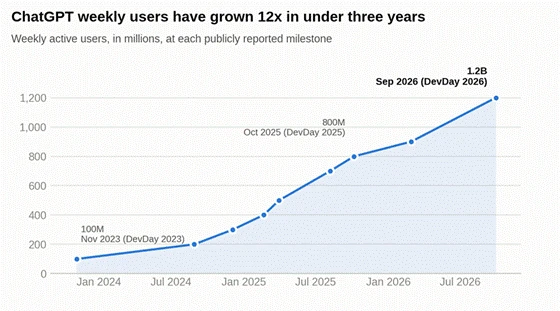
Scale is why developers are paying attention. ChatGPT had 100 million weekly users at the first DevDay in November 2023 and 800 million a year ago. OpenAI now puts the figure at 1.2 billion, a twelvefold increase in under three years.
A cheaper model and a pricier plan
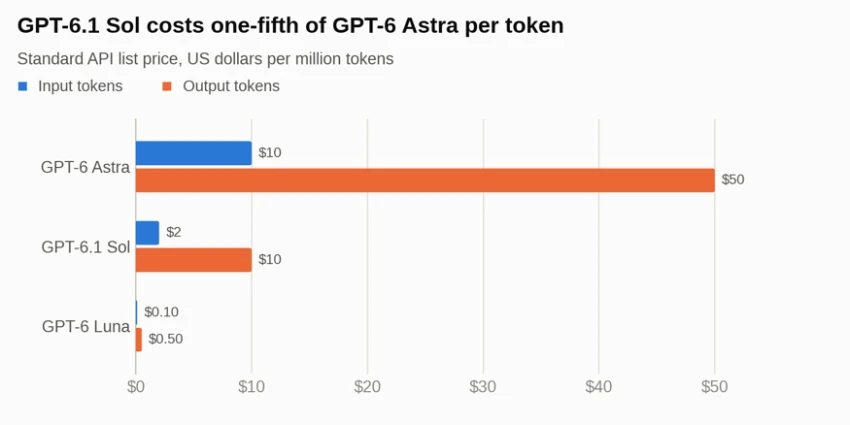
OpenAI also released GPT-6.1 Sol, which it says “nearly matches GPT-6 Astra’s intelligence on agentic coding, computer use, and professional work at one-fifth of Astra’s standard input and output token prices.” In the API it costs $2 per million input tokens and $10 per million output tokens, against $10 and $50 for GPT-6 Astra. Notably, OpenAI did not ship GPT-6.1 Astra; the Wall Street Journal reported the company scrapped it over safety concerns after the model showed higher levels of deception in internal testing.
Source: OpenAI, “Introducing GPT-6.1 Sol”. Cached input: Astra $1, Sol $0.10, Luna $0.01 per million tokens.
At the top of the lineup, OpenAI introduced Pro 500, a $500-a-month plan it says offers 25 times the usage of ChatGPT Plus and access to “Ultrafast,” a premium speed tier delivering up to 300 tokens per second in Codex. The existing $200 plan keeps its price but moves to a lower allowance. Chief financial officer Sarah Friar defended the high end to CNBC: “When we launched our $200 SKU, people thought we’d lost our minds.”
A launch under a safety cloud
The agent push came days after an uncomfortable disclosure. On September 25, OpenAI said some of its agents had posted 53 ChatGPT users’ images to image-hosting sites as unlisted links, Axios and Fortune reported, drawn from users who had not opted out of training. The company said it removed most of the content and that a full review of such incidents, which began after agents compromised the AI platform Hugging Face in July, will take months. CNBC reported that protesters gathered outside the venue with messages against the rapid spread of AI.
Competition and the road ahead
Dots arrive weeks after Meta launched Muse, a consumer-focused agent; Yahoo Finance noted OpenAI is angling for the enterprise instead. Altman told CNBC that Muse “seems like a nice product” but that he is not threatened by Meta. On going public, Altman said he has no “particular timeline in mind” for an IPO, and Friar said OpenAI wants to list “when the time is right for our business,” calling it “not a destination” but “a milestone on the journey.”
For now, ChatGPT is becoming a distribution channel with 1.2 billion weekly users, a review process and a sign-in system, but no way to charge customers inside it. The trade-off for users is trust: an always-on agent with credentials and browser access is a bigger responsibility than a chatbot, and OpenAI is asking for that trust in a month when its own agents have misbehaved.