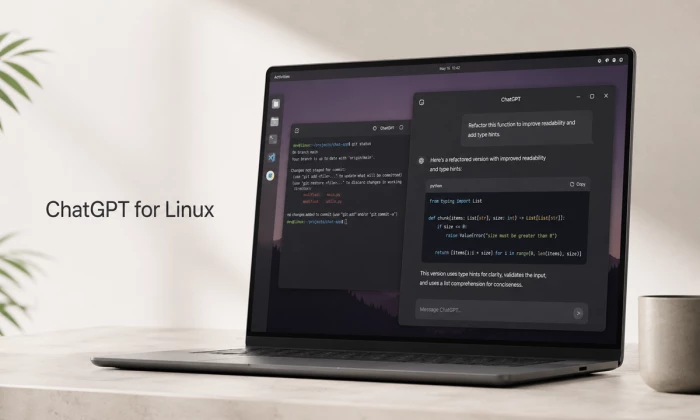
OpenAI has finally released an official ChatGPT desktop application for Linux, filling one of the most obvious gaps in its desktop strategy and giving developers native access to ChatGPT, ChatGPT Work and Codex from Linux machines.
The company announced the Linux version on August 11, 2026, saying the app is available globally in preview. OpenAI described Linux as one of the most requested platforms for its desktop software and said the release brings its desktop experience to every major computer operating system.
The launch is particularly significant because this is more than a desktop wrapper for ordinary ChatGPT. OpenAI is positioning its new desktop software as a combined workspace where users can move between normal ChatGPT conversations, longer agent-driven Work tasks and Codex software-development workflows.
Ubuntu, Debian and Fedora Get First Support
The initial preview supports Ubuntu 24.04 LTS and 26.04 LTS, Debian 13, and Fedora 43 and 44. OpenAI is providing builds for both x64 and ARM64 processors, distributed through .deb and .rpm packages.
That selection covers several of the most important families in the Linux ecosystem. Ubuntu and Debian also serve as the foundation for numerous downstream Linux distributions, meaning the practical compatibility footprint could eventually extend beyond the distributions OpenAI currently lists as officially supported. TechCrunch notes that OpenAI expects some downstream distributions to be compatible, although they should not automatically be treated as officially supported during the preview.
The timing is notable because Linux has become increasingly relevant on desktop systems. Statcounter's July 2026 measurement put Linux at 7.53% of worldwide desktop operating-system usage, compared with 71.18% for Windows.
For OpenAI, however, the more important audience may be developers rather than the overall desktop market.
Linux Fits Directly Into OpenAI's Developer Push
Stack Overflow's 2025 Developer Survey provides some useful context. Among respondents answering its operating-system question, Ubuntu alone was used personally by about 28%, while the survey also found that OpenAI's GPT models were used for development work by 82% of developers who answered its LLM question.
That overlap makes Linux support particularly valuable for Codex.
Inside the desktop application, Codex can work with local folders, repositories, terminals and other development tools. ChatGPT Work, meanwhile, is designed for longer tasks such as researching information, analyzing files and producing documents, spreadsheets, presentations and reports. OpenAI says local Work sessions can access files on a user's computer when permission is granted.
The desktop app also brings projects and browser workflows into the same environment, allowing users to keep more of a development or research task inside ChatGPT rather than constantly switching between the browser, terminal and separate AI tools.
OpenAI Arrives After Anthropic
OpenAI is not the first major AI company to bring its latest desktop agent experience to Linux.
Anthropic introduced Linux support for Claude Desktop earlier this summer. Its beta supports Ubuntu 22.04 or newer and Debian 12 or newer on both x86_64 and ARM64 systems, with Chat, Cowork and Claude Code available inside the application.
That makes the Linux desktop another direct competitive front between OpenAI and Anthropic. Both companies increasingly want their AI systems to sit closer to developers' files, terminals, repositories and day-to-day work instead of existing only as browser chatbots.
OpenAI has an enormous user base to bring into that competition. Earlier in 2026, the company said ChatGPT had around 900 million weekly users, while AP reported that roughly 95% were using the service for free at the time.
The Linux Version Is Still a Preview
The word “preview” matters. OpenAI has not presented the Linux release as fully mature or universally compatible across the hundreds of Linux distributions available.
There may also be differences from macOS and Windows while development continues. OpenAI's current desktop documentation, for example, specifically lists Voice with Work and Codex as a macOS and Windows desktop capability, rather than a Linux feature.
Still, the Linux release closes a long-standing platform gap. Users had been publicly requesting an official Linux version in OpenAI's developer community since at least 2024, with the requests becoming especially frequent as Codex and ChatGPT Work gained deeper access to local development environments.
For OpenAI, Linux may represent a relatively small portion of the overall consumer desktop market, but it reaches an unusually valuable audience: developers, engineers and technical professionals who are among the heaviest users of coding agents.
That makes this less about adding one more operating system and more about putting ChatGPT and Codex directly onto the machines where a significant share of AI-assisted software development already happens.