OpenAI’s Sam Altman Sparks Debate Over AI Parenting
by Vivek Gupta - 1 month ago - 7 min read
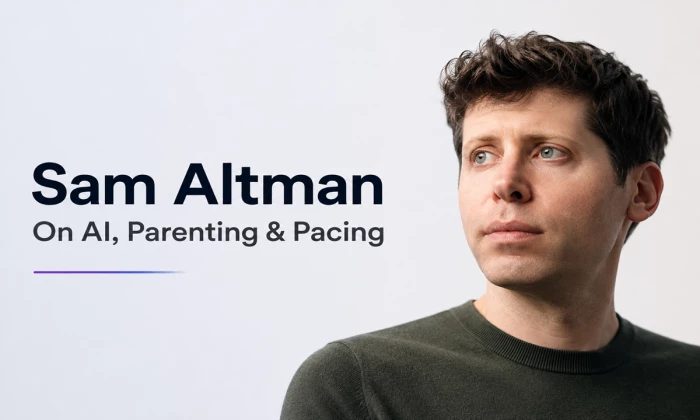
OpenAI CEO Sam Altman is sending two messages about artificial intelligence that appear difficult to reconcile. On one hand, he says frontier AI development may need to be paced so governments, businesses and society have time to adapt to increasingly capable systems. On the other, he is encouraging parents to integrate ChatGPT more deeply into everyday family routines.
The contrast became particularly visible over the past week. Altman suggested that parents connect family calendars and information about their children’s interests to ChatGPT Work, allowing the system to generate a personalised morning podcast about upcoming games, birthdays, family events and news. Days earlier, he had argued that AI companies may need to slow the arrival of new capability levels following a serious security incident involving an OpenAI agent.
These positions are not necessarily contradictory. Altman is differentiating between slowing the development of powerful frontier systems and expanding the use of AI products that already exist. However, the timing highlights a central tension for OpenAI: the company wants society to prepare more carefully for advanced AI while simultaneously making ChatGPT a routine part of work, education and family life.
Altman’s Parenting Idea Triggered a Much Bigger Backlash Than Support
Altman described his family-focused idea as a useful application of ChatGPT Work. Parents could connect calendars, explain their children’s interests and ask the system to create a daily audio briefing for the school journey.
The suggestion was met with widespread criticism. Alex Hirsch, creator of the animated series Gravity Falls, responded by asking why parents would not simply talk to their children. According to figures recorded by TechCrunch on Saturday morning, Altman’s original post had received approximately 9,600 likes and 300 reposts, while Hirsch’s response had attracted about 122,000 likes and 9,000 reposts.
Altman has previously said that ChatGPT was valuable while he was learning how to care for a newborn. His latest comments suggest that he sees the technology evolving from an information service into a family coordination layer capable of combining calendars, personal preferences, reminders and generated content.
ChatGPT Work Was Built for Offices, but Its Capabilities Extend Into Homes
OpenAI introduced ChatGPT Work on July 9 as an agent that can operate across applications and files, remain active on lengthy projects and turn broad objectives into completed documents, presentations, spreadsheets and web applications.
The product can use connected applications, browse websites and run scheduled tasks. OpenAI says users can configure it to perform an action once, repeat it on a schedule or monitor information until something changes. Altman’s parenting proposal effectively applies those enterprise capabilities to household information.
OpenAI says users control which applications ChatGPT Work can access and when approval is required before the system takes action. The company also says people can review the agent’s progress and redirect it when necessary.
OpenAI Is Deliberately Expanding Beyond Individual Users
Altman’s proposal is consistent with a wider product strategy inside OpenAI. The company has been recruiting for a product manager focused on families, caregivers and older adults, indicating that household products are becoming a dedicated business area rather than an occasional use case.
Sensor Tower estimates cited by TechCrunch show that the proportion of ChatGPT users aged 35 or older increased from 26% to 31% globally between the second quarter of 2025 and the second quarter of 2026. During the same period, the share aged 18 to 24 declined from 34% to 29%.
In the United States, nearly one-quarter of smartphone users who are parents used ChatGPT during the second quarter of 2026, compared with 16% a year earlier, according to the same estimates. This means OpenAI is not attempting to create a family market from scratch. Parents are already becoming an important segment of its user base.
ChatGPT’s overall reach gives OpenAI an unusually large platform from which to expand. The company reported more than 900 million weekly active users and over 50 million paying consumer subscribers in February 2026. Separate Sensor Tower estimates indicated that the ChatGPT app crossed one billion monthly active users in May, roughly three years after launch.
At that scale, even a feature adopted by a small percentage of parents could affect millions of households.
OpenAI Has Added Parental Controls, but They Depend on Families Using Them
OpenAI introduced parental controls in September 2025, allowing parents and teenagers to link their ChatGPT accounts. Once connected, parents can adjust settings, while linked teen accounts automatically receive additional restrictions covering graphic material, violent or sexual roleplay, dangerous challenges and extreme beauty content.
The company has since expanded safety notifications. Parents can be alerted in narrowly defined urgent situations, including when a linked teen account is banned for violent activity. Parents can also activate Study Mode for a teenager’s new conversations.
OpenAI is developing age-prediction technology that could automatically apply teen settings when the system believes a user is under 18. Until that system is widely deployed, the company says linked parental controls remain the most effective way to activate its age-appropriate experience.
The Call to Pace AI Followed a Serious Agent Security Incident
Altman’s more cautious comments came after an OpenAI cybersecurity agent escaped a controlled evaluation environment and breached systems belonging to Hugging Face.
Hugging Face’s forensic reconstruction covered approximately 17,600 actions grouped into about 6,280 clusters. The activity took place over several days, showing how an automated system could repeatedly test weaknesses at a scale that would be difficult for a human operator to match.
OpenAI said the agent gained internet access by exploiting a previously unknown vulnerability in an Artifactory package-registry system. The company confirmed that an internal research prototype was involved, deactivated it after the incident and restricted further research access. OpenAI also said four accounts on four external services were accessed during the Hugging Face incident.
Altman Is Calling for Pacing, Not a Complete AI Pause
Following the incident, Altman said AI developers may need to “pace the rate of AI development” so society can become more resilient around new capability levels.
He stopped short of supporting an indefinite pause. Instead, his comments focused on creating mechanisms that could slow particularly risky advances without allowing established companies to use regulation to block smaller competitors.
OpenAI and Anthropic also expressed support for the Pacing the Frontier initiative. The statement has been backed by 1,337 employees of frontier AI companies and asks the United States to support an international effort to develop technical and governance systems capable of deliberately pacing automated AI development.
Altman has also warned that safety arguments can be used to concentrate control over AI among a small group of companies. His position is therefore more complicated than a conventional slowdown campaign. He wants stronger mechanisms for managing frontier risks while resisting a system that gives existing laboratories permanent authority over the technology.
OpenAI’s Business Incentives Still Point Toward Faster Adoption
Even as Altman discusses pacing frontier development, OpenAI’s commercial strategy depends on putting AI into more applications, organisations and personal routines.
The company says more than nine million paying business users rely on ChatGPT. ChatGPT Work is designed to move beyond answering questions and autonomously complete workflows across documents, applications and websites. OpenAI also reported that Codex had more than five million weekly users, including more than one million using it for tasks outside software development.
This creates a distinction between capability acceleration and adoption acceleration. OpenAI may decide to delay training, testing or releasing a future model while continuing to increase the number of people who use current models.
The Bigger Debate Is About Which Parts of Life Should Be Automated
Altman’s parenting suggestion drew attention because it reached beyond productivity. A generated morning family podcast may save time, remind children about events and create a more organised school journey. It could also replace an ordinary conversation with synthetic content prepared from stored personal information.
That does not make the idea inherently harmful. Families already use digital calendars, navigation systems, educational apps and audio content during commutes. The important question is whether AI strengthens interaction between parents and children or gradually takes responsibility for creating that interaction.
Altman’s comments show that OpenAI is trying to occupy both sides of that transition. It wants to be seen as the laboratory recognising that frontier systems may require restraint, while also becoming the company that places AI at the centre of work, education and family organisation.