Relay.app Shuts Down as Founder Joins Google Chrome
by Harpreet Singh - 1 month ago - 4 min read
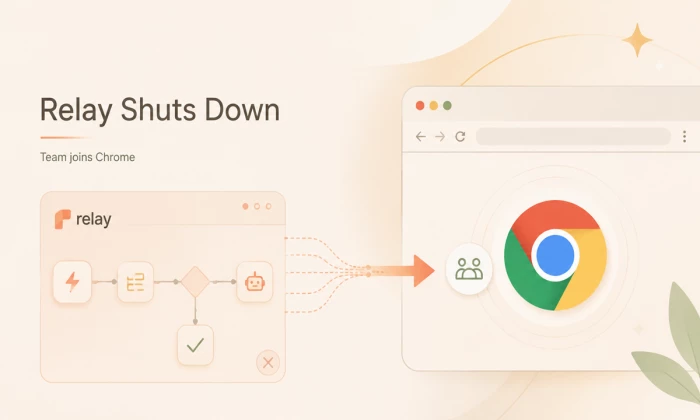
AI workflow automation startup Relay.app is shutting down after roughly five years of operation, with founder and CEO Jacob Bank and some members of the company’s team moving to Google’s Chrome organization.
Relay confirmed that free accounts stopped operating on August 15, 2026, while paying customers will retain access until September 14. The company stopped accepting new signups and upgrades on July 16, when it first disclosed its shutdown plans.
The closure ends an ambitious attempt to build an AI-powered alternative to established automation platforms such as Zapier. But Relay’s technology and team experience could now influence a much larger platform as Google pushes deeper into AI-powered and agentic browsing.
Relay raised $8.1 million to challenge traditional automation platforms
Bank founded Relay after leaving Google in July 2021. The startup initially focused on collaborative workflow automation, allowing businesses to connect tools and automate repetitive processes such as employee onboarding, meetings, document preparation and project management.
In 2022, Relay raised a $5 million seed round led by Khosla Ventures, with participation from Neo, BoxGroup, SV Angel and angel investors. A year later, during its public launch in October 2023, Relay announced another $3.1 million round led by Andreessen Horowitz, bringing disclosed funding to approximately $8.1 million.
By 2023, Relay had expanded beyond conventional trigger-and-action automation by adding AI-powered content generation, information extraction, classification and human approval steps. Its positioning was particularly focused on combining automation with human judgment rather than allowing software to execute every action autonomously.
That approach looks increasingly relevant as AI agents begin taking direct actions inside browsers and business applications.
Jacob Bank returns to Google in a major Chrome product role
Bank is now returning to Google as Vice President of Product for Google Chrome, where he is expected to lead Chrome’s product and developer relations teams. Some Relay employees are also joining the Chrome organization, although neither Relay nor Google has publicly disclosed how many people are making the move.
This is not Bank’s first move to Google. His previous startup, smart scheduling company Timeful, was acquired by Google in 2015. Bank subsequently spent more than six years at Google, including work across Gmail, Google Calendar and Google Chat, before leaving to start Relay.
Bank said Chrome is an ideal environment for helping people work with AI and described the browser as a strong place to collaborate with AI agents. He also said the Chrome team has ambitious plans for helping users get work done with AI.
The timing fits Google’s push toward an agentic Chrome
Relay’s team is arriving at Chrome as Google aggressively expands the browser beyond conventional web navigation.
Google has already introduced Gemini directly into Chrome, allowing the assistant to work across tabs, connect with products including Gmail, Calendar, Maps and YouTube, and provide contextual assistance without users leaving the page they are viewing. In India, Google began expanding these capabilities in March 2026 with support for more than 50 additional languages.
More importantly, Google is developing Chrome into an agentic platform capable of performing actions instead of simply answering questions.
Its Auto Browse feature can handle multi-step tasks such as scheduling appointments, completing online forms, gathering documents, checking bills, managing subscriptions and researching travel options. The feature is currently available in preview in the U.S. for Google AI Pro and AI Ultra subscribers.
That makes Relay’s background in workflows, AI agents, application integrations and human-in-the-loop approvals particularly relevant to Chrome’s direction.
Relay customers now have until September to migrate
Relay has given paying customers a 60-day transition period ending September 14 at 11:59 p.m. PT. Paid subscriptions were cancelled effective July 16, and annually billed customers are receiving prorated refunds for unused subscription periods.
The company is also giving paying users an additional 25,000 automation steps and 10,000 AI credits per month during the shutdown period at no charge. Users can export workflows, AI prompts, run histories and other data before accounts are permanently deleted.
Relay has not publicly stated a specific financial, competitive or operational reason for closing, so claims that the startup failed because of market competition or funding pressure remain speculative.
The more significant development may therefore be where its people are going next. Relay spent years trying to build AI agents capable of completing real workplace tasks across multiple applications. Google is now trying to bring many of those same concepts directly into Chrome, potentially putting agentic automation in front of a far larger user base.
Relay itself may disappear in September, but some of the ideas behind it could reappear inside one of the world’s most widely used web browsers.