
A negative review is rarely a conversation with the person who wrote it. It is a conversation with every prospective customer who reads it afterwards, most of whom will never post anything themselves. That audience is not scoring the complaint. It is scoring the reply: whether the business sounds defensive or steady, whether it deals in specifics or in slogans, and whether a problem, once raised, actually gets fixed.
This guide covers the full workflow, from the first four minutes after a review lands to the closed loop two weeks later. It includes a decision tree for triage, a six part response structure, twelve situation specific scripts that can be adapted in under five minutes, the platform rules that quietly govern what a reply may and may not say, and a small set of numbers worth reporting every month.
Two pieces of arithmetic explain why the response habit pays for itself, and neither depends on survey data or marketing claims.
The first is dilution. A single one star review lands very differently on a thin listing than on a deep one. On a listing carrying ten reviews at a 4.70 average, one angry customer drags the displayed rating down by roughly a third of a star, which is often enough to fall below the filter thresholds shoppers apply on maps and marketplaces. On a listing carrying five hundred reviews, the same complaint moves the number by less than one hundredth of a star.
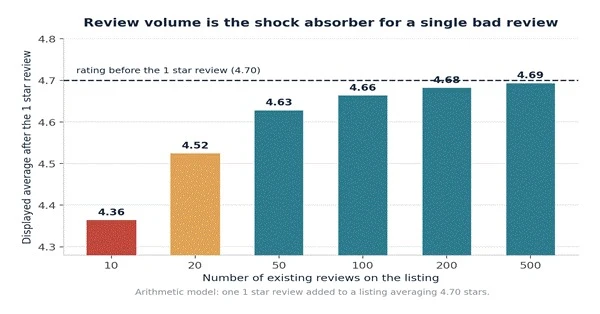
Figure 1: The same one star review costs a thin listing thirty times more rating damage than a deep one.
The second is the cost of recovery. Restoring a 4.70 average after a single one star review takes roughly thirteen fresh five star reviews, and that ratio holds regardless of how large the listing already is. Ten bad reviews left unattended represent well over a hundred recovery reviews of work.
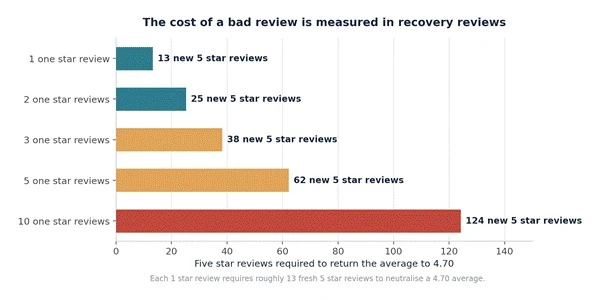
Figure 2: Recovery is expensive, which is why prevention and fast resolution beat volume campaigns.
The practical conclusion is that response work and review generation work are the same programme, not two separate ones. A reply that persuades an unhappy customer to amend a rating is worth thirteen new customers asked politely for a review. A reply that stops the next five customers from experiencing the same failure is worth more than that.
The three audiences of every public reply 1. The reviewer, who may update, downgrade further, or escalate depending on tone. 2. The silent majority of future buyers, who read the two or three most recent negative reviews and the replies beneath them before deciding. 3. The platform and the search engine, which treat responsiveness as an engagement and freshness signal on the listing. |
Ad hoc replies drift. One is warm, the next is curt, a third argues with a customer in public and stays online forever. A named sequence keeps output consistent across everyone who touches the inbox. The six steps below run in order, and the first four take place in public while the last two happen off the platform.
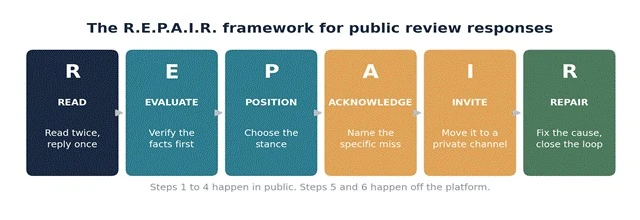
Figure 3: The R.E.P.A.I.R. sequence for handling any negative public review.
| Step | What happens | Common failure |
| Read | The review is read twice, once for facts and once for the emotion underneath. The stated complaint and the real grievance are often different things. | Replying to the first sentence and missing the actual issue in the last one. |
| Evaluate | The claim is checked against records: booking, order number, ticket history, shift roster, delivery scan. | Apologising for something that never happened, or disputing something that did. |
| Position | One of four stances is chosen: own it, clarify it, correct it, or decline it. | Mixing stances inside one reply, which reads as evasive. |
| Acknowledge | The specific failure is named in the reviewer's own terms, once, without hedging. | Generic regret language that could be pasted under any review on the internet. |
| Invite | The conversation moves to a named person and a real channel. | A support address nobody monitors, or an invitation with no name attached. |
| Repair | The underlying cause is fixed, and the reviewer is told what changed. | The public reply promises a fix that never reaches the operation. |
Verification takes two minutes and prevents the two most expensive mistakes in review management: apologising for a fabricated incident, and disputing a genuine one. The reviewer name on a platform profile frequently differs from the name on the booking, so the match should be attempted on details rather than identity.
Not every negative review deserves the same handling or the same speed. Triage sorts the queue so that the small number of reviews carrying legal, safety or reputational risk are escalated immediately, while routine criticism follows the standard path.
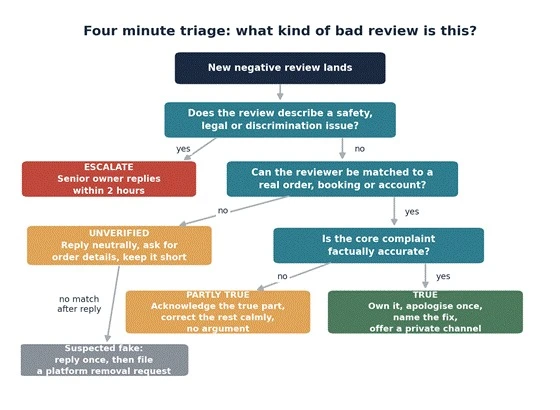
Figure 4: Triage decision tree. Anything touching safety, discrimination or legal exposure leaves the standard queue.
A reply that apologises, defends, corrects and deflects in the same four sentences reads as insincere because it is trying to satisfy four audiences at once. One stance per reply is the rule.
| Stance | Use when | Opening move | Never do this |
| Own it | The complaint is verified and the failure is the business's own. | Name the failure in plain words and apologise once. | Apologise three times or blame a supplier. |
| Clarify | The facts are right but context is missing. | Confirm what happened, then add the missing detail neutrally. | Frame the clarification as a correction of the customer. |
| Correct | A material claim is factually wrong. | State the verifiable record in one sentence, without adjectives. | Call the reviewer a liar, or imply it. |
| Decline | The review is abusive, fabricated or an extortion attempt. | Post one short factual reply, then stop and file a removal request. | Argue in public across multiple replies. |
The structure below produces replies between sixty and ninety words, which is long enough to be specific and short enough to be read. Anything past roughly one hundred and twenty words starts to look like a defence brief, and readers discount it accordingly.
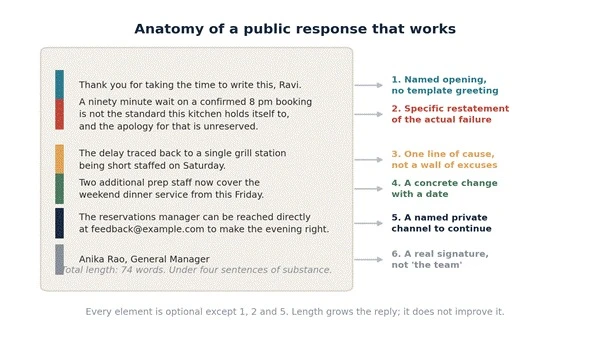
Figure 5: A worked example of the six part structure, annotated.
The only three mandatory elements A named opening that shows a human read the review, a specific restatement of what actually went wrong, and a real channel to continue the conversation. Cause, corrective action and signature strengthen the reply but can be dropped when the facts are still unclear. |
Certain constructions reliably make a reply worse, either because they shift blame onto the customer or because they signal a template. The replacements below keep the same information without the cost.
| Avoid | Why it backfires | Use instead |
| "We are sorry you feel that way" | Apologises for the emotion, not the event. Reads as a dismissal. | "The wait on Saturday was ninety minutes and that is not acceptable." |
| "We have no record of your visit" | Publicly accuses the reviewer of lying before the facts are settled. | "The booking cannot be located under this name. Order number sent to the address below will find it." |
| "Unfortunately, our policy states..." | Makes the policy the hero and the customer the obstacle. | "The cancellation window is 48 hours. Given the circumstances described, an exception is being reviewed." |
| "Please contact us so we can make this right" | Appears under millions of reviews. Carries no information. | "Rohit Sharma, service manager, can be reached at 022 4xxx xxxx between 10am and 6pm." |
| "As mentioned in our terms and conditions" | Signals that a legal argument is coming. | Restate the relevant term in one plain sentence, without citing the document. |
| "This is very unusual for us" | Prospective customers cannot verify it, and it minimises the complaint. | Say what changed operationally after the incident instead. |
| "We would love the opportunity to..." | Marketing register inside a service failure. | Plain register: "A replacement can ship today if the order number is confirmed." |
Public replies work best as an acknowledgement plus an exit. Resolution details, refunds, medical facts, account data and anything requiring back and forth belong in a private channel, for three reasons: platforms restrict what can be disclosed publicly, negotiation in public invites other customers to demand the same outcome, and long public threads keep the negative review at the top of the listing through recency sorting.
Speed carries information. A reply within a day signals a business that monitors its own service. A reply three weeks later, arriving after the reviewer has moved on, reads as reputation housekeeping. The tiers below work as an internal service level agreement, measured on calendar hours rather than business hours, because review platforms do not observe weekends.
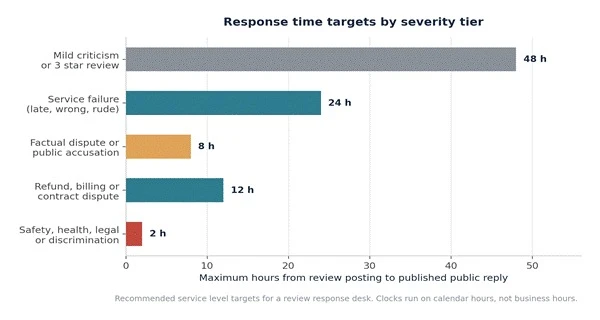
Figure 6: Suggested response time targets by severity tier.
One caveat runs against pure speed: replies written inside the first hour of reading an unfair review are the ones most likely to be regretted. The workable compromise is to draft immediately, then have a second person publish. A mandatory second pair of eyes on any reply to a two star or one star review costs a few minutes and prevents most public escalations.
The reply is the visible part of the work. The value sits in what happens afterwards. Reviews that produce an operational change and a follow up message are the ones that convert into rating upgrades, and an upgraded review is worth roughly thirteen new five star reviews in arithmetic terms.
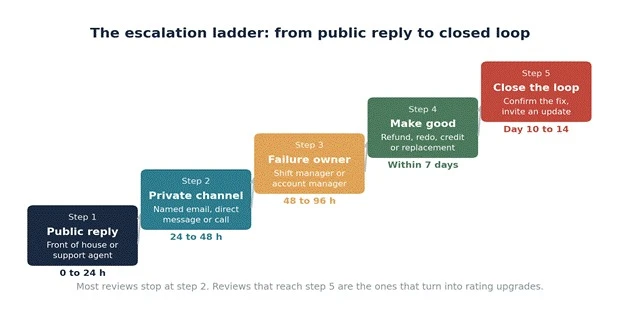
Figure 7: The escalation ladder from public acknowledgement through to a closed loop.
At step five, an update can be invited once, in the private channel, and never on the public thread. Neutral phrasing keeps it compliant with platform policy on both counts: an invitation to revisit the review is acceptable, while an inducement to change or delete it is not.
Closing message template, day 10 to 14, private channel Hello Ravi, following the wait you experienced on the 14th, two additional prep staff now cover weekend dinner service, and the table hold policy was rewritten so that no confirmed booking waits beyond fifteen minutes. The dinner for two mentioned earlier is open ended and needs no notice. If the experience has changed since, the review can be revisited at whatever rating seems fair. Either way, the feedback made the operation better. Anika Rao, General Manager |
Each situation below carries the review as a customer would post it, the reply that typically makes things worse, and a script that can be adapted in minutes. Bracketed placeholders mark the details that must be substituted before publishing. Names in the examples are illustrative.
Restaurant | Google Business Profile | 1 star | Verified booking
The review as posted "Booked for 8pm for my wife's birthday, seated at 9.35pm with no explanation and no apology from anyone. Starters came cold. The manager never once came to the table. Ruined the evening completely." |
Reply that makes it worse: "We are sorry you feel that way. Saturdays are our busiest night and there may be a wait. We hope to welcome you again soon."
Reply to publish Thank you for writing this, Ravi, and an apology is owed for the birthday it spoiled. A ninety five minute wait on a confirmed 8pm booking is indefensible, and cold starters on top of it made a bad night worse. The delay traced back to a single grill station running short staffed, which is a rota failure, not an excuse. Two additional prep staff now cover weekend dinner service from this Friday, and confirmed bookings are seated within fifteen minutes or the table is comped. Anika Rao, General Manager, can be reached at [email] to make the evening right. |
Why it lands: Verified failures call for the cleanest stance available. The reply apologises once, names the exact failure in the reviewer's own terms, gives one line of cause without hiding behind it, commits to a change with a date, and hands over a named person. Nothing is disputed, which leaves the reader with the impression of a business that already knows where it went wrong.
Hotel | TripAdvisor | 2 stars | Verified stay
The review as posted "Filthy room. Hair in the bathroom, stained carpet, air conditioning barely worked. Front desk did nothing for three days. Worst hotel in the city by a distance." |
Reply that makes it worse: "Our housekeeping team is award winning and this simply does not reflect our standards. Records show engineering attended your room. We are disappointed by this unfair review."
Reply to publish Thank you for the detail, and the bathroom should never have been handed over in that state. Housekeeping missed it and the apology for that is unreserved. On the air conditioning, the maintenance log shows a unit replacement on the morning of the 12th, so roughly one night of the stay was affected rather than three. Anything left unresolved after that visit should have been escalated and was not, which is the front desk failure here. A full deep clean audit of the fourth floor was completed on the 15th and the checklist now requires a supervisor signature before handover. Meera Iyer, Rooms Division Manager, at [email], to review a partial adjustment for the affected night. |
Why it lands: The stance is clarify, not defend. The true part is conceded first and without qualification, which buys the credibility to correct the timeline afterwards. The correction is stated as a record, not as a contradiction of the guest, and the reply still ends with a remedy rather than a rebuttal.
E commerce | Trustpilot | 1 star | Verified order
The review as posted "Ordered on the 2nd with next day delivery, arrived on the 11th. Nine days. Tracking never updated once. Nobody answered three emails. Never ordering here again." |
Reply that makes it worse: "This delay was entirely caused by our courier partner and is outside our control. Please take this up with them directly using your tracking number."
Reply to publish Nine days against a next day promise is a broken promise regardless of where the breakdown happened, and the refund of the delivery charge has been processed today. The parcel was mis routed at a carrier hub on the 3rd, and the tracking feed stopped updating at the same point. Three unanswered emails is the more serious failure of the two, and that queue was under staffed last week. Two changes are live: parcels with no tracking movement for 48 hours are now flagged automatically for manual chase, and support coverage was extended to cover the backlog. Priya at [email] will confirm the refund reference and arrange a credit toward the next order. |
Why it lands: Carrier failures are still the seller's failure from the buyer's seat. The reply accepts responsibility for the promise before explaining the mechanism, and it treats the ignored emails as the larger problem, which is usually the accurate reading. Refund first, explanation second.
SaaS | G2 or Capterra | 1 star | Verified account
The review as posted "Charged 48,000 rupees for a renewal I never agreed to. No warning email, no invoice in advance, and support refused a refund citing terms nobody reads. Predatory billing." |
Reply that makes it worse: "As outlined in section 7.2 of our Terms of Service, which you accepted at signup, subscriptions renew automatically. No refund is available."
Reply to publish Being charged without a warning email is a fair complaint and the renewal reminder is the part that failed here. The renewal notice was sent to the billing address on file on the 14th, seven days ahead, and mail logs show it bounced. Relying on a single email to a single address is a weak design, and it has been changed: renewal notices now go to every admin on the account and appear as an in app banner from thirty days out. On the charge itself, a pro rata refund for the unused portion is available now, and the account can be moved to manual renewal permanently. Karthik Menon, Customer Success, at [email], can process either option the same day. |
Why it lands: Quoting the contract in public wins the argument and loses every reader. The reply concedes the notification design flaw, offers the remedy without being pushed, and describes a product change that answers the same objection for every future reader of the listing.
Clinic | Google or Practo | 1 star | Confidentiality applies
The review as posted "Waited two hours past my appointment. The doctor spent six minutes with me, dismissed my symptoms, and I was still charged the full consultation fee. Complete waste of money." |
Reply that makes it worse: "Your appointment was at 4pm, you arrived at 4.25pm, and your chart shows the tests you were advised to complete. The full history was explained at the time."
Reply to publish A two hour wait falls well short of what this clinic aims for, and the apology for that is owed regardless of anything else. Clinical details of any individual visit cannot be discussed in a public forum, so this reply is deliberately limited to process. On timing, afternoon lists were over booked through July and the schedule was rebuilt on 1 August with fixed twenty minute slots and a live wait time board at reception. Any concern about the consultation itself deserves a proper hearing, and the practice manager can arrange a no charge review appointment with a different clinician. Sunita Deshpande, Practice Manager, [phone], Monday to Saturday. |
Why it lands: The single most common serious error in regulated sectors is confirming that a person was a patient or client and then discussing their case in public. The reply names the confidentiality limit explicitly, which reads as professionalism rather than evasion, then answers everything that is process rather than clinical.
Home services or contracting | Google | 2 stars | Verified job
The review as posted "Quoted 35,000 for the bathroom, final bill was 61,000. Extras were never discussed with me, just added at the end. Work itself was fine but the billing feels like a scam." |
Reply that makes it worse: "Variations were verbally agreed on site with your husband. The invoice reflects the actual work carried out. Payment is now overdue."
Reply to publish A bill arriving at nearly double the quote with no written approval in between is a legitimate complaint, and the process failure is on this side. The extra work covered a corroded soil pipe and rewiring found once the wall came down, both genuinely unforeseeable at quoting stage. It should still have gone out as a written variation for sign off before anyone started, and it did not. Every variation now requires a signed change order before work continues, with no exceptions, effective across all sites. The invoice is on hold pending a line by line walk through. Sandeep at [phone] can arrange that this week, and anything that cannot be evidenced against a signed order will be removed. |
Why it lands: Price disputes turn on consent, not on whether the work was necessary. The reply separates the two, defends the necessity of the extras while conceding the missing approval, and puts the invoice on hold, which converts a public argument into a private reconciliation.
Retail or hospitality | Google | 1 star | Disputed account
The review as posted "The girl at the counter, Neha, was unbelievably rude. Rolled her eyes at me, spoke over me the entire time and made me feel like an inconvenience. Terrible attitude." |
Reply that makes it worse: "Neha is one of our longest serving and most loved staff members. Several other customers have praised her that same week. We think there has been a misunderstanding."
Reply to publish Being spoken over and made to feel like an inconvenience is not the experience anyone should have at the counter, and the apology for how the visit felt is unreserved. The exchange has been reviewed with the team member concerned and with the shift supervisor who was present, and the two accounts differ on several points. Naming individual staff in public is not something this business does either way, so the rest of that conversation stays internal. What does not depend on whose account is right: the interaction ended with a customer walking out unhappy and nobody stepping in. Counter handover training was refreshed on the 20th, and a supervisor is now on the floor through peak hours. Rahul at [email] would like to hear the full account directly. |
Why it lands: Publicly defending an employee against a customer creates a losing situation for both. The reply validates the experience, protects the employee from being litigated in public, and shifts the commitment onto something observable, which is the absence of supervision. Note that no admission is made about the employee's conduct, which matters if employment consequences follow later.
Any platform | 1 star | No matching record
The review as posted "Absolutely disgusting. Rats in the kitchen, staff smoking near the food, health inspector should shut this place down immediately." |
Reply that makes it worse: "This is a completely false and defamatory review posted by a competitor. We have reported you and our lawyers have been instructed."
Reply to publish Claims of this seriousness are worth answering directly. No booking, order or walk in transaction matching this account can be located, and the most recent municipal health inspection, dated [date], was passed with no findings. The certificate is displayed at the entrance and a copy is available to anyone who asks. If a visit did take place, [name] at [email] would like the date and the receipt number so the matter can be investigated properly. Until then this review will be reported to the platform for verification, and no further public comment will follow. |
Why it lands: The stance is correct, then decline. One factual reply is published for the benefit of future readers, evidence is offered rather than asserted, a route back is left open in case the reviewer is genuine, and the thread is closed. Legal threats in public replies almost always inflame the situation and are frequently screenshotted.
Any platform | 2 stars | Verified customer
The review as posted "Missed the return window by four days because I was travelling and they refused to refund a product I never even opened. Rigid and unhelpful. Buy elsewhere." |
Reply that makes it worse: "Our returns policy is clearly stated on the website and at checkout. Fourteen days means fourteen days. We are unable to make exceptions."
Reply to publish Being four days outside the window on an unopened item is exactly the kind of case where a policy feels arbitrary, and that reaction is understandable. The fourteen day window exists because returns are re inspected and restocked in batches, and past that point the item cannot go back into sellable stock. That is the reason, though it is not much comfort in this instance. Two things have changed as a result: the window is now visible on the order confirmation and on the packing slip rather than only at checkout, and unopened items within thirty days are eligible for store credit. That second change applies to this order. Store credit can be issued today by contacting [name] at [email]. |
Why it lands: Policy complaints are best answered by explaining the reason for the policy, then changing something, then applying the change to the complainant. Every future reader learns both the rule and the fact that the business adjusts it when the rule produces a poor outcome.
Any platform | 1 star | Extortion attempt
The review as posted "Terrible service. Will happily update this to five stars once someone refunds my full stay and adds a free night. Your call." |
Reply that makes it worse: "Please remove the review and a refund will be arranged immediately."
Reply to publish Any service issue from the stay will be looked into on its merits, and [name] at [email] is the right contact for that. Compensation is not something this business negotiates against a review rating, in either direction. That applies to every guest equally and it is the only fair way to handle it. The underlying complaint remains open and will be dealt with through the normal channel. |
Why it lands: Paying to remove a review invites repetition, breaches platform policy on most major sites, and can breach consumer protection rules in several jurisdictions. The reply refuses without hostility, keeps the service issue alive on its own merits, and creates a clean public record. The review should then be reported under the platform's conflict of interest or incentivised review policy.
Google or app marketplaces | 1 star | No comment
The review as posted ★☆☆☆☆ (no written review) |
Reply that makes it worse: Ignoring it entirely, or replying with a generic block of marketing copy.
Reply to publish A one star rating with no detail is difficult to learn from, and the intent here is to learn from it rather than dispute it. If something specific went wrong, [name] at [email] would genuinely like to hear it, and it will be treated as a service report rather than an argument. |
Why it lands: Roughly one in five negative ratings carries no text. A short, calm, non defensive reply signals to future readers that even a silent complaint gets attention, and it occasionally produces the detail that was missing. Length should be kept to two sentences, because a long reply to a blank review looks anxious.
Glassdoor, AmbitionBox or similar | 1 star
The review as posted "Toxic management, unpaid overtime as standard, promotions go to favourites. HR exists to protect the company. Avoid unless desperate." |
Reply that makes it worse: "This does not reflect the experience of our 400 employees. Anyone who dislikes our culture is free to move on, as this person did."
Reply to publish Thank you for taking the time to write this. Feedback of this kind is uncomfortable and it is still worth reading properly. On overtime, the time off in lieu policy was reviewed in [month] and the current position is that additional hours are logged and compensated, with the process documented in the handbook. On promotions, a structured competency framework and twice yearly review cycle replaced manager discretion in [month]. Whether those changes have landed on the ground is a fair question and the honest answer is that they are still bedding in. [Name], Head of People, at [email], for anyone current or former who wants to discuss this directly. |
Why it lands: Employer reviews are read by candidates who assume every company has problems and are watching for how leadership handles being criticised. Defensiveness confirms the review. Specific policy changes, plus an admission that the change is incomplete, reads as credible in a way that a denial never does.
Every major platform enforces its own constraints on business responses, and breaching them can cost the reply, the listing, or in rare cases the account. The table summarises the operating differences that matter most in day to day work. Platform policies change, so the current guidelines should be confirmed before any policy is written into a team playbook.
| Platform | Key constraints on replies | Practical implication |
| Google Business Profile | Replies are public and permanent under the review. Personal data must not be disclosed. Soliciting review changes in exchange for anything is prohibited. | Highest visibility of any channel, since replies surface in local search results. Treat every reply as public copy. |
| Yelp | Public comments and private messages are both available. Requesting reviews is restricted, and aggressive replies are actively surfaced. | Use the private message first for resolution, and keep the public comment short and neutral. |
| Trustpilot | Businesses may reply once and edit later. Reviews can be flagged for verification, and reviewers are asked for documentation. | The flagging route is comparatively effective for genuinely unverifiable reviews. Keep order references ready. |
| G2 and Capterra | Reviews are moderated and often verified against employment or account records before publication. | Factual disputes are better routed through the vendor moderation process than argued publicly. |
| TripAdvisor | Management responses are moderated before publication and must avoid personal attacks or promotional content. | Promotional language and offers of compensation can cause a response to be rejected outright. |
| Amazon | Public comments on product reviews were removed for most sellers. Buyer messaging is restricted to order related contact. | Handle through buyer messaging and the review abuse reporting route, not a public reply. |
| App Store and Google Play | One developer reply per review, which can be edited. Replies notify the user directly. | Replies are the strongest lever for rating updates, since the notification reaches the reviewer immediately. |
| Glassdoor and AmbitionBox | Replies are attributed to a company representative. Attempts to identify the reviewer breach policy. | Never speculate publicly about which former employee wrote a review. |
The points below are general orientation rather than legal advice, and local rules vary considerably. Qualified advice should be taken before any contested review is escalated.
Confidentiality: in healthcare, legal, financial and education settings, confirming that a person was a patient or client can itself be a disclosure. Replies should stay at the level of process.
Employment exposure: public statements about a named employee's conduct can be used in a subsequent employment dispute. Individual conduct should never be discussed publicly.
Non disparagement clauses: contract terms that penalise customers for negative reviews are prohibited in several jurisdictions, including under the United States Consumer Review Fairness Act. Their use should be reviewed before any enforcement is attempted.
Incentivised reviews: offering compensation for removal or for a higher rating breaches most platform policies and can attract regulatory attention. Resolution and review requests should be kept demonstrably separate.
Defamation: a genuinely false statement of fact may be actionable, but litigation is slow, expensive and frequently amplifies the original review. Platform removal routes should be exhausted first.
Data protection: order numbers, addresses, appointment details and account identifiers should never appear in a public reply, even when the reviewer disclosed them first.
Removal requests succeed when they cite a specific policy breach with evidence attached, and fail when they argue that a review is unfair. The categories below are the ones most platforms will act on.
| Grounds | Evidence to attach | Likelihood |
| Conflict of interest, such as a competitor or former employee | Screenshots of the account's review history, employment records | Moderate |
| No transaction ever took place | Confirmation that no matching order, booking or account exists in the period | Moderate |
| Wrong business, common with similar names or shared premises | The correct business named in the review text, location data | High |
| Profanity, hate speech or personal attack | The review text itself against the platform content policy | High |
| Extortion or a conditional rating offer | Screenshots of messages demanding compensation for a rating change | High |
| Off topic content, such as political commentary | The review text showing no reference to the goods or service | Moderate |
| Duplicate or coordinated posting | Timestamps and near identical text across multiple accounts | Moderate |
A public reply should be posted before or alongside the removal request, because most requests are declined and an unanswered accusation is the worse outcome.
Review response fails when it belongs to everyone and to nobody. The allocation below works for most small and mid sized operations, and scales by adding reviewers rather than approvers.
| Review type | Drafts the reply | Approves before publishing | Target |
| 4 and 5 star | Front line team member | No approval required | 72 hours |
| 3 star | Front line team member | Team lead spot checks weekly | 48 hours |
| 2 and 1 star, routine | Team lead | Second person reads before publishing | 24 hours |
| Factual dispute or accusation | Marketing or operations lead | Owner or department head | 8 hours |
| Safety, legal or discrimination | Owner or senior leader | Legal counsel where available | 2 hours |
Reputation dashboards tend to bloat. Four measures cover the programme: how much of the queue gets answered, how fast, whether the review base is growing, and whether replies are actually changing outcomes. The fourth is the one that proves the work.
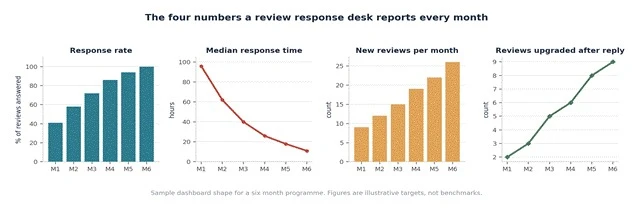
Figure 8: The reporting shape for a six month response programme. Values shown are illustrative targets.
Response rate should reach one hundred percent within a quarter, including positive reviews, because a listing where only complaints receive replies looks defensive. Median response time under twenty four hours is a realistic steady state for a small team. Review velocity matters more than average rating, since velocity is what dilutes future damage, as figure 1 showed. Upgrades after reply is the direct measure of whether the escalation ladder is being worked past step two.
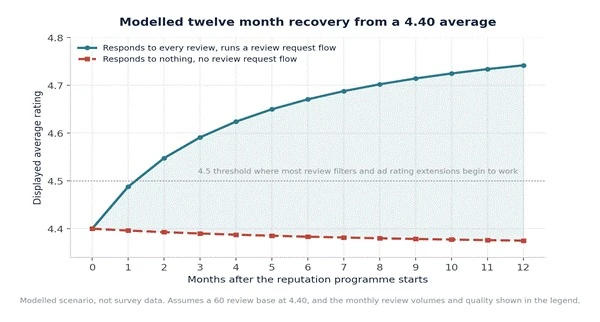
Figure 9: Modelled twelve month rating trajectory with and without an active response and review request programme.
The modelled gap in figure 9 comes from two compounding effects rather than one. Responding businesses tend to generate more reviews because resolved customers are more willing to be asked, and the reviews they generate skew higher because obvious failures get fixed before the next customer meets them.
| Week | Focus | Deliverable |
| Week 1 | Audit and access | Claim and verify every listing, consolidate logins, export the last twelve months of reviews, tag them by root cause. |
| Week 2 | Standards | Write the stance definitions, the six part structure and the banned phrase list into a one page internal document. Assign owners and service levels. |
| Week 3 | Backlog | Reply to every unanswered review from the last ninety days, oldest negative first. Escalate anything unresolved into the private channel. |
| Week 4 | Prevention and measurement | Fix the top two root causes from the week 1 tagging. Launch a post service review request. Stand up the four number monthly report. |
Every reply to a one or two star review should clear all fourteen lines before it goes live.
A bad review does not become a reputation problem simply because it exists. The bigger risk is responding defensively, ignoring it, or treating the reply as a piece of damage-control copy rather than the start of a real resolution.
The strongest approach is consistent: verify what happened, choose a clear stance, acknowledge the specific issue, move sensitive details into a private channel, and fix the operational problem behind the complaint. A calm, specific response shows future customers that criticism is taken seriously without turning the review section into a public argument.
Most importantly, review management should not end when the reply is published. Track response times, close the loop with the customer, identify recurring complaints, and use those patterns to improve the service itself. When that process becomes routine, negative reviews stop being isolated reputation threats and start becoming useful signals for building a stronger customer experience and a more trustworthy public profile.
Share your thoughts about this article.
Be the first to post a comment!

The short answerTo be cited, your page must first be retrievable (ChatGPT reads...
Sakshi Dhingra1 month ago

One red warning page can empty your traffic overnight. Here is how blacklists wo...
Deepak Mehra1 month ago

Relay.app spent five years building AI-powered workflow automation as an alterna...
Sakshi Dhingra1 month ago