The short answer
|
For twenty years, the goal of SEO was a blue link near the top of Google. That goal is quietly being replaced. People are increasingly getting their answer directly inside ChatGPT or Perplexity, and the only brands that exist in that answer are the ones the model chooses to cite.
The shift is measurable. AI referral traffic has been growing at roughly 500–780% year over year, doubling every few months from a small base, while AI platforms pushed well over a billion referral visits in a single month in 2025. At the same time, the share of searches that end without a click keeps climbing, close to 58% of US searches overall, and over 80% when an AI answer is present. The traffic that does come through converts unusually well.
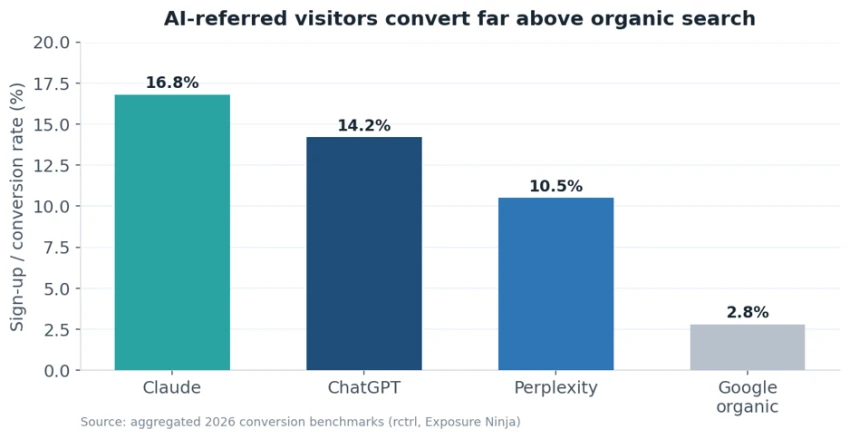
Figure 1 — Visitors arriving from AI assistants convert at several times the rate of ordinary organic search.
The takeaway for anyone running content or review sites: a citation inside an AI answer is now worth chasing on its own terms. It is high-intent, high-converting, and it compounds. This guide explains exactly how ChatGPT and Perplexity decide what to cite, what the research says actually changes the outcome, and a step-by-step procedure you can run on any page.
Not all AI engines are equal in reach. ChatGPT is still the dominant referrer by a wide margin, but its share has been falling as Gemini, Perplexity and Claude grow. Perplexity punches far above its user count: it is citation-first by design, showing numbered sources on every answer, which makes it the easiest engine to influence and measure.
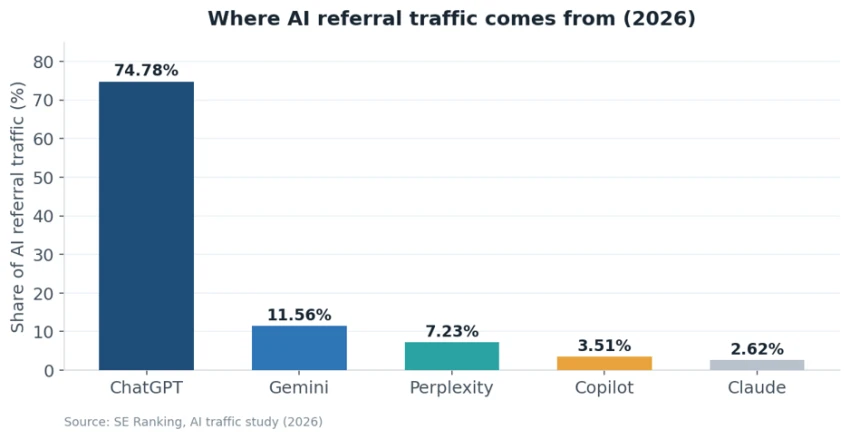
Figure 2 — ChatGPT leads AI referral traffic, but a meaningful long tail is forming across Gemini, Perplexity, Copilot and Claude.
A key structural point: Perplexity cites a far broader set of sources than classic search. An arXiv analysis found Perplexity referenced about 1,430 unique news sources against roughly 881 for Google and 707 for OpenAI. Broader sourcing means more room for mid-sized and niche sites, exactly the kind of properties that struggle to rank on page one of Google to win a citation slot.
ChatGPT does not cite on every answer. It only pulls and cites live sources when its browse (search) tool fires, which happens in a minority of conversations, usually on the opening question. When it doesn’t browse, it answers from training weights and shows no sources at all. So the first battle is simply triggering retrieval.
When browse mode does fire, ChatGPT runs a retrieval-augmented generation (RAG) pipeline:
Query rewriting — it rewrites your natural question into several of its own search queries. You are not optimizing for the words the user typed.
Retrieval — it queries the Bing index (plus its own OAI-SearchBot crawler) and pulls a candidate set of pages. Pages not in Bing simply cannot be retrieved.
Re-ranking — it re-scores candidates on semantic match, structural clarity and recency, keeping a small pool.
Extraction & citation — it extracts clean, quotable passages from a handful of pages and cites only those that directly support a claim in the answer.
The attrition is brutal. According to AirOps research, about 85% of the pages ChatGPT retrieves are never cited in the final answer. A page can clear retrieval and still get cut at the extraction stage.
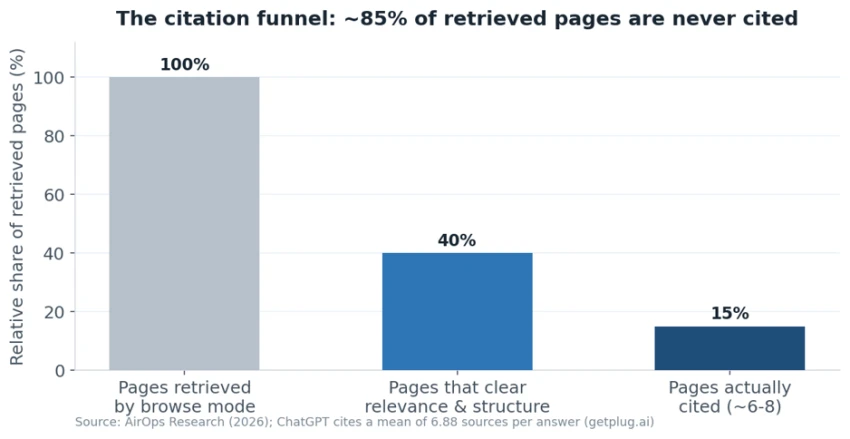
Figure 3 — Retrieval is not citation. Most pages that ChatGPT fetches never make it into the answer.
ChatGPT also reads deep, not wide. One analysis of 602 prompts and 21,143 citations found it cites a mean of about 6.9 sources per answer while extracting several times more language from each one than a classic search snippet. It wants a few strong sources it can quote at length, the opposite of the old “breadth of mentions” game. And it leans heavily on third-party authority: independent coverage, reviews and directories are cited far more often than brand-owned pages for category and comparison questions.
Perplexity is simpler to reason about because every query triggers a live web search. It retrieves roughly 10–30 candidate pages (and can pull 60+ on a standard query), splits them into passages, ranks those passages by how closely they match the question, then synthesizes an answer with inline numbered citations. Authority signals are pulled from Google, Bing and Brave indexes.
Perplexity’s selection is effectively a set of gates, a page must clear each one to earn a citation. Analysts estimate the approximate weighting of its factors as follows:
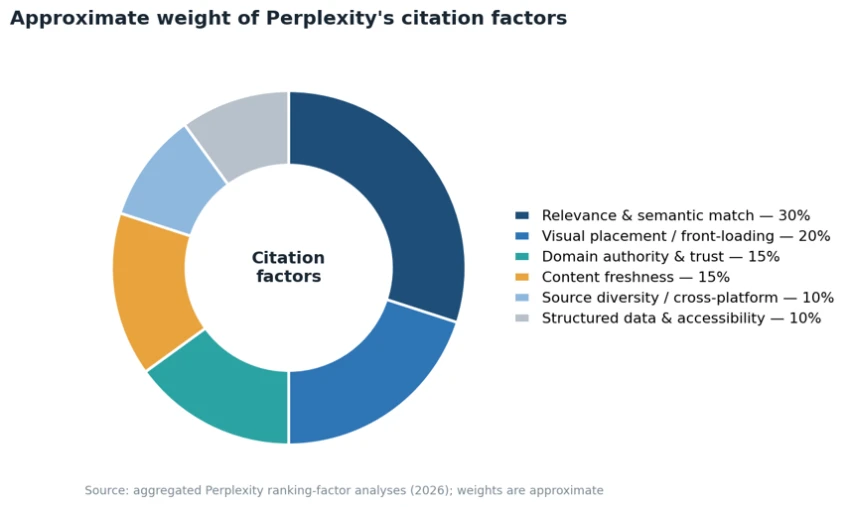
Figure 4 — Relevance and front-loaded placement dominate; freshness and authority split the next tier. Weights are approximate, from aggregated 2026 analyses.
Two factors deserve special attention. First, freshness: pages updated within the last 30 days consistently out-cite older ones, and some analyses report a ~40% drop in citation likelihood once content passes the 30-day mark. Second, structured data: pages with schema markup (JSON-LD) show roughly a 47% top-3 citation rate versus about 28% without. Unlike Google, Perplexity happily cites a mid-authority niche page over a big generalist brand when the smaller page answers the question more directly.
| Factor | ChatGPT (with browse) | Perplexity |
|---|---|---|
| When it cites | Only when browse mode fires (minority of chats) | Every query triggers a live search |
| Retrieval index | Bing index + OAI-SearchBot crawler | Own index + Google / Bing / Brave signals |
| Sources per answer | ~6–7 cited, read deeply | Dozens evaluated; a handful cited inline |
| Biggest lever | Third-party authority & extractable passages | Freshness, front-loaded answers, schema |
| % retrieved not cited | ~85% dropped before the answer | Binary gate — cited or invisible |
| Easiest to influence? | Harder (opaque, Bing-gated) | Easier (visible citations, fast to re-rank) |
The foundational evidence comes from the peer-reviewed Princeton GEO study (Aggarwal et al., “GEO: Generative Engine Optimization,” KDD 2024), run across 10,000 queries in 25 domains and validated on a live engine. It tested nine content changes and measured how each affected a page’s share of the AI answer. The winners were not design tricks, they were signals of machine-extractable provenance.
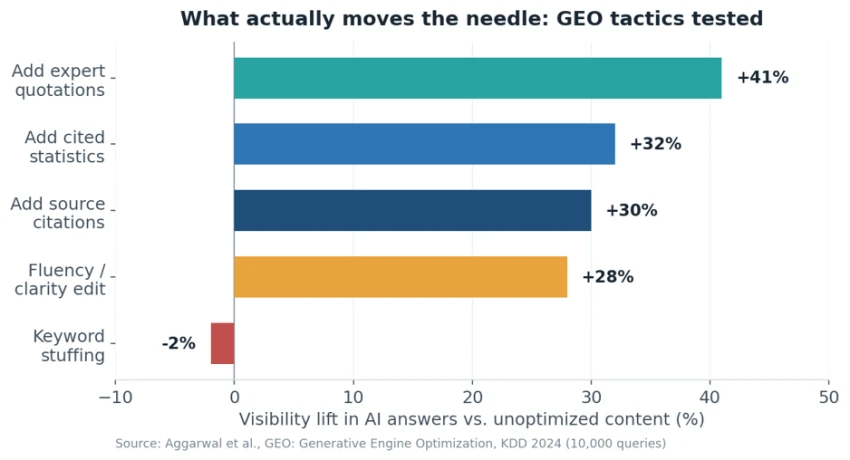
Figure 5 — Adding quotations, statistics and citations produced the largest visibility gains. Keyword stuffing — the old SEO reflex — did essentially nothing.
Three findings matter most for anyone optimizing content today:
Provenance wins. Adding expert quotations (+41%), cited statistics (+32%), and source citations (+30%) each lifted visibility 30–41% versus unoptimized content.
Keyword stuffing is dead. The density tactic that defined early SEO showed no meaningful effect in generative engines, and can hurt.
Underdogs gain most. Lower-ranked pages benefit far more than leaders; the study reported a 115% visibility jump for a fifth-ranked page after adding citations, while the top page actually lost share.
One honest caveat: the “40%” figure is a relative maximum under one benchmark and engine set, not a guaranteed result. Treat it as strong directional evidence, the direction has held up across later studies, rather than a promise. Combining tactics (for example, fluency plus statistics) outperformed any single one.
Here is the repeatable workflow. Run it per target question, not per keyword — AI engines answer questions, so each citable asset should own one clear question.
Map the real questions your audience asks an AI assistant, the conversational, long-tail phrasings (“what’s the best X for Y,” “how do I do Z”). Assign one primary question per page, and let the page answer sub-questions in its sections. A page that tries to own ten questions owns none.
AI engines extract passages. Open each section with a direct, standalone answer in the first 1–2 sentences (the BLUF pattern, bottom line up front). Around 44% of AI citations come from the first third of a piece of text, so the answer must appear before any wind-up. The opening block should make sense if lifted out of the page entirely, because that is exactly what happens.
Rewrite test Before: “There are many factors to consider when choosing project-management software, and it depends on your needs” After: “The best project-management software for small teams in 2026 is [X], because it combines [a], [b] and [c] at [price]. Here’s how the top five compare.” |
This is the highest-ROI step, straight from the Princeton findings. For each key claim:
Where you can, publish original data , a small survey, your own benchmark, aggregated numbers. Original statistics are disproportionately quoted because nobody else has them.
For category and “best of” questions, AI engines usually cite sources other than your own site, reviews, directories, forums and publishers. So being mentioned where the engine looks matters as much as your own page:
Freshness is one of the strongest signals, especially for Perplexity. Add a visible “last updated” date, refresh statistics and examples on a schedule, and re-publish meaningfully (not cosmetically) at least every quarter for pages you want cited. Content can lose a large share of its citations within about 30 days of going stale.
Unlike Google rankings, AI citation is binary: you are in the answer or you are invisible. Track it deliberately (see the metrics below), find the questions where you are retrieved but not cited, and improve those passages first, they are closest to winning.
| Lever | What to do | Impact |
|---|---|---|
| Retrievability | Index in Bing; allow GPTBot / PerplexityBot / ClaudeBot; server-render | Gate, required |
| Front-loaded answer | Direct, standalone answer in first 1–2 sentences of each section | High |
| Statistics | Replace vague claims with concrete, sourced numbers | +32% |
| Quotations | Add attributed expert / source quotations | +41% |
| Citations | Link credible primary sources in-content | +30% |
| Schema (JSON-LD) | Article, FAQPage, HowTo markup | ~47% vs 28% top-3 |
| Freshness | Update on a schedule; show last-updated date | High |
| 3rd-party authority | Reviews, directories, Reddit, digital PR | High (category queries) |
Note: the percentage impacts are relative visibility lifts from the Princeton GEO benchmark, not guarantees for every page.
Track these four metrics per target question:
Citation presence — are you cited at all for the question? (Binary, the one that matters most.)
Citation position — are you source #1 or #6? Earlier citations carry more click-through.
Citation velocity — how quickly a new page earns its first citation after publishing.
AI referral traffic & conversions — segment ChatGPT / Perplexity referrers in analytics and watch conversion quality, which tends to run well above organic.
Run your priority questions through both engines on a regular cadence (manually, or with an AI-visibility monitoring tool), log who gets cited, and work the “retrieved-but-not-cited” gap first.
Share your thoughts about this article.
Be the first to post a comment!

One red warning page can empty your traffic overnight. Here is how blacklists wo...
Deepak Mehra3 days ago

Relay.app spent five years building AI-powered workflow automation as an alterna...
Sakshi Dhingra6 days ago