German Army Tests Kamikaze Drones and AI Targeting in Lithuania
by Nitin - 8 minutes ago - 7 min read
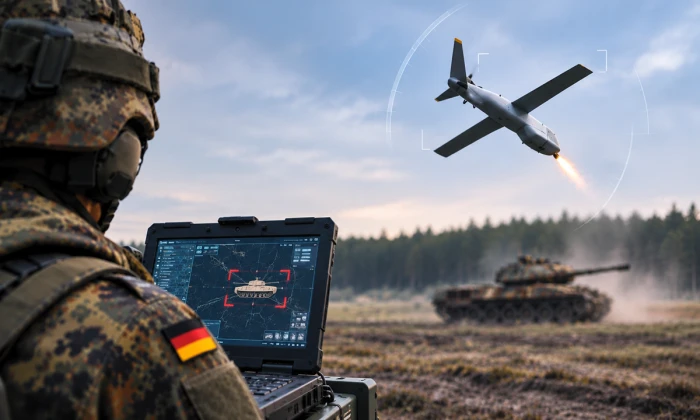
Germany's army began its first tactical tests of kamikaze drones on Sunday, November 22, at the Rūdninkai training area in Lithuania, close to the border with Belarus. The trials are part of Freedom Shield 26-II, a NATO exercise led by the German armoured brigade that will be permanently stationed in the country by the end of 2027.
Days earlier, German soldiers at the same site carried out the first field tests of Clarity, an artificial intelligence targeting platform built by Munich-based Helsing. Lieutenant General Christian Freuding, the head of the German Army, watched the drone strikes and considers both technologies essential for modern combat, according to Reuters.
Inert Warheads Against Main Battle Tanks
Drones from Helsing and Berlin-based Stark Defence carried inert warheads for the exercise and dived onto main battle tanks set up as targets on the range. It was also the first time Stark’s Virtus had been used in one of the brigade’s exercises.
Freuding, who ran Berlin’s arms deliveries to Kyiv before taking over the army, is due to become Germany’s chief of defence in February.
A loitering munition is built for a single use. It circles over an area until an operator assigns a target over a data link, then dives and detonates on impact. Both sides in the war in Ukraine depend on these weapons for a large share of their strikes, and Germany decided in 2025 to buy them after years of political dispute over the purchase.
Freedom Shield 26-II started on November 17 and is the biggest combat exercise the Bundeswehr has held in Lithuania.
About 3,800 soldiers from eight NATO members are taking part: Germany, the Netherlands, Norway, the Czech Republic, Croatia, Belgium, Luxembourg and Lithuania. Roughly 700 drones of various types are in use, and the scenario puts more weight on electronic warfare than earlier drills did. On November 20, German units crossed the Nemunas River south of Kaunas on floating bridges alongside Dutch engineers.
A second German formation, the 37th Mechanised Infantry Brigade “Freistaat Sachsen”, is running the parallel Grand Eagle 26 exercise at the General Silvestras Žukauskas training area. Together the two drills involve more than 6,000 troops. Lithuanian authorities expect military convoys to leave the training areas for the Kalvarija border crossing and the port of Klaipėda between November 28 and December 3.
Clarity Gets Its First Field Run
Helsing unveiled Clarity in Berlin on November 11 and presents it as a European alternative to Maven Smart System, the targeting software sold by US company Palantir.
The platform merges satellite imagery, drone footage, sensor feeds and written military reports with open-source material. Hundreds of specialised AI agents work through that data in parallel to locate enemy forces and cross-check findings between sources, then attach confidence levels and recommend how a target should be engaged. Reuters described the software as able to analyse that volume of information faster than any human.
Helsing says Clarity proposes a target only when independent sources agree with high confidence, and every nomination needs confirmation from a human operator. The system can run on infrastructure owned by the customer and link to weapons from any manufacturer. Co-CEO Gundbert Scherf told reporters at the launch that European militaries must keep control over how their own data is analysed.
When Clarity was launched, a military trial tied to possible adoption by the Bundeswehr had yet to take place. The Rūdninkai sessions were the first. Germany’s armed forces have said they want to start introducing AI-enabled systems from 2027.
Three Suppliers and Billions in Framework Deals
The Bundeswehr is buying loitering munitions from three companies at once. It argues that several types with different mission profiles spread the risk, so troops are not left dependent on a single supplier if quality or delivery volumes fall short.
The Bundestag budget committee cleared an initial package of about €540 million on February 25, 2026, and the framework contracts with Helsing and Stark were signed the next day. The first call-offs cover 4,300 HX-2 units from Helsing and 2,200 Virtus units from Stark, each worth roughly €270 million. Media reports put the potential value of the two frameworks at around €4.3 billion, with Stark’s ceiling at about €2.9 billion.
Rheinmetall, passed over in the first round, signed its own framework deal for the FV-014 on April 22. The initial call-off is worth around €300 million, with options for a five-figure number of drones. Deliveries are set to begin in the first half of 2027.
| System | Maker | Stated range | First order |
|---|---|---|---|
| HX-2 | Helsing (Munich) | Up to 100 km | 4,300 units for about €270 million |
| Virtus | Stark Defence (Berlin) | Up to 130 km | 2,200 units for about €270 million |
| FV-014 | Rheinmetall | Up to 100 km | About €300 million, deliveries from the first half of 2027 |
The contracts include exit milestones that cap the Bundeswehr’s risk if development stalls, plus innovation clauses that allow the drones’ software to be updated as it changes.
A Brigade Built for NATO’s Eastern Flank
Defence Minister Boris Pistorius pledged in 2023 to station a German combat brigade permanently in Lithuania, a first for Berlin. Panzerbrigade 45, based at Rūdninkai and Rukla, is due to be fully operational by the end of 2027 with about 5,000 troops and 2,000 vehicles, including dozens of tanks. Around 1,800 of those soldiers are already in the country.
From 2027, the brigade is meant to become the first major army formation with a unit able to scout and strike enemy targets using unmanned systems. The reconnaissance-and-strike network behind that plan was first tested in Germany at the Altmark training area in December 2025. A second round at Ohrdruf in April 2026 had troops hunting four moving main battle tanks with kamikaze drones, and it included soldiers who will join the Lithuania brigade.
Brigade commander Brigadier General Christoph Huber called Freedom Shield “another milestone” toward a fully equipped brigade ready for combat.
Lithuania borders Belarus and Russia’s Kaliningrad exclave. NATO officials have warned for years that Russia could mount a large-scale attack on alliance territory as early as 2029. Moscow denies any aggressive intent and accuses NATO of stoking tensions through its expansion.
Questions Over Hit Rates
Both start-ups came to Lithuania with a mixed testing record. In November 2025, Stark’s Virtus failed in back-to-back live-fire trials watched by British and German evaluators, missing both strike attempts during a British Army exercise in Kenya.
Helsing faced its own scrutiny. Politico reported that its drones hit their targets five times out of 14 in Ukraine’s Donbas region, and Bloomberg reported in January 2026 that Kyiv had held off on further HX-2 orders over technical concerns, a claim Helsing disputed.
The Bundeswehr pushed back on the criticism. In December 2025, Chief of Defence General Carsten Breuer said both the HX-2 and the Virtus had shown a probability of destroying targets above 90 percent in tests. In June 2026, the HX-2 flew 17 sorties during Project Flytrap, a US-led exercise at Pabradė in Lithuania, scoring 15 hits and two near misses while operating under jamming.
The army has also conceded that drone success rates on the battlefield can sit well below what footage of successful strikes suggests.
Electronic interference and improving counter-drone defences have exposed the limits of these weapons in Ukraine, and whether the systems tested at Rūdninkai deliver the expected edge in combat has yet to be proven. The programme has drawn political attention as well, with the Greens raising concerns about the stake US investor Peter Thiel holds in Stark.
Stark has since opened a site in Lithuania so its developers can work directly with the soldiers who will use the Virtus. Chief executive Uwe Horstmann has argued that modern defence technology cannot be developed for years in isolation from the people who use it.