Most people land on Grubby AI after seeing the name somewhere and wanting a straight answer: what does it do, is it safe, and are the reviews good enough to trust? This guide keeps the answer practical by looking at features, pricing, user feedback, pros, cons, safety, and alternatives, then giving an honest verdict on who should and should not bother.
Grubby AI sits in a category that needs extra care. It is an AI humanizer, a tool built to rewrite AI-generated text so it reads as human and slips past AI detectors. That promise carries real risks around accuracy, billing, and academic integrity, so this guide weighs the marketing against what independent tests and real users actually report.
Quick Summary Before You Try Grubby AI
Point
Details
Tool name
Grubby AI (grubby.ai)
Category
AI humanizer / AI-detection bypass tool for written text
Best for
Lightly rewording short, plain English drafts, with realistic expectations
Overall rating
2.5 / 5 (editorial)
User review rating
About 3.0 / 5 on Trustpilot from roughly 56 reviews (checked June 2026)
Free plan
Yes, a small free allowance (commonly cited around 300 words); verify on the live site
Pricing
Paid tiers roughly $5 to $20 per month plus a higher business tier; varies by source and billing cycle
Main concern
Inconsistent output quality, weak results against strong detectors, and refund/billing complaints
Best alternative type
A reputable paraphrasing or editing tool, or transparent AI use with genuine self-editing
Verdict in one line: Grubby AI may be worth a quick free trial if you only need to smooth short, simple English, but it should not be treated as a reliable way to pass strong AI detectors, and the billing complaints mean you should check refund terms before paying.
My Review Method and Testing Boundaries
A trustworthy software review should explain how its conclusions were reached.
This assessment included checking Grubby AI’s homepage, pricing page, account information available before purchase, stated language support, product positioning, terms, public customer feedback, and independent tests from other publishers.
I also compared positive and negative reviews to identify repeated patterns rather than treating one unusually good or bad review as representative of the entire product.
The following areas could be assessed directly from publicly accessible information:
Area reviewed
Method used
Product positioning
Checked the official Grubby AI website
Free allowance
Checked the live pricing page
Supported language
Checked the official FAQ
Account entry process
Reviewed the available sign-up information
Company claims
Compared homepage and pricing statements
Customer sentiment
Analysed the current Trustpilot profile
Billing concerns
Compared user complaints with the company’s public responses
Detection reliability
Reviewed independent testing and user-reported results
Paid-plan experience
Not personally verified across every tier
Institutional Turnitin performance
Not personally verified through a university account
This distinction matters because no outside reviewer can responsibly guarantee that a humanizer will pass every detector, assignment system, or future model update.
Editorial Rating Breakdown
The scores below reflect feature clarity, pricing transparency, public feedback, privacy-policy clarity, available demos, and comparison with similar tools. They are an editorial opinion, not a number taken from any review site.
Category
Rating
Reason
Ease of use
3.5/5
Paste-and-rewrite is simple, but some users hit regional access blocks and a clunky cancellation screen
Features
2.5/5
Narrow, single-purpose tool with no built-in detector and a multilingual claim that often just translates to English
Pricing clarity
2.5/5
Prices and word limits differ across sources, and the no-refund clause is easy to miss
Output quality
2.0/5
Independent tests and reviews report frequent incoherent output once text gets longer
Safety/privacy clarity
2.0/5
Billing and cancellation complaints, an opaque operator, and limited public detail on data handling
User feedback
2.5/5
Mixed Trustpilot reviews, with genuine positives for cheap short rewrites offset by quality and refund complaints
Overall rating
2.5/5
A cheap, simple tool that struggles on the one job it advertises most loudly
Grubby AI in Simple Terms
Grubby AI is a web tool that rewrites existing text, usually content generated by ChatGPT or another AI writer, so it sounds more natural and is harder for AI detectors to flag. The user pastes a draft, runs the rewrite, and gets back a reworded version.
The problem it tries to solve is detection. Students worry that AI checkers will flag assignments, and SEO writers worry that search engines or clients will penalize content that reads as machine-made. Grubby AI markets itself to both groups, promising output that scores as human.
In practice it is a one-trick tool. It does not write content from scratch, it does not include its own detector, and it works best in English on short passages. That focus can be a strength for a quick reword, but it also means the tool lives or dies on a single question: does the rewrite actually read well and stay undetected? That is exactly where the evidence gets shaky.
Once the basic purpose is clear, the next useful step is to check whether the features are strong enough for real users.
Core Features Users Should Check
AI Text Humanizer
The core feature rewrites AI-generated text into a different linguistic pattern.
This may reduce repetitive sentence construction and replace predictable transitions. However, substantial wording changes do not automatically produce better writing.
A humanized paragraph can still sound unnatural if it uses unusual synonyms, inconsistent phrasing, or sentence structures that do not match the subject.
The most practical use is to treat the generated version as an alternative draft. Compare it with the original and retain only the changes that improve clarity.
Detector-Focused Rewriting
Grubby AI markets its service around bypassing AI detectors and makes strong claims about receiving human scores. Its pricing page also promotes a guarantee related to Turnitin.
The limitation is that detector performance cannot be treated as permanent.
AI detectors are updated, rewriting tools change their models, and results vary by subject, length, writing style, and checker. User feedback also shows conflicting experiences: some reviewers report successful results, while others say the output remained detectable or became difficult to read.
A tool-generated score should therefore be treated as one signal rather than proof that a passage is authentically written or academically acceptable.
English-Language Processing
Grubby AI’s official FAQ states that it can humanize AI text only in English. This is clearer than several third-party descriptions that attribute broader multilingual support to the tool.
Users working with another language should not assume equivalent quality unless the company officially expands and documents its language support.
Even within English, output quality can vary between simple conversational writing and specialist material. Legal, medical, academic, financial, or highly technical passages require particularly close review because one altered term may change the meaning.
Free Word Allowance
The live pricing page checked on July 18, 2026 displayed an allowance of 150 free words per month.
This is enough to inspect a small sample but not enough to evaluate a complete article, essay, report, or long-form assignment.
Older reviews and search results may mention 300 words or other limits. Those figures should not be treated as current because Grubby AI can modify its plans and allowances.
The live checkout and pricing pages should always be checked before subscribing.
Paid Processing Plans
Grubby AI offers paid access for users who need higher word limits and additional processing capacity.
Prices found in third-party reviews differ considerably, partly because some sources display annual billing equivalents while others refer to monthly subscriptions or older offers.
Rather than relying on a static figure copied from another review, users should confirm four details on the live checkout page:
Pricing detail
Reason it matters
Billing frequency
A low monthly figure may require annual payment
Word allowance
Limits can differ substantially between plans
Renewal price
Introductory pricing may not continue
Cancellation and refund terms
These determine what happens after payment
This is especially important because some public reviews raise concerns about automatic renewal, cancellation, charges, and refund requests. These are individual customer reports rather than independently verified findings, but they appear frequently enough to justify reading the terms carefully.
Reviews and User Feedback
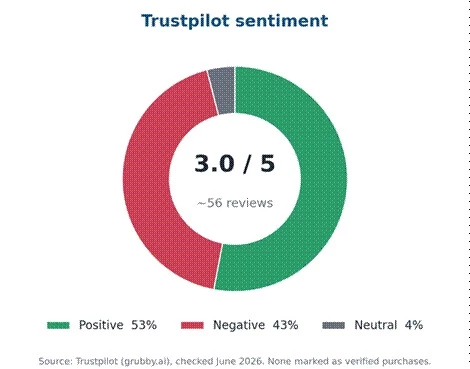
Public feedback exists but is thin and polarized. Trustpilot is the main source, and independent reviewers and detector companies have run their own tests. The snapshot below summarizes the sentiment rather than quoting individual reviews.
Trustpilot sentiment for grubby.ai, checked June 2026. Roughly half of reviews are positive and a large share are negative, with none marked as verified purchases.
Source
Rating
Positive Pattern
Negative Pattern
Writer's Take
Trustpilot
~3.0/5 (~56 reviews)
Cheap, fast, fine for short rewrites
Gibberish on longer text, denied refunds, billing issues
Useful signal, but no verified purchases, so read it with caution
Detector blogs
Test-based
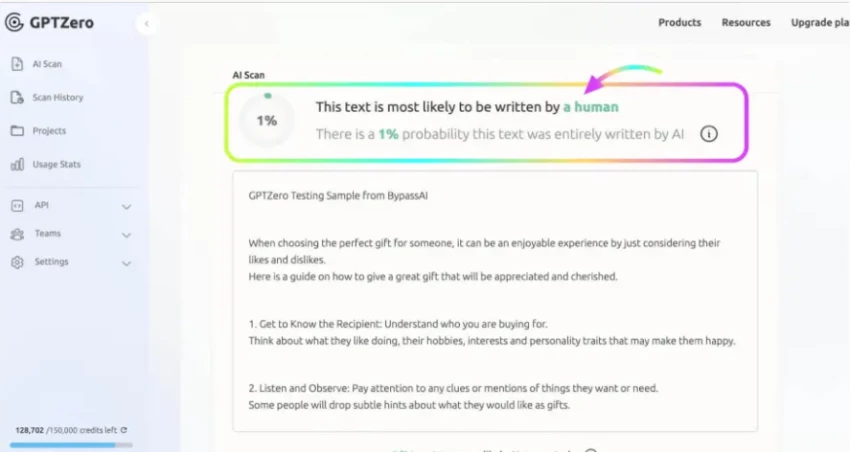
Can beat weak detectors such as ZeroGPT
Strong detectors still flag the output
Treat detector-pass claims as best case, not typical
Reddit / forums
No star rating
Some say it saves time
Cancellation and region-block complaints
Mixed and often negative on reliability
Owner responses
n/a
Owner engages directly, calls it a passion project
Replies can be combative on refund disputes
Direct contact is a plus, tone is a mixed signal
Public reviews for Grubby AI are limited and split, so the tool should be judged carefully using its free trial, pricing page, refund terms, and an independent detector before paying, rather than trusting the marketing.
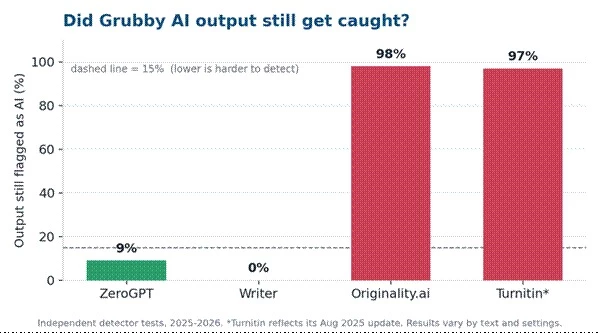
The most important question is whether the rewrite actually escapes detection. Independent tests give a clear pattern: it can fool weaker checkers and fails the strong ones.
Lower bars mean the text passed. Grubby AI cleared ZeroGPT and Writer in tests, but Originality.ai and Turnitin still flagged it as AI. Figures are from independent 2025-2026 tests and vary by text and settings.
This matters because the strong detectors are the ones schools and serious publishers actually use.Turnitin's August 2025 update specifically targets humanizer tools, and an academic test reported that Grubby's detection rate climbed from about 60 percent to roughly 97 percent afterward. Originality.ai's own test found the AI score barely moved. So the detector-pass promise is real only for the weakest tools.
Pros of Grubby AI
Pro
Reason It Matters
Low entry price
Cheaper than many rivals and far cheaper than full writing suites, so the cost of testing is small
Simple workflow
Paste, rewrite, copy. There is almost nothing to learn, which suits one-off rewrites
Free trial without a card
A small free allowance lets you judge quality before paying, and reviewers note no card is needed to start
Fine for short plain English
For a quick reword of a simple paragraph, output can read naturally enough
The biggest advantage of Grubby AI is that it is cheap and easy to try. If your only goal is to lightly reword a short, simple passage, you may not need a heavier platform. Just keep expectations low and verify the result yourself.
Cons of Grubby AI
Con
Why It Matters
Quality drops on longer text
Multiple reviewers report output that becomes awkward or incoherent past a short passage
Weak against strong detectors
Originality.ai and post-update Turnitin still flag the output, undercutting the core promise
Refund and cancellation complaints
Trustpilot reviews describe denied refunds and a cancellation flow that is hard to use, leading to continued charges
Opaque operator, thin reviews
Run by a single individual with limited public detail, and none of the Trustpilot reviews are verified purchases
The most serious concern is the gap between the promise and the result. A humanizer that strong detectors still flag, paired with reports of refund refusals and a balky cancellation screen, is a tool to approach carefully. If you do test it, prefer a payment method you can stop easily and save the refund terms first.
Pricing Details
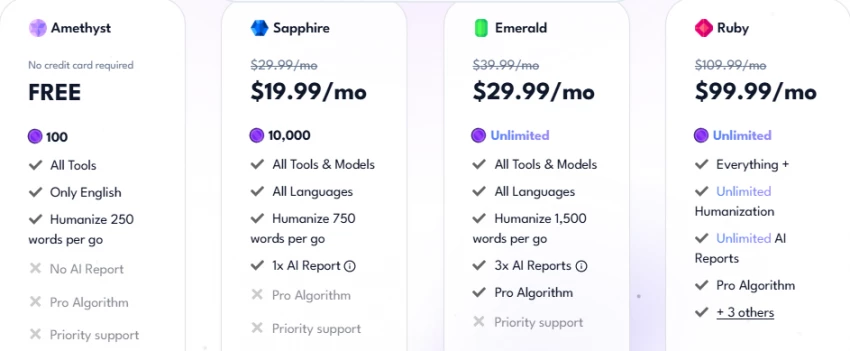
Grubby AI offers a small free allowance plus several paid tiers. Reported prices and word limits differ noticeably across third-party sites and between monthly and annual billing, which is itself a reason to confirm the current numbers on the live page before paying. The table below shows the typical shape of the plans rather than a guaranteed price.
Watch the claims in the pricing table. Reviewers note that Grubby AI's plans advertise promises like guaranteed Turnitin bypass and 100 percent human scores. Given the detector tests above, treat those as marketing, not guarantees.
Safety, Privacy, and Account Checks
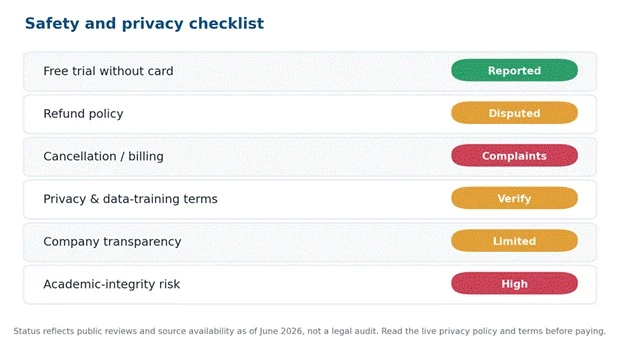
Because this tool rewrites text you paste in and charges a subscription, the safety questions are about billing, data handling, and the integrity risk of the use case itself.
Safety Check
Status
User Advice
Free trial without card
Reported
You can usually test before paying; confirm at signup
Privacy policy
Verify
Read it before pasting anything sensitive; public detail is limited
Payment page
Verify
Confirm secure checkout and which card you use
Refund policy
Disputed
Reviews report denied refunds and an all-sales-final clause; save the terms first
Cancellation / billing
Complaints
Users report a hard-to-use cancellation flow and continued charges
Data training policy
Verify
Not clearly documented; check whether your text may be stored or reused
Academic integrity
High risk
Passing AI work off as your own can breach school policy regardless of detection
Before uploading sensitive files or paying, check the privacy policy, refund terms, and whether your content is stored or reused. And if the goal is academic, remember that detectors increasingly flag humanized text and that submitting it can violate integrity rules even when it slips through.
Common Use Cases for Grubby AI
Individual Users
The most realistic fit is a person who wants to lightly reword a short, simple English passage and is willing to check the result. For anything longer or higher-stakes, the quality risk grows quickly.
Content Creators and Marketers
Some SEO writers use humanizers to soften AI drafts. This is risky as a strategy: search engines reward genuinely helpful content, and a reworded-but-thin page is not improved by hiding its origins. Editing for real quality beats disguising the source.
Students
Students are the most heavily targeted group and the most exposed. With Turnitin and similar tools now flagging humanizer output, and with integrity policies that judge the act rather than the detection result, this is the use case to be most cautious about.
Small Teams and Businesses
Team or business use is hard to recommend until the commercial terms, data handling, and reliability are clear. The billing complaints alone make it a weak fit for anything that touches a company card or client work.
Grubby AI Compared With Similar Tools
These are other tools people weigh against Grubby AI. The honest caveat is that the entire humanizer category struggles against strong detectors, so none of these is a guaranteed pass.
Tool
Best For
Compared With Grubby AI
Main Difference
QuillBot
General paraphrasing and editing
More established, broader writing features
Built as a writing aid, not a detector-evasion tool
Undetectable AI
Humanizing with wider language support
Larger user base, more polish
More features and support, similar detector limits
WriteHuman / StealthWriter
Alternative humanizers
Comparable promise, different output
Quality and pricing vary; same core risk
Writing it yourself with light AI help
Reliable, low-risk results
No subscription, no detection gamble
Effort up front, but no integrity or billing risk
Better Fit and Poor Fit
Grubby AI May Fit You If
• You only need to reword short, simple English passages
• You want the cheapest possible tool and will test before paying
• You will verify each rewrite with a separate detector and your own read
• You have checked the privacy policy and refund terms and accept the risk
Grubby AI May Not Fit You If
• You need reliable results on longer or important documents
• You are submitting academic work that strong detectors will scan
• You want proven reliability, many verified reviews, or strong support
• You plan to paste sensitive data or charge it to a business card
• You expect the advertised detector guarantees to hold up
Can Grubby AI Bypass AI Detectors?
No responsible review can guarantee that Grubby AI will consistently bypass every AI detector.
The company claims that its text can become undetectable and promotes a Turnitin-related guarantee. However, its public reviews contain both successful and unsuccessful detection reports. Some users say the tool worked for them, while others report high AI scores after processing.
Independent testing has also produced mixed findings. One review from Originality.ai concluded that Grubby AI did not consistently avoid stronger detection systems. Because Originality.ai sells a competing detection product, its conclusions should be considered alongside other sources rather than treated as completely neutral.
The wider problem is that AI-detection results are probabilistic rather than definitive. Scores can differ between services, and a detector may incorrectly classify human-written text or fail to identify AI-assisted text.
A low score from one checker does not guarantee:
that another checker will agree;
that a university’s version of a system will produce the same result;
that the text complies with academic or workplace rules;
or that the writing is factually correct and genuinely original.
For academic work, the safer approach is to follow the institution’s AI policy, disclose permitted assistance where required, and contribute genuine research and reasoning.
Final Verdict
Grubby AI is a cheap, simple humanizer that does an acceptable job on short, plain English and a poor job on almost everything else. For a quick, low-stakes reword, a free trial costs you nothing but a few minutes. As a dependable way to beat AI detection, it does not deliver: independent tests show strong checkers like Originality.ai and post-update Turnitin still flag its output, and reviews describe quality that falls apart on longer text.
Two things should give any buyer pause. First, the refund and cancellation complaints are a financial risk, so check the terms and use a card you can stop. Second, if the goal is academic, the use case itself is risky: detectors increasingly catch humanized writing, and submitting AI work as your own can breach integrity rules even when it passes a checker.
If you still want to try it, start with the free version, run any rewrite through a separate detector, and read it closely before you rely on it. For schoolwork or client publishing, you are better served by genuine editing or transparent AI use, and worth comparing against at least two established alternatives before paying for any humanizer at all.