Coomer.su is one of those websites people usually discover through search results, forums, or social media discussions rather than through official creator platforms. It is commonly discussed as a third-party archive or mirror-style site connected to creator subscription content, which is why the keyword “coomer su” often appears around questions of adult-content leaks, copyright, privacy, cybersecurity, and creator rights.
The important question is not only what Coomer.su is. The bigger question is whether a user should trust it, download anything from it, or rely on it as a normal content platform. Based on public safety signals, cybersecurity warnings, hidden ownership details, and the type of content involved, Coomer.su should be treated as a high-risk third-party archive rather than a safe entertainment website.
| Question | Short Answer |
| What is Coomer.su? | A third-party archive or mirror-style site commonly associated with creator subscription content |
| Is it official? | No, it is not an official creator subscription platform |
| Is it safe? | Safety signals are mixed, but cybersecurity vendors have raised serious warnings |
| Is it legal? | Unauthorized sharing or downloading of creator-owned/paywalled content may create copyright and privacy issues |
| Should users download files from it? | Downloads from risky archive sites are not recommended |
| Safer option | Use official creator pages, legal platforms, and content sources where permission is clear |
The safest way to understand Coomer.su is simple: it is not a regular content platform with clear creator permission, transparent ownership, and mainstream safety assurance. It sits in a risky area where cybersecurity, copyright, and consent concerns overlap.
Coomer.su is generally described online as an archive or mirror site linked to creator-based subscription content. In practical terms, that means it is associated with material that may have originally appeared on paid creator platforms or private creator spaces. That alone creates a major difference between Coomer.su and official creator platforms.
Official creator platforms usually have account systems, payment controls, reporting tools, copyright policies, and creator terms. A mirror-style archive does not give users the same trust signals. Even if content is visible somewhere online, that does not mean the content is free to download, redistribute, repost, or use commercially.
This is where many users misunderstand the issue. The risk is not only about whether the website opens in a browser. The deeper risk is whether the content is authorized, whether the site is safe, and whether interacting with it supports creator-content misuse.
People search for Coomer.su for different reasons. Some are curious after seeing the name mentioned on forums. Some are checking whether it is safe. Some may be looking for creator archives. Some creators may search for it because they are worried their content has appeared on mirror sites. Others may be researching piracy, leaked content, or adult-platform safety.
That search interest does not make the platform safe or ethical. A site can be popular and still be risky. In this case, the attention around Coomer.su comes partly from controversy, not credibility.
When a platform is tied to adult creator content, privacy and consent matter more than usual. Creator content is often made for a specific paid audience, under specific platform rules. If that material appears on a third-party archive without permission, it can harm creators financially, emotionally, and professionally.
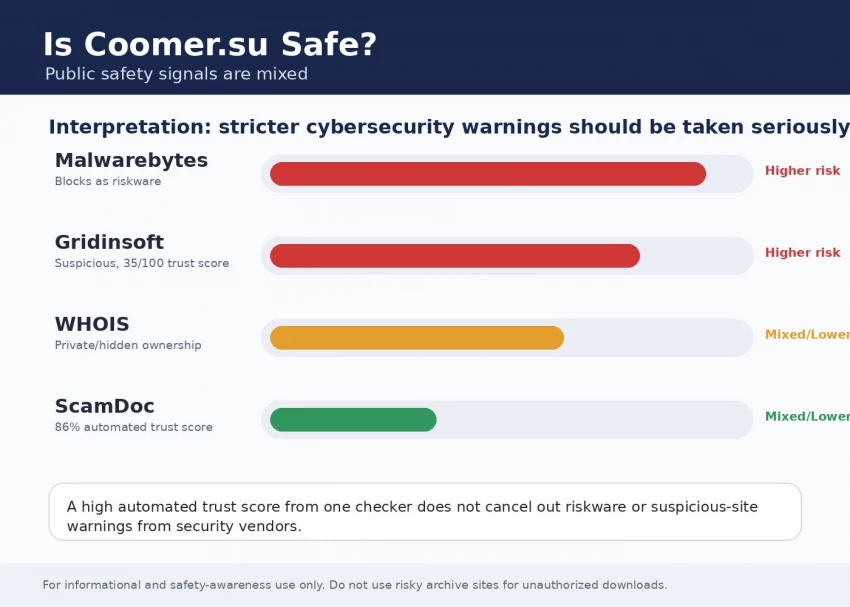
The safety signals around Coomer.su are not perfectly consistent, which is exactly why the article should treat it carefully. Malwarebytes blocks the domain because it is associated with riskware and says the platform can be abused to share malicious files. Gridinsoft also marks Coomer.su as suspicious and gives it a 35/100 trust score with a blacklist warning.
At the same time, ScamDoc gives Coomer.su a higher automated trust score of 86%, while still noting that HTTPS does not automatically mean a site is safe. WHOIS data shows the domain was registered on August 25, 2022, and the registrant is listed privately, which reduces transparency even if it is not proof of wrongdoing by itself.
| Source | Public Signal | Why It Matters |
| Malwarebytes | Blocks coomer.su as riskware | Strong warning from a cybersecurity vendor |
| Gridinsoft | Suspicious website, 35/100 trust score | Suggests users should avoid sensitive actions |
| ScamDoc | 86% trust score | Shows that automated trust tools may disagree |
| WHOIS | Private registrant details | Reduces ownership transparency |
| Website context | Adult archive/mirror-style content | Raises privacy, copyright, and malware concerns |
A higher trust score from one automated checker does not cancel out riskware warnings from cybersecurity vendors. Automated reputation tools use different signals, so the safest approach is to take the stricter warnings seriously, especially when a site involves adult material, file downloads, redirects, and third-party media.
The biggest concern with Coomer.su is not only the content category. It is also the environment around archive-style websites. These sites can expose users to risky downloads, redirects, intrusive ads, suspicious mirror domains, browser notification spam, and phishing attempts.
Malwarebytes describes riskware as software or behavior that may not always be strictly malicious but can still create user risk. In the specific Coomer.su alert, Malwarebytes says the domain is blocked because it is associated with riskware and can be abused to share malicious files.
| Risk | Why It Matters |
| Malicious downloads | Files may contain harmful or misleading content |
| Redirect ads | Users may be pushed toward unsafe pages |
| Fake mirror domains | Copycat sites can imitate the original domain |
| Phishing prompts | Login or payment forms may steal private data |
| Browser notifications | Users may receive spam or scam popups |
| Tracking scripts | Adult-site browsing can expose sensitive behavior |
| Riskware warnings | Security tools may block the site for valid reasons |
Users should never enter passwords, payment details, or private account information into suspicious third-party pages. They should also avoid downloading files, allowing browser notifications, installing extensions, or ignoring antivirus warnings from such domains.
The legal concern around Coomer.su is mainly connected to creator rights. Many creator platforms are built around paid access, subscription agreements, and creator-owned media. If a third-party archive mirrors or redistributes content without permission, it may create copyright, privacy, and platform-terms issues.
The simple rule is that visibility does not equal ownership. Just because a file appears on a website does not mean users are allowed to download it, repost it, sell it, use it in edits, or share it elsewhere.
| Action | Risk Level | Safer Choice |
| Viewing questionable archive content | Medium to high | Avoid risky domains |
| Downloading files | High | Do not download unauthorized content |
| Reposting creator content | Very high | Get clear permission first |
| Sharing private or paywalled media | Very high | Do not redistribute |
| Supporting creators officially | Low | Use official creator platforms |
This article is not legal advice, but from a content-safety and E-E-A-T perspective, the responsible recommendation is to avoid unauthorized creator-content archives and use official sources instead.
Privacy is a major part of the Coomer.su discussion. Creator content may be personal, paywalled, or intended for a limited audience. Even if a creator publishes adult content professionally, that does not mean they consent to their material being mirrored, indexed, downloaded, or redistributed on third-party sites.
This distinction matters. Consent is not removed because someone is a creator. A paid post, private post, limited-access upload, or subscription-based image still belongs to the person who created it or the rights holder connected to it.
Users who access leaked or mirrored material may indirectly support a system that harms creators. Creators can lose income, control, privacy, and trust when their work is copied outside the platform where they intended it to appear.
Any adult archive or mirror-style site should be checked more carefully than a normal website. This is especially true when security vendors flag it, ownership is not transparent, and the site may involve file downloads or user-shared media.
| Check | Why It Matters |
| Security vendor warnings | Antivirus and riskware flags should be taken seriously |
| Domain transparency | Hidden ownership reduces accountability |
| HTTPS | Helpful, but not proof that the site is safe |
| Download behavior | Unexpected files are a major red flag |
| Ads and popups | Risky ad networks can lead to unsafe pages |
| Login requests | Sharing credentials with third-party sites is dangerous |
| Creator consent | Ethical access depends on permission |
| Takedown process | Rights-respecting platforms should offer clear reporting |
| Public reviews | Mixed or limited review data increases uncertainty |
For a topic like Coomer.su, Google-friendly content should not try to exploit curiosity. A stronger article should prioritize safety, privacy, copyright, and creator-rights context.
Safer alternatives should not mean other mirror or leak sites. The ethical alternative is to use official creator sources, legal platforms, and public content that creators intentionally publish.
| Need | Safer Alternative |
| Follow a creator | Use their official profile or website |
| Access premium content | Subscribe through approved platforms |
| Save public updates | Use built-in bookmark or save features |
| Research the creator economy | Use legitimate reports, blogs, and platform data |
| Find legal adult content | Use licensed and compliant platforms |
| Support creators | Pay through official creator links |
This approach protects both the user and the creator. It also avoids the cybersecurity risks commonly connected with adult archive and mirror domains.
Coomer.su is best understood as a controversial third-party archive connected to creator subscription content. It should not be treated like a normal, trusted entertainment platform. The risk is not limited to one area. It includes cybersecurity warnings, hidden ownership signals, adult-content privacy concerns, possible unauthorized content sharing, copyright issues, and creator-consent problems.
The strongest public warnings come from cybersecurity sources. Malwarebytes blocks Coomer.su as riskware, while Gridinsoft marks it suspicious with a low trust score. Even though some automated trust tools show more positive signals, those do not remove the need for caution.
The safest recommendation is to avoid using such sites for downloads, reposting, or access to material that may be unauthorized. Users who want creator content should support creators through official platforms. Creators who find their work mirrored should document evidence, file takedown requests, report the issue, and seek legal advice when necessary.
Share your thoughts about this article.
Be the first to post a comment!
Are you tired of spending hours creating invoices for your clients? I was,...
Sakshi Dhingra5 days ago
How I approached this review: I researched Wegic AI through its public site, pri...
Sakshi Dhingra1 week ago

PicLumen has been quietly creeping into AI creator circles for over a year now,...
Sakshi Dhingra1 week ago

The thing that broke me, finally, was the seventh-grade Egypt quiz.It was a Thur...
Sakshi Dhingra3 weeks ago
A 56% Wake-Up Call for Every StudentTL;DR — Perplexity wins for fact-finding, ci...
Sakshi Dhingra3 weeks ago
Excerpt: Most Shopify vs WooCommerce articles read like they were written withou...
Sakshi Dhingra3 weeks ago