A marketing team in 2023 that wanted a two-minute product explainer typically booked a studio, hired a presenter, scheduled an editor, and waited a fortnight for the first cut. In 2026 the same team types a script into a browser, selects a presenter from a library, and downloads a finished 1080p file before the meeting that requested it has ended. That shift is the story of AI avatar video: digital presenters generated from text, driven by synthetic or cloned voices, and rendered with lip movements accurate enough that most viewers cannot spot the difference on a laptop screen.
The technology has crossed from experimentation into infrastructure. According to Pictory's compilation of 2026 industry data, 35% of corporate training videos produced this year use an AI avatar rather than an on-camera human, up from 8% in 2023. Market analysts at Precedence Research value the global AI avatar market at $12.90 billion in 2026 and forecast $142.62 billion by 2035. At the same time, the European Union's AI Act transparency obligations became applicable on 2 August 2026, meaning that any business publishing synthetic presenter video to EU audiences now carries a legal disclosure duty.
This guide covers what AI avatar video does in 2026, where the market stands, which business functions see the strongest returns, what the four leading platforms charge once minutes, credits, and seats are counted, how to judge organisational readiness with a structured 30-point scoring model, and what the new compliance landscape requires.
Key takeaways at a glance
| Theme | What the evidence shows in 2026 |
| Market scale | Precedence Research values the global AI avatar market at $12.90 billion in 2026, rising to $142.62 billion by 2035 at a 30.73% compound annual growth rate. |
| Adoption | 35% of corporate training videos now use AI avatars (8% in 2023). 78% of marketing teams use AI-generated video in at least one campaign per quarter (Pictory, 2026). |
| Speed | A finished video under ten minutes long renders in under five minutes, against four to six hours for a traditional shoot and edit. |
| Cost | Entry paid tiers on Synthesia, HeyGen, Colossyan, and D-ID cluster between $27 and $29 per month billed monthly, or $16 to $24 on annual billing. Real spend is driven by minutes, credits, and seats, not the headline price. |
| Compliance | EU AI Act Article 50 disclosure duties apply from 2 August 2026. Penalties reach EUR 15 million or 3% of worldwide annual turnover, whichever is higher. |
| Readiness | The AVATAR Fit Score introduced in Section 7 gives a six-factor, 30-point method for deciding between a pilot, a full rollout, or a hold. |
An AI avatar video is a piece of video content in which the on-screen presenter is a computer-generated digital human rather than a filmed person. The presenter's speech comes from text-to-speech or a cloned voice, the facial movement and lip sync are synthesised to match that audio, and the scene, captions, and graphics are assembled in a browser-based editor rather than a traditional editing suite.
The category is distinct from general text-to-video generators. Tools such as Google Veo and Runway render entire scenes, camera moves, and environments from a written prompt, which makes them suited to cinematic clips and concept work. Avatar platforms are built for a narrower job: a consistent, brand-safe, editable talking presenter that can be regenerated in seconds when a price changes or a policy is updated. That narrowness is exactly why businesses adopt them at scale.
Platforms now offer four broad categories of presenter, each with its own cost profile, consent burden, and ideal use case.
Table 1: Avatar types compared
| Avatar type | What it is | Typical availability | Best suited to |
| Stock avatar | A licensed library presenter, filmed and modelled by the platform. Synthesia lists 125+ on Starter and 240+ on Enterprise; HeyGen lists 500+. | Included in all paid plans, often in free tiers with a watermark. | Training modules, product explainers, knowledge base clips, generic internal updates. |
| Custom avatar (digital twin) | A modelled likeness of a real employee, executive, or brand ambassador, usually created from a short filmed session or webcam capture. | Synthesia: 3 on Starter, 5 on Creator. HeyGen: included from Creator, expanded on Business. Colossyan and D-ID: paid tiers and above. | Executive communications, sales outreach, thought leadership, localised campaigns with a known face. |
| Photo avatar | A single still image animated to speak, the core of D-ID's original product. | Lowest cost; D-ID Lite starts at about $4.70 per month on annual billing (non-commercial). | Quick personalised messages, low-stakes internal notes, rapid prototyping of scripts. |
| Interactive real-time avatar | An avatar connected to a large language model that answers live questions in a chat or kiosk interface. D-ID launched V4 Expressive Visual Agents in March 2026; DeepBrain AI released Interactive AI Video Agents the same month. | Enterprise or usage-based pricing on most platforms. | Customer support, retail kiosks, sales assistants, onboarding concierges. |
Grand View Research reports that interactive avatars accounted for 68.4% of AI avatar market revenue in 2025, a signal that the category is moving beyond pre-rendered clips toward live, conversational deployments. For most businesses in 2026, however, the pre-rendered presenter video remains the entry point because it needs no integration work and delivers value on day one.
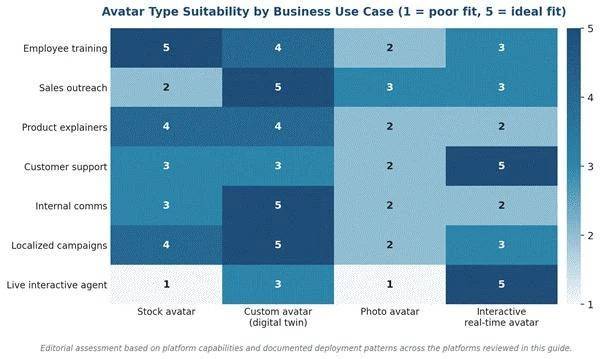
Figure 1: Editorial assessment of avatar type suitability across seven common business use cases. Scores reflect platform capabilities and documented deployment patterns as of September 2026.
The production pipeline has settled into six stages that look broadly the same on every major platform. Understanding each stage helps a buyer see where quality is won or lost, and where the credit meters actually run.
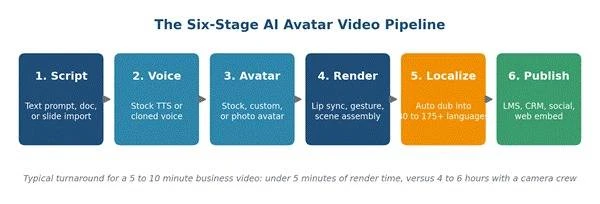
Figure 2: The six-stage AI avatar video pipeline used by Synthesia, HeyGen, Colossyan, and D-ID in 2026.
Every avatar video starts as text. Platforms accept typed scripts, pasted documents, imported slide decks, and increasingly a one-line brief that an in-app assistant expands into a full script. Synthesia's AI Video Assistant, available from the Starter tier, is one example. Script quality drives everything downstream: a badly paced script produces a robotic video regardless of how expressive the rendering model is.
The script is converted to speech either by a stock text-to-speech voice or by a cloned voice built from a short recording of a real person. Voice cloning is available from HeyGen's Creator plan (one clone) and D-ID's Pro plan (one clone, rising to three on Advanced). Cloning a voice requires explicit consent from the person recorded, and the platforms enforce a verification step for that reason.
The buyer selects a stock presenter, a custom digital twin, or a photo avatar. The rendering model then generates facial movement, blinking, gesture, and head motion to match the audio. HeyGen's Avatar IV model is the most expressive option in its lineup but consumes 20 credits per minute, roughly 6.7 times the rate of its Avatar III model. Colossyan's NEO 2 model is capped at 10 minutes per month even on its Business plan. These caps matter because premium rendering is where subscription allowances drain fastest.
The platform composites the avatar over a background, adds captions, on-screen text, screen recordings, and brand elements, and exports at 1080p or 4K. HeyGen restricts 4K to its Pro tier and above; Synthesia and Colossyan handle resolution at the plan level. Pictory's 2026 data puts render time for a video under ten minutes at less than five minutes.
One master video can be dubbed into dozens of languages with the avatar's lip movements re-synchronised to the translated audio. HeyGen supports 175+ languages, Colossyan lists 70+, and D-ID's Video Translate covers 30+. Synthesia places one-click translation on its Enterprise tier. Localisation is the feature that most often justifies the subscription for multinational teams, because it replaces a per-language reshoot with a per-language credit charge.
Finished files export as MP4, embed via a share link, or push directly into a learning management system through SCORM packages. SCORM export sits on Synthesia Enterprise, HeyGen Business, and Colossyan Enterprise. API access, for teams that want to generate video programmatically from a CRM or a product database, is available on Synthesia Creator, D-ID Pro, and HeyGen through a separate prepaid API wallet.
Market sizing for AI avatars varies widely depending on what analysts count. Narrow definitions cover only avatar video generation tools. Broad definitions fold in gaming characters, virtual influencers, and conversational digital humans. Both views agree on the growth rate: every major forecast published in 2026 lands between 30% and 33% compound annual growth.
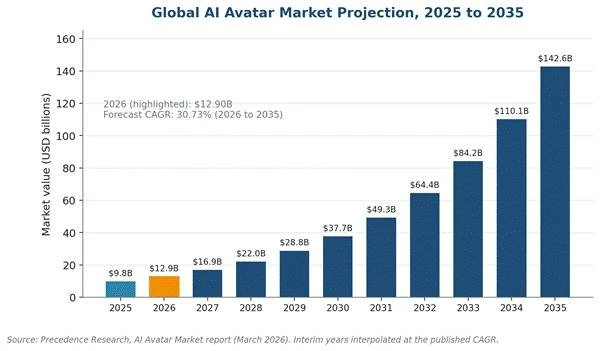
Figure 3: Precedence Research's projection for the global AI avatar market, 2025 to 2035. The 2026 figure of $12.90 billion is highlighted; interim years are interpolated at the published 30.73% CAGR.
Table 2: How the major forecasts compare
| Source | 2026 estimate | Forecast end point | CAGR | Scope |
| Precedence Research (March 2026) | $12.90 billion | $142.62 billion by 2035 | 30.73% | Broad: interactive and non-interactive digital humans across gaming, BFSI, education, advertising, and other verticals. |
| Grand View Research (July 2026) | $1.08 billion | $7.90 billion by 2033 | 32.9% | Narrower: AI avatar platforms and digital human software for enterprise engagement, training, and content. |
| ToolixLab industry summary (June 2026) | $5.1 billion (avatar technology segment) | Not stated | 32% annually | Digital human presenters for training, marketing, and customer content; names Synthesia, HeyGen, and Colossyan as segment leaders. |
| Coherent Market Insights (August 2026) | $5.50 billion (total AI video) | $42 billion by 2033 | 27% | Total AI video market including avatars, dubbing, and generative clips; cites UBS using Synthesia avatars of its analysts since May 2025. |
Adoption indicators tell a more practical story than market value. The share of corporate training videos built with avatars more than quadrupled in three years, and AI video has become a routine campaign tool for most marketing departments.
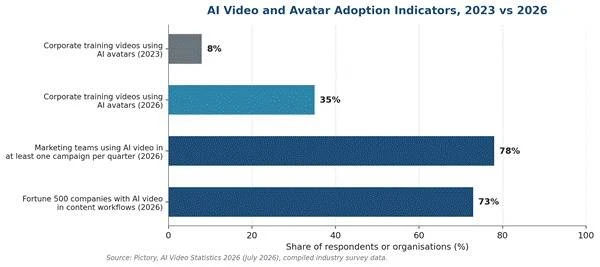
Figure 4: Adoption indicators compiled by Pictory from 2026 industry survey data.
The UBS example cited by Coherent Market Insights illustrates how adoption looks inside a regulated enterprise. Since May 2025 the bank has converted analyst research into client-facing videos using avatars of the analysts themselves, generated with Synthesia and scripted with OpenAI models, removing the need for each analyst to book studio time. Financial services, professional training, and e-learning are the industries that G2 reviewers most often cite as active buyers across all four leading platforms.
The strongest returns come from formats that are short, frequently updated, and distributed to many people. Those three conditions are exactly where traditional production is weakest and avatar production is strongest. For teams deciding which solution best matches these workflows, our guide to choosing the right AI avatar video platform for your business compares the major options based on practical business needs.
Table 3: Use case playbook
| Use case | Typical length | Avatar type | Primary metric | Platform features that matter |
| Employee training and onboarding | 3 to 8 minutes per module | Stock or custom | Completion rate, time to competency, retraining cost | SCORM export, quizzes, branching scenarios, version control |
| Sales outreach and account-based marketing | 45 to 90 seconds | Custom digital twin of the rep | Reply rate, meetings booked | Personalisation variables, CRM integration, API generation |
| Product explainers and feature announcements | 1 to 3 minutes | Stock | Watch-through rate, trial activation | Screen recording, brand kit, template library |
| Customer support and knowledge base | 1 to 2 minutes | Stock or interactive | Ticket deflection, self-service resolution | Multilingual output, web embed, real-time agent option |
| Internal communications | 1 to 3 minutes | Custom twin of a leader | Open rate, comprehension survey | Same-day turnaround, approval workflow |
| Localised marketing campaigns | Any | Custom | Regional engagement, cost per language | One-click translation, lip re-sync, regional voice selection |
Learning and development teams were the first to adopt avatar video at scale, and they remain the largest buyer group. The economics are simple: a compliance module that changes every quarter costs a full reshoot under the traditional model and a two-minute regeneration under the avatar model. Colossyan built its entire product around this segment, with interactive branching, multi-actor scenes, and SCORM packaging. Synthesia's Enterprise tier and HeyGen's Business tier compete for the same buyers. Guidde cites a 2026 Forrester study reporting that organisations using AI-powered video documentation cut content production time by up to 90% and achieved 23% faster employee onboarding.
A sales representative with a custom avatar can generate hundreds of one-minute prospect videos from a single template, each addressing the prospect by name and referencing their company. The rep records once; the platform handles the variations. HeyGen and Synthesia both expose personalisation variables for this purpose, and Synthesia's Creator plan includes API access so a CRM can trigger generation automatically. The metric to watch is reply rate against a plain-text control, not production volume.
For any company selling in more than three languages, localisation is usually the line item that turns an avatar subscription from a nice-to-have into a cost saving. A ten-minute product training video localised into eight languages by traditional means requires eight voice actors, eight studio sessions, and eight edits. On an avatar platform it requires one approved master and eight translation runs. HeyGen's 175-language coverage and lip re-sync are the reference point here, though buyers should check that the specific dialect and voice gender they need is available before signing.
Time savings are the least disputed benefit. Pictory's 2026 data places traditional production of a sub-ten-minute video at four to six hours of crew, talent, and editing time, against under five minutes of render time on an avatar platform. Teams also report roughly 70% less time spent on scheduling, because there is no studio, no talent calendar, and no post-production hand-off to coordinate.
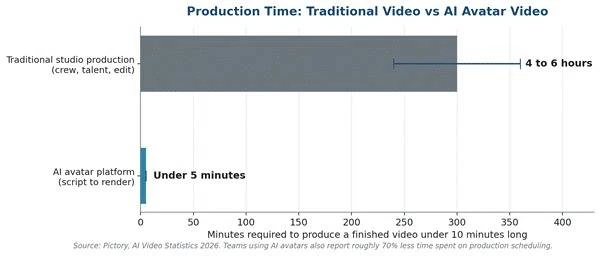
Figure 5: Production time for a finished video under ten minutes long, traditional studio workflow versus AI avatar platform.
Headline subscription prices are easy to compare. The number that matters is cost per finished minute of usable video, which depends on the minute or credit allowance attached to each plan. Table 4 works that figure out from the published allowances on each platform's entry and mid tiers.
Table 4: Subscription cost per finished minute (single seat, billed monthly, September 2026)
| Plan | Monthly price | Monthly allowance | Approximate cost per minute | Notes |
| Synthesia Starter | $29 | About 10 minutes | $2.90 | Same 1,200-credit pool as the free tier; shared across video, dubbing, and API use. |
| Synthesia Creator | $89 | About 30 minutes | $2.97 | Adds API access, interactive video, and 5 personal avatars. Overage minutes reported at $2 to $5 each. |
| HeyGen Creator | $29 | 600 credits | About $0.97 at Avatar IV rates (20 credits per minute) | Standard avatars consume fewer credits, so effective cost can be lower. Unlimited video count. |
| Colossyan Starter | $27 | 15 minutes | $1.80 | Annual billing drops the plan to $19 per month, or $1.27 per minute. |
| Colossyan Business | $88 | Unlimited NEO 1 video; NEO 2 capped at 10 minutes | Volume dependent | Best value for high-volume training teams that can live with the NEO 1 model. |
| D-ID Pro | About $29 | Roughly 10 to 15 minutes | About $1.90 to $2.90 | Lowest tier that permits commercial use. Credits are consumed even when a render needs a retry. |
Several less visible charges push real spend above the plan price on every platform, and they explain most of the pricing complaints found in public reviews:
Set against this, the traditional alternative involves a crew day rate, a presenter fee, studio hire, and editing hours, plus the same again for every reshoot and every language. For teams producing more than a handful of videos per month, even the most expensive avatar tier is a fraction of that cost. For teams producing one hero campaign per year, the arithmetic is far less clear, which is the point of the readiness model in Section 7.
Four platforms account for the overwhelming majority of business deployments: Synthesia, HeyGen, Colossyan, and D-ID. Each has a distinct centre of gravity. Synthesia is the enterprise learning and communications standard. HeyGen leads on expressiveness, language coverage, and creator-friendly pricing. Colossyan is the specialist for training teams that need interactivity and SCORM at a lower price. D-ID is the developer-first, API-centric option with the cheapest entry point and the strongest real-time agent story.
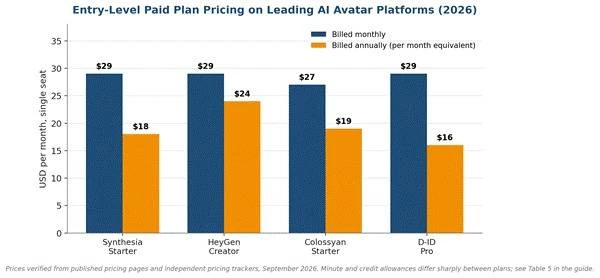
Figure 6: Entry-level paid plan pricing on the four leading AI avatar platforms, monthly versus annual billing. Verified September 2026.
Table 5: Platform pricing tiers (verified September 2026)
| Platform | Free tier | Entry paid tier | Mid tier | Team and enterprise |
| Synthesia | $0, watermarked, limited minutes, 9 avatars. | Starter: $29 per month ($18 annual). About 10 minutes, 125+ avatars, 3 personal avatars, logo removal. | Creator: $89 per month ($64 annual). About 30 minutes, 180+ avatars, 5 personal avatars, API, interactive video. | Enterprise: custom, typically low five figures annually. Unlimited minutes, 240+ avatars, SSO, SCORM, one-click translation. |
| HeyGen | $0, 3 videos per month, watermark, up to 1 minute each. | Creator: $29 per month (about $24 annual). 600 credits, 1080p, unlimited videos, 1 voice clone. | Pro: $49 to $99 per month, tiered. 1,000+ credits, 4K export, translation script editing. | Business: $149 per month plus $20 per extra seat. 1,500 credits, SSO, collaboration, SCORM. Enterprise: custom. |
| Colossyan | $0, about 3 minutes per month. | Starter: $27 per month ($19 annual). 15 minutes, 70+ avatars. | Business: $88 per month ($70 annual). Unlimited NEO 1 video, 110+ avatars, multi-editor. | Enterprise: custom. SCORM export, advanced collaboration, unlimited generation. |
| D-ID | 14-day trial, 5 minutes, watermark, 512px. | Lite: about $4.70 per month on annual billing. Non-commercial, 512px, single presenter. | Pro: about $16 per month annual (about $29 monthly). 1080p, API access, 1 voice clone, commercial use. | Advanced: about $108 per month annual. 3 voice clones, branding, priority render. Enterprise: custom, agents, SLAs. |
Table 6: Platform strengths and watch-outs
| Platform | Standout strengths | Watch-outs |
| Synthesia | Polished enterprise editor, brand governance controls, and the widest adoption among large learning and development teams. | Per-seat pricing with no pooled minutes; SCORM export and one-click translation are locked to the Enterprise tier. |
| HeyGen | Avatar IV expressiveness, 175+ language coverage, and the fastest iteration on new rendering models. | Credit maths is opaque; Avatar IV burns 20 credits per minute; a Trustpilot score of 2.4 driven largely by billing complaints. |
| Colossyan | Cheapest professional plan on annual billing; interactive branching and multi-actor scenes built for training teams. | NEO 2 model capped at 10 minutes per month on Business; presenters can still read as artificial in some scenes. |
| D-ID | Photo-to-avatar in seconds, a developer-friendly API, and V4 Expressive Visual Agents for real-time use. | Low minute caps on entry plans; watermark removal only from Advanced; credits are consumed on failed renders. |
Pricing disclaimer All prices above were cross-checked against published pricing pages and independent pricing trackers (Arcade, Layer3 Labs, Flowith, Costbench, G2, and Capterra) in September 2026. Every platform has changed its plan structure at least once in the past twelve months, and HeyGen's Creator credit allowance alone was reported at three different levels between April and July 2026. Buyers should treat these figures as a starting point and confirm the live pricing page, the current credit consumption rate per model, and the annual billing terms before purchase. |
Most guidance on avatar video stops at feature comparison. The harder question is whether a specific organisation, with its audience, content volume, and regulatory exposure, should deploy the technology at all, and at what scale. The AVATAR Fit Score answers that with six weighted factors, each scored from 1 to 5, producing a total out of 30. The acronym maps directly to the six questions a decision-maker needs to answer.
Table 7: AVATAR Fit Score criteria and scoring anchors
| Factor | Question | Score 1 | Score 3 | Score 5 |
| A Audience expectations | Will the target audience accept a synthetic presenter for this content? | Audience expects a named human face and emotional authenticity (luxury brand, grief support, crisis comms). | Mixed; some segments accept, others would notice and object. | Audience is indifferent to presenter identity and values clarity and speed (training, product help, internal updates). |
| V Volume and velocity | How many videos per month, and how often does the content change? | One or two videos per year with stable content. | Five to ten videos per quarter, occasional updates. | Weekly or daily output, frequent revisions, multiple languages. |
| A Approval and compliance load | How heavy is the review and disclosure burden? | Regulated content requiring legal sign-off on every frame, EU-facing deepfake disclosure, no existing process. | Some review needed; disclosure policy exists but is untested. | Light review; disclosure template and labelling workflow already in place. |
| T Talent and likeness rights | Are the people whose faces or voices will be used willing, and is consent documented? | No consent framework; key presenters uncomfortable with cloning. | Consent obtainable but not yet in writing; stock avatars acceptable as fallback. | Written consent secured, usage scope defined, stock avatars approved by brand team. |
| A Analytics baseline | Can the business measure the outcome the video is meant to move? | No baseline metric; success would be anecdotal. | Metric exists but is tracked manually or inconsistently. | Clear baseline (completion rate, reply rate, ticket volume) with tooling in place. |
| R Resource budget | Does the current production spend justify a subscription once seats, credits, and overages are counted? | Current video spend is near zero; a subscription would be net new cost. | Subscription roughly matches current spend with modest savings. | Subscription is a clear fraction of current agency or studio spend. |
Table 8: Interpreting the total score
| Total score | Verdict | Recommended action |
| 24 to 30 | Strong fit | Proceed to a full deployment on a team or business tier. Negotiate annual billing. Build templates and a disclosure workflow before the first publish. |
| 17 to 23 | Pilot fit | Run a 90-day pilot on a single-seat entry tier against one measurable use case. Score again at the end of the pilot with real data. |
| 6 to 16 | Hold | The gap is usually in audience expectations, consent, or volume. Address the lowest-scoring factor first; a free tier is sufficient for exploration in the meantime. |
Two worked examples show how the score separates cases that look similar on the surface. Example A is a 400-person software company building an onboarding library for new hires in four languages. Audience expectations score 4 (new hires want clarity, not celebrity), volume scores 5 (twenty modules updated quarterly), compliance scores 3 (internal use, but EU staff means the disclosure duty still applies), talent rights score 4 (the head of people has agreed in writing to a digital twin), analytics scores 4 (the LMS already tracks completion), and budget scores 5 (an external e-learning vendor currently charges more per module than a year of Colossyan Business). Total: 25, a strong fit.
Example B is a luxury fashion house planning its autumn hero campaign. Audience expectations score 2, volume scores 2, compliance scores 2 (public EU campaign with a real ambassador means full deepfake labelling), talent rights score 3, analytics score 2, and budget scores 3. Total: 14, a hold. The model does not say avatar video is wrong for luxury brands; it says this particular job is the wrong first job.
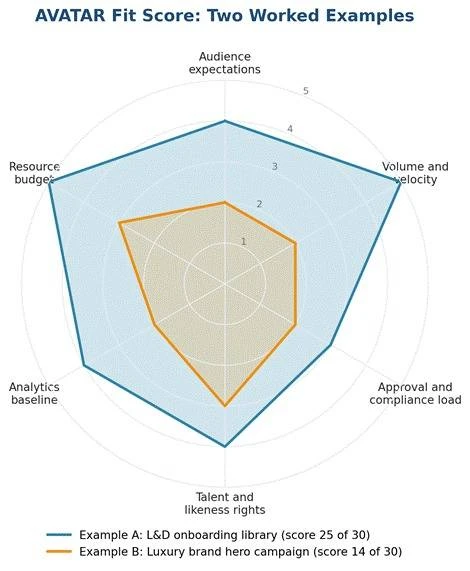
Figure 7: The two worked examples plotted on the AVATAR Fit Score. Example A (teal) scores 25 of 30; Example B (orange) scores 14 of 30.
The following workflow reflects how experienced teams operate in 2026. Each step exists because skipping it costs either credits or credibility.
The failure patterns in avatar video are remarkably consistent across company size and industry. Most are process problems rather than technology problems.
Table 10: Frequent mistakes, their cost, and the fix
| Mistake | Why it hurts | Fix |
| Writing the script like a document | Long sentences and passive constructions make even the best rendering model sound robotic. Viewers blame the avatar; the script is the culprit. | Read every script aloud. Cut any sentence that needs a breath in the middle. |
| Choosing the plan by headline price | The $29 tiers differ by a factor of three in usable minutes once credit rates and model tiers are counted. | Calculate cost per finished minute (Table 4) for the intended model before choosing. |
| Using a founder's twin for everything | Novelty fades fast, consent scope may not cover routine content, and a real person's likeness on a mundane update dilutes its impact when it matters. | Reserve custom twins for content where the specific person adds credibility. |
| Skipping the pronunciation pass | Mispronounced product names are the single most common reason business viewers stop trusting an avatar video. | Maintain a phonetic glossary per brand and apply it to every script. |
| Localising before approval | Every translation run consumes credits; corrections then multiply across languages. | Approve the master first, then localise. |
| Ignoring disclosure until launch day | Retrofitting an on-screen label to dozens of published videos is expensive and, after 2 August 2026, legally urgent for EU audiences. | Build the disclosure into the brand kit template. |
| Measuring output instead of outcomes | Producing 200 videos is not a result. A 12-point lift in training completion is. | Define the metric in step one of the workflow and report on it monthly. |
The direction of travel is visible in the product releases of the past six months. Five developments will shape purchasing decisions over the coming year.
AI avatar video in 2026 is a mature, well-priced production method for a specific class of business content: short, frequently updated, widely distributed, and measurable. For training, product education, sales outreach, and localisation, the time and cost advantages over traditional production are large enough that the decision is usually about which platform and which tier rather than whether to adopt at all.
Two things separate the deployments that deliver from the ones that quietly lapse after the first renewal. The first is choosing the plan by cost per finished minute at the rendering model actually needed, rather than by headline price. The second is treating disclosure, consent, and provenance as design inputs rather than launch-day afterthoughts, which after 2 August 2026 is a legal necessity for any content reaching EU audiences. The AVATAR Fit Score exists to force both questions before a credit card is entered. Organisations that score above 24 should move now; those between 17 and 23 should pilot one use case with a clear metric; and those below 17 should fix the lowest-scoring factor first, because the technology will still be there, and cheaper, when they return.
Share your thoughts about this article.
Be the first to post a comment!
What actually happens in the space between the moment an app builder produces a...
Nitin3 weeks ago

Two years ago, an AI presenter on screen was a talking point. Today it is a line...
Parveen Verma1 month ago

Quick answer: ChatGPT is owned and operated by OpenAI Group PBC, a for-profit pu...
Sakshi Dhingra1 month ago

Here is the exact moment most people end up asking this question. You have final...
Nitin2 months ago
A stolen password does not always look suspicious to a login system. If the user...
Deepak Mehra2 months ago
The short versionA Claude API key is created in the Claude Console at platform.c...
Harpreet Singh2 months ago