| Quick answer: ChatGPT is owned and operated by OpenAI Group PBC, a for-profit public benefit corporation that is controlled by the nonprofit OpenAI Foundation. No single company or individual owns ChatGPT outright. Microsoft is the largest external shareholder with roughly 27 percent of the company, the OpenAI Foundation holds about 26 percent along with full governance control, and current and former employees together with outside investors hold the remaining 47 percent. The figures reflect the recapitalization OpenAI completed on October 28, 2025. |
Few questions in technology generate as much confusion as the ownership of ChatGPT. The product reaches more than 900 million people every week, yet its parent sits behind one of the most unusual corporate structures ever built: a nonprofit foundation that controls a for-profit corporation valued at 852 billion dollars as of March 2026. This breakdown maps every layer of that structure, backed by primary disclosures and verified figures.
Legal owner: OpenAI Group PBC, a Delaware public benefit corporation formed through the October 28, 2025 recapitalization.
Controlling entity: The nonprofit OpenAI Foundation, which appoints the entire board of the for-profit and holds a 26 percent stake worth about 130 billion dollars, plus a long-dated equity warrant.
Largest external shareholder: Microsoft, with roughly 27 percent on an as-converted diluted basis, valued near 135 billion dollars at the recapitalization.
Valuation: 852 billion dollars after a record 122 billion dollar funding round closed on March 31, 2026.
Scale: More than 900 million weekly active users, over 1 billion monthly active users as of June 2026, and more than 50 million paying subscribers.
Public listing: Not yet. A confidential S-1 was filed on June 8, 2026, with a listing now expected in 2027 at a targeted valuation near 1 trillion dollars.
Individual stakes: CEO Sam Altman holds no equity. Co-founder Elon Musk holds no equity and left the board in 2018.
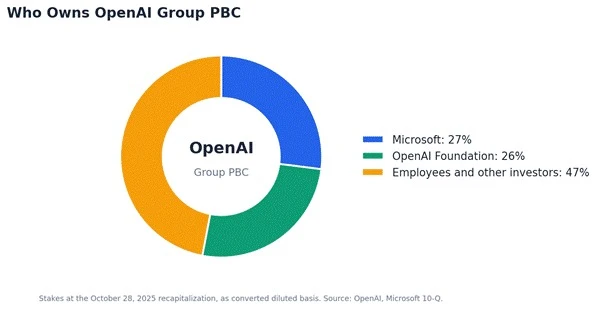
Figure 1. The three ownership blocks of OpenAI Group PBC at the October 2025 recapitalization: Microsoft at 27 percent, the OpenAI Foundation at 26 percent, and employees plus outside investors at 47 percent.
Asking who owns ChatGPT produces four different correct answers depending on which layer of ownership is examined. To keep those answers straight, this article applies the Four Layer Ownership Model, a framework that separates the question into legal title, governance control, economic interest, and operational leadership. Layer one identifies the entity that legally holds the product. Layer two identifies who controls decisions. Layer three identifies who captures the financial value. Layer four identifies who actually runs the operation.
Every figure below was verified on August 26, 2026 against primary disclosures, including OpenAI's official structure page and funding announcements, Microsoft's 10-Q filing dated October 30, 2025, and reporting from CNBC, Reuters, and the Financial Times.
ChatGPT belongs to OpenAI Group PBC, the for-profit arm of OpenAI. The entity took its current form on October 28, 2025, when OpenAI completed a recapitalization that converted its capped-profit subsidiary, originally created in 2019 as OpenAI LP, into a Delaware public benefit corporation. A public benefit corporation differs from a conventional company in one important way: its charter legally requires it to advance a stated mission, in this case ensuring that artificial general intelligence benefits humanity, alongside shareholder interests.
OpenAI Group PBC owns and operates the full commercial product line: ChatGPT across its free, Plus, Pro, Team, Enterprise, and Edu tiers, the developer API, the Sora video products, and the growing agent and commerce features. When a business signs a ChatGPT Enterprise contract, the counterparty is OpenAI Group PBC or one of its regional service entities.
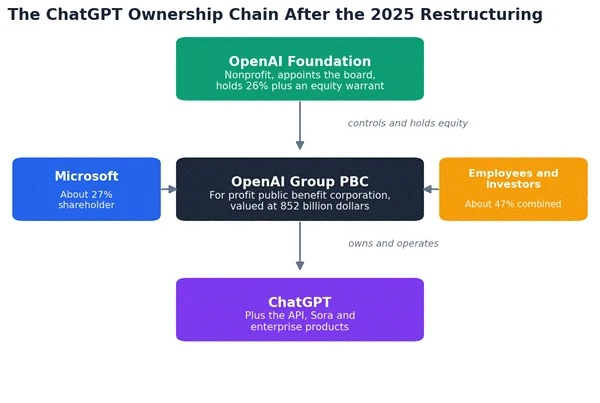
Figure 2. The ownership chain: the nonprofit OpenAI Foundation controls OpenAI Group PBC, which owns ChatGPT, while Microsoft, employees, and outside investors hold shares in the PBC.
Control of ChatGPT does not sit with the largest shareholder. It sits with the OpenAI Foundation, the nonprofit that started the entire organization in 2015. Under the recapitalized structure, the Foundation appoints every member of the OpenAI Group PBC board and retains the power to replace directors. Special governance provisions, including oversight through the Safety and Security Committee, remain Foundation powers that extend across the commercial group.
The Foundation also holds real economic weight: a 26 percent equity stake valued around 130 billion dollars at the recapitalization, plus a warrant that grants additional shares if the stock price exceeds a set threshold after 15 years. OpenAI has stated that the Foundation is positioned to be the single largest long-term beneficiary of the company's success. Its opening philanthropic commitment totals 25 billion dollars, focused on using AI to help cure diseases and on building societal resilience to AI itself.
One point deserves emphasis because it is widely misunderstood: the Foundation does not control OpenAI because it owns 26 percent. It controls OpenAI because the legal structure grants it exclusive board appointment rights. The Foundation board includes chair Bret Taylor, Sam Altman, Adam D'Angelo, Sue Desmond-Hellmann, Zico Kolter, Paul Nakasone, Adebayo Ogunlesi, and Nicole Seligman.
Microsoft has committed more than 13 billion dollars to OpenAI since 2019, of which about 11.6 billion dollars had been funded as of its October 2025 quarterly filing. Following the recapitalization, Microsoft disclosed for the first time an exact position: roughly 27 percent of OpenAI Group PBC on an as-converted diluted basis, valued at approximately 135 billion dollars. Before the recapitalization, Microsoft's stake stood at 32.5 percent on an as-converted basis, excluding recent funding rounds.
The accompanying October 2025 agreement extended Microsoft's rights to OpenAI's models and products through 2032 and committed OpenAI to purchase an additional 250 billion dollars of Azure cloud services, while removing Microsoft's position as exclusive compute provider. Reporting in April 2026 indicated the partnership loosened further, including caps on revenue-sharing payments. The critical distinction: Microsoft is a shareholder and commercial partner. It does not own ChatGPT, holds no majority, and controls no board seats.
Current and former employees together with outside investors hold the remaining 47 percent of OpenAI Group PBC. The investor bench has grown into one of the deepest in private markets. SoftBank led the 40 billion dollar round of March 2025 at a 300 billion dollar valuation, then returned with 30 billion dollars in the March 2026 round. That later round, which closed on March 31, 2026 with 122 billion dollars in committed capital at an 852 billion dollar post-money valuation, was anchored by Amazon at 50 billion dollars, of which 35 billion is contingent on an IPO or an AGI milestone, alongside Nvidia and SoftBank at 30 billion dollars each. Andreessen Horowitz, MGX, TPG, D.E. Shaw Ventures, and T. Rowe Price advised accounts also participated. Earlier backers include Thrive Capital, Sequoia Capital, Khosla Ventures, Y Combinator, and the Reid Hoffman Foundation.
| Stakeholder | Stake | Value at recap | Role |
| Microsoft | About 27% | About $135 billion | Largest external shareholder, cloud and product partner |
| OpenAI Foundation | About 26% | About $130 billion | Nonprofit controller, appoints the entire board |
| Employees and founders | Part of 47% | Not disclosed | Equity held by current and former staff |
| Outside investors | Part of 47% | Not disclosed | SoftBank, Amazon, Nvidia, Thrive, a16z, MGX, TPG, and others |
| Sam Altman | 0% | Zero | Chief executive and Foundation board member |
Table 1. The OpenAI Group PBC cap table by block. Percentages reflect the October 28, 2025 recapitalization and predate dilution from the March 2026 round.
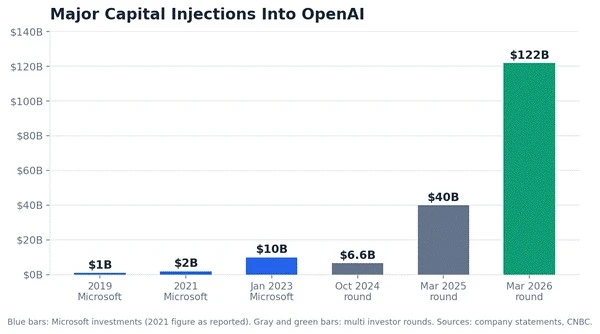
Figure 3. Major capital injections into OpenAI, from Microsoft's initial 1 billion dollar investment in 2019 to the record 122 billion dollar round of March 2026.
Sam Altman co-founded OpenAI in 2015 and has served as chief executive of the for-profit since 2019, yet he holds no equity in the company, an arrangement that remains one of the most unusual in technology. Any future grant would require board approval and public disclosure, and none had been announced as of August 2026. President Greg Brockman, another co-founder, remains central to the research organization, while Fidji Simo joined in 2025 as chief executive of Applications, overseeing ChatGPT's consumer business.
Governance power at OpenAI is not theoretical. In November 2023 the nonprofit board removed Altman as chief executive, then reinstated him within days after employee and investor pressure. The episode demonstrated exactly where ultimate control sits and set in motion the restructuring that produced the current Foundation and PBC arrangement.
| Date | Event | Ownership impact |
| December 2015 | OpenAI founded as a nonprofit by Sam Altman, Elon Musk, Greg Brockman, Ilya Sutskever, Wojciech Zaremba, John Schulman, Andrej Karpathy, and others, with about 1 billion dollars pledged by donors including Musk, Peter Thiel, Reid Hoffman, AWS, Infosys, and YC Research | No owners; donor funded |
| February 2018 | Elon Musk departs the board, citing potential conflicts with Tesla's AI work | Musk's influence ends |
| March 2019 | Capped-profit subsidiary OpenAI LP created to raise investment capital | First investor equity, returns capped |
| July 2019 | Microsoft invests 1 billion dollars and becomes exclusive cloud partner | Microsoft enters the cap table |
| November 2022 | ChatGPT launches and reaches an estimated 100 million users within two months | Product value explodes |
| January 2023 | Microsoft commits roughly 10 billion dollars more at a reported 29 billion dollar valuation | Microsoft stake deepens |
| October 2024 | 6.6 billion dollar round led by Thrive Capital values OpenAI at 157 billion dollars | Broad institutional entry |
| March 2025 | SoftBank leads a 40 billion dollar round at a 300 billion dollar valuation | SoftBank becomes a major holder |
| October 2025 | Employee secondary sale at a 500 billion dollar valuation; recapitalization completed on October 28 creates the OpenAI Foundation and OpenAI Group PBC | Modern cap table fixed: 27, 26, and 47 percent blocks |
| March 2026 | 122 billion dollar round closes at an 852 billion dollar valuation, anchored by Amazon, Nvidia, and SoftBank | Largest private financing in history |
| June 2026 | Confidential S-1 filed with the SEC on June 8 | IPO preparation begins |
Table 2. Eleven moments that shaped who owns ChatGPT today.
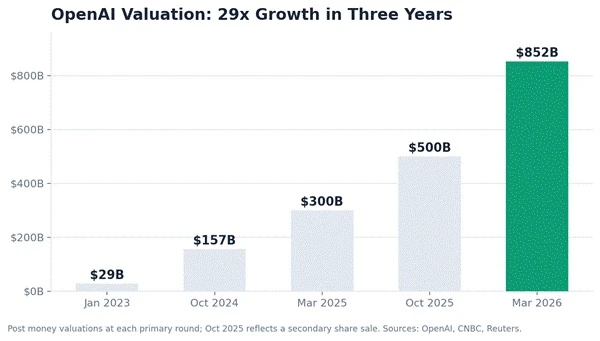
Figure 4. OpenAI's valuation multiplied roughly 29 times between January 2023 and March 2026, reaching 852 billion dollars.
No. Musk co-founded OpenAI in 2015 and contributed early funding reported at roughly 45 million dollars, but he resigned from the board in February 2018 and holds no equity in OpenAI Group PBC. Since 2024 he has pursued litigation against OpenAI over its conversion to a for-profit structure, and in February 2025 he led an unsolicited 97.4 billion dollar bid for the nonprofit's assets, which the board rejected unanimously. His xAI venture, maker of Grok, competes directly with ChatGPT.
Ownership stakes matter because of what they represent. ChatGPT surpassed 900 million weekly active users in early 2026 and crossed 1 billion monthly active users in June 2026, with more than 50 million paying subscribers and over 9 million business users across more than 7 million enterprise seats. OpenAI reports that 92 percent of Fortune 500 companies use its products. Annualized revenue reached about 25 billion dollars in February 2026, roughly 2 billion dollars per month, although audited 2025 statements reported by the Financial Times and Fortune showed 13.07 billion dollars in booked revenue against a 20.9 billion dollar operating loss, a reminder that compute costs still far outrun income.
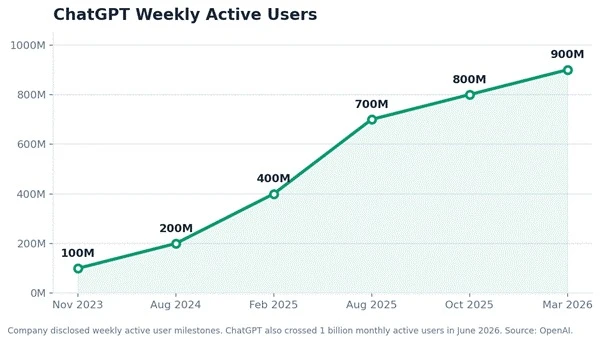
Figure 5. ChatGPT grew from 100 million to more than 900 million weekly active users in under two and a half years.
Not directly, at least not yet. OpenAI remains private, so no ChatGPT or OpenAI ticker exists. Public market exposure runs through shareholders and partners: Microsoft (NASDAQ: MSFT) with its roughly 27 percent stake, Nvidia (NASDAQ: NVDA), and SoftBank Group (TYO: 9984). That could change soon. OpenAI filed a confidential S-1 with the SEC on June 8, 2026, and reporting from the New York Times indicates the company is leaning toward a 2027 listing, with leadership targeting a valuation of at least 1 trillion dollars. Nothing in this article constitutes investment advice.
The ownership of ChatGPT is far more complex than a simple company or individual holding the rights to the product. Legally, ChatGPT is owned and operated by OpenAI Group PBC, while strategic control remains with the nonprofit OpenAI Foundation, which maintains governance authority over the company. Microsoft is the largest external shareholder, but its investment does not give it ownership or control of ChatGPT.
OpenAI’s unusual structure separates ownership, control, and economic benefits across different groups. The Foundation controls the direction of the organization, Microsoft and other investors hold significant financial stakes, and employees share ownership through equity holdings. This model allows OpenAI to raise massive amounts of capital while keeping its original mission-driven governance structure intact.
As ChatGPT continues expanding to more than 900 million weekly users and becomes a core technology platform for individuals, businesses, and developers, understanding its ownership structure becomes increasingly important. The company’s future may change further if it moves toward a public listing, but for now, ChatGPT remains a privately controlled OpenAI product rather than an asset owned by Microsoft, Sam Altman, or any single investor.
Ultimately, the answer to “Who owns ChatGPT?” depends on the definition of ownership: OpenAI Group PBC owns the product, the OpenAI Foundation controls the organization, investors share the economic value, and OpenAI’s leadership manages its operations. This layered structure is what makes ChatGPT one of the most valuable yet uniquely governed technology platforms in the world.
Share your thoughts about this article.
Be the first to post a comment!
What actually happens in the space between the moment an app builder produces a...
Nitin2 weeks ago
A marketing team in 2023 that wanted a two-minute product explainer typically bo...
Sakshi Dhingra1 month ago

Two years ago, an AI presenter on screen was a talking point. Today it is a line...
Parveen Verma1 month ago

Here is the exact moment most people end up asking this question. You have final...
Nitin1 month ago
A stolen password does not always look suspicious to a login system. If the user...
Deepak Mehra2 months ago
The short versionA Claude API key is created in the Claude Console at platform.c...
Harpreet Singh2 months ago