AI voice technology has expanded far beyond basic text-to-speech. Businesses can now deploy agents that answer phone calls, qualify leads and schedule appointments, while creators can generate narration, clone approved voices and localize content into multiple languages.
However, these products do not all solve the same problem. Retell AI is designed primarily for real-time conversational phone automation. Murf AI and ElevenLabs cover voice generation as well as increasingly advanced conversational use cases. Speechify is strongest as a text-to-speech and accessibility platform, while Voice.ai combines voice agents with voice changing, cloning and audio-production tools.
This comparison has been prepared using publicly available product documentation, feature pages, support resources and current pricing information. We have not conducted a controlled hands-on test of every platform, so claims about latency, voice quality and performance are attributed to the providers rather than presented as independent benchmark results.
At-a-Glance: AI Voice Tools Worth Considering
Tool
Best suited for
Main strength
Important limitation
Voice.ai
Small businesses wanting voice agents and creative audio tools
Voice agents, TTS, cloning and voice changing in one platform
Voice agents currently support English
Murf AI
Marketing, training and business narration
Detailed voiceover editing and multilingual content production
Advanced business features can require higher plans or sales contact
ElevenLabs
Realistic synthetic speech and conversational agents
Expressive voices combined with agent-building capabilities
Agent, LLM and telephony costs require careful calculation
Speechify
Reading, accessibility and rapid narration
Converts documents and webpages into listenable audio
Not primarily a full phone-agent platform
Retell AI
Inbound and outbound phone automation
Telephony, conversation flows, monitoring and agent analytics
Best suited to teams comfortable configuring workflows and integrations
One important distinction should guide the entire buying decision: a realistic AI voice is not automatically a capable AI voice agent. A phone agent must also understand callers, manage interruptions, use business data, complete actions and recover when a conversation goes off script.
Voice.ai is one of the broadest products in this comparison. It combines AI voice agents with text-to-speech, instant voice cloning, a real-time voice changer and several audio-processing tools.
Its voice-agent platform is designed for businesses that want to automate calls, answer customer questions, schedule appointments and connect conversations with existing systems. Voice.ai also offers APIs and SDKs for custom deployments.
This combination makes Voice.ai particularly relevant to small businesses or content teams that need more than one voice function. A team could use the platform to generate a video narration, create an approved branded voice and experiment with automated customer calls without immediately subscribing to separate services.
Voice.ai Pricing
Voice.ai uses credits that can be spent on text-to-speech, voice agents or audio tools.
Plan
Monthly price
Monthly credits
Approximate voice-agent allowance
Free
$0
5,000
No clearly listed included agent minutes
Starter
$5
15,000
Up to 15 minutes
Launch
$24
200,000
Up to 200 minutes
Core
$99
1 million
Up to 1,000 minutes
Scale
$330
4 million
Up to 4,000 minutes
Business
$880
22 million
Up to 22,000 minutes
Enterprise
Custom
Custom
Custom
The Launch plan was temporarily displayed at $12 for the first month, with a regular price of $24 per month. Promotional pricing should not be treated as the permanent monthly rate.
The $5 Starter plan includes five instant voice clones, commercial usage rights, downloadable text-to-speech files, two concurrent agent calls and one phone number. Its 15-minute agent allowance is sufficient for evaluating a simple workflow, but it is too limited for a customer-facing operation with regular call volume.
The Core plan increases the allowance to approximately 1,000 voice-agent minutes and supports eight concurrent agent calls. The Scale plan raises that to 4,000 minutes and 16 concurrent calls, while the Business plan includes up to 22,000 minutes and 30 concurrent calls.
Where Voice.ai Fits Best
Voice.ai offers good entry-level value for users who want to experiment with multiple types of voice technology. Its lowest paid plan costs only $5 per month, which is less than the entry price of most platforms covered here.
The shared-credit system is also convenient when usage changes from month to month. A creator may use most credits for narration during one month and allocate more credits to voice-agent calls during the next.
The limitation is that the same credit balance is shared across different functions. Generating voiceovers reduces the credits available for automated calls. Businesses therefore need to estimate total usage rather than considering agent minutes in isolation.
Voice.ai supports text-to-speech in more than 15 languages, while its website positions the platform for both cloud and enterprise deployments. Businesses with multilingual calling needs should still verify language availability specifically for voice agents rather than assuming every text-to-speech language is supported in live conversations.
Best for: Small businesses, creators and publishers that want voice agents, cloning, text-to-speech and audio tools in one platform
Murf AI is primarily known as an AI voiceover and text-to-speech platform. It supports narration, voice cloning, dubbing, translation, transcription, voice changing and API-based speech generation.
Its main advantage is production control. Users can adjust elements such as pacing, pronunciation, pauses, pitch and emphasis, making it suitable for polished business content rather than only quick audio generation.
Murf is especially relevant for training videos, product explainers, presentations, advertisements and e-learning material. Its platform supports more than 200 voices and over 35 languages, according to its official product pages.
Murf AI Pricing
Murf divides its pricing across Studio, API, dubbing and enterprise products.
Murf product or plan
Starting price
Free trial
$0
Creator or Starter plan
$19 per month
Business plan
Approximately $66 per month
Enterprise
Custom pricing
API pay as you go
$0.03 per 1,000 characters
Falcon TTS API
From $0.01 per generated minute
Dubbing pay as you go
$1 per credit
Murf’s free trial includes 10 minutes of voice generation and 10 minutes of transcription. It provides access to premium features for evaluation, but downloaded output is not included in the free trial.
The entry paid plan is listed at approximately $19 per month. Murf has also displayed a Business plan at approximately $66 per month, while Enterprise pricing requires contacting the company.
For developers, Murf offers pay-as-you-go API access at $0.03 per 1,000 characters, with a minimum purchase of $2. Its Falcon text-to-speech model is separately advertised from $0.01 per generated minute.
Murf’s dubbing service uses another pricing system. Pay-as-you-go dubbing costs $1 per credit, with a minimum purchase of $5.
Where Murf AI Fits Best
Murf makes the most sense when the final audio is prepared in advance. A training team can write a script, select a consistent voice, correct brand-name pronunciation, adjust pacing and combine the narration with slides or video.
This production-oriented workflow separates Murf from dedicated phone-agent platforms. It offers more control over pre-recorded narration, but businesses looking mainly for inbound call handling may find Retell AI or ElevenLabs more directly aligned with that task.
Its pricing can also become confusing because Studio, API, dubbing and conversational products do not necessarily share the same allowance. Buyers should confirm whether their selected subscription covers downloadable voiceovers, API generation, dubbing or live conversational use.
For regular narration, the $19 plan is a reasonable starting point. Developers generating speech inside an app may find the API pricing more relevant, while large companies will likely require custom terms.
Best for: Marketing teams, educators and companies creating polished narration, training videos, advertisements and multilingual content.
3. ElevenLabs
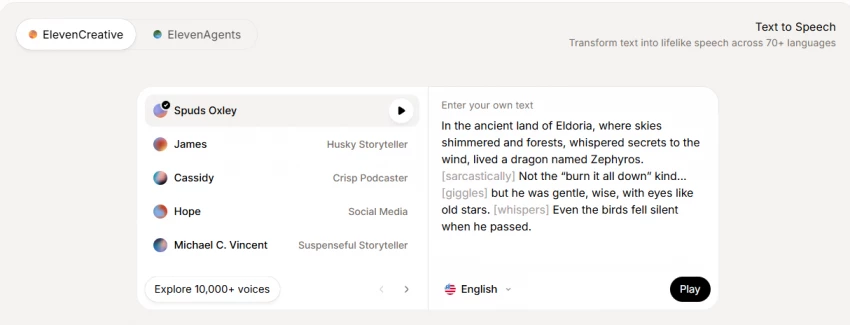
ElevenLabs combines high-quality synthetic speech with conversational voice agents, voice cloning, dubbing, sound generation and developer APIs.
Its ElevenAgents platform allows businesses to build agents that can speak, type, access information and perform actions through connected tools. The product supports real-time voice and chat interactions, monitoring, knowledge retrieval and workflow integrations.
The platform is particularly relevant when the quality and expressiveness of the voice are important to the customer experience. This can include support calls, appointment scheduling, lead qualification, interactive website assistants and branded conversational experiences.
ElevenLabs states that its wider platform supports thousands of voices and more than 70 languages.
ElevenLabs Pricing
ElevenLabs provides separate pricing views for creative tools, APIs and ElevenAgents. Businesses interested in live agents should focus on the agent allowances and additional usage costs.
ElevenAgents plan
Monthly price
Included agent minutes
Free
$0
15 minutes
Starter
$6
75 minutes
Creator
$22
275 minutes
Pro
$99
Approximately 1,238 minutes
Scale
$299
Approximately 3,738 minutes
Business
$990
Approximately 12,375 minutes
Enterprise
Custom
Custom
Additional regular agent usage is priced at approximately $0.08 per minute after the included allowance. Usage that exceeds a plan’s normal concurrency limit may be billed at a higher burst rate. Language-model usage, phone charges and other external services can also be billed separately.
The standard ElevenLabs creative subscription begins with a free plan. Paid creative plans include Starter at $6 per month, Creator at $22, Pro at $99, Scale at $299 and Business at $990, although the credit allocation and included products vary by tier.
For API users, ElevenLabs lists Flash and Turbo text-to-speech generation at approximately $0.05 per 1,000 characters.
Where ElevenLabs Fits Best
ElevenLabs is a strong option when a company needs both content-generation voices and real-time conversational agents.
For example, a brand could use the same ecosystem to create marketing narration, dub product videos and deploy a website or phone assistant. This is more flexible than subscribing to a voiceover-only tool and then sourcing a separate conversational platform.
The Creator plan at $22 per month provides a practical entry point for a small pilot. However, the included 275 minutes would support only about 55 five-minute calls. A company processing hundreds or thousands of calls should calculate the cost of overage minutes, language-model usage and telephony before choosing a plan.
The main pricing risk is assuming the subscription price represents the complete operating cost. A live agent depends on speech generation, speech recognition, a language model, phone infrastructure and connected tools. The final cost may therefore be higher than the listed monthly plan.
Best for: Brands, developers and support teams that need expressive voices, multilingual content and conversational agents in the same ecosystem.
4. Speechify
Speechify is better known for text-to-speech reading and AI voiceover production than for traditional call-center automation.
Its reader can convert books, documents, PDFs, emails and webpages into audio. Speechify Studio provides a separate production environment for voiceovers, dubbing, voice cloning, voice changing and commercial audio projects.
This distinction is important. Someone who wants articles or documents read aloud needs the Speechify Reader product, while a YouTube creator or marketing team producing downloadable narration should compare Speechify Studio plans.
Speechify Pricing
Speechify Studio currently offers three main monthly plans.
Speechify Studio plan
Monthly price
Included credits
Free
$0
600 credits
Studio Starter
$19
7,200 credits
Studio Creator
$49
28,800 credits
The free plan includes access to more than 1,000 voices, the Voiceover Studio, Dubbing Studio and Voice Changer. However, it does not include voice cloning or commercial usage rights.
Studio Starter costs $19 per month and adds commercial usage rights, voice cloning, stock media and 7,200 monthly credits. Studio Creator costs $49 per month and increases the allowance to 28,800 credits.
Speechify explains that one second of voiceover generation consumes one Studio credit. Dubbing consumes three credits per second, while avatar generation consumes 30 credits per second.
Based on that structure, the 7,200-credit Starter plan can theoretically cover up to 120 minutes of standard voiceover generation when all credits are used only for voiceover. The 28,800-credit Creator plan could cover up to 480 minutes under the same assumption.
However, regenerating speech after changing the script, speed, pitch or emotional delivery consumes additional credits. Simply exporting unchanged generated content does not consume more credits.
Speechify’s Text-to-Speech Reader is a separate subscription and should not be confused with Studio. Its consumer pricing page lists free and premium reading options, with Premium commonly displayed around $29 per month depending on billing terms and current promotions.
Where Speechify Fits Best
Speechify is most useful for people who need to consume or produce spoken content rather than operate an automated phone department.
A student can listen to a PDF while travelling. A professional can review reports as audio. A content creator can generate narration, clone an authorized voice and dub a video into another language.
The $19 Starter plan is competitively priced for commercial voiceover production because it includes voice cloning and commercial usage rights. However, credit consumption can rise when users repeatedly regenerate the same script with different delivery settings.
Speechify should not be presented as a direct alternative to Retell AI for complex inbound and outbound calling. Although it can generate audio for IVR greetings and telephone systems, its clearest strengths remain document listening, narration and produced media.
Best for: Students, professionals, YouTubers, course creators and teams turning written material into accessible or commercial audio.
Retell AI is the most specialized phone-agent platform among the five products covered here.
It is designed to build, test, deploy and monitor AI agents for inbound and outbound calls. Its platform includes phone infrastructure, prompts, conversation flows, knowledge bases, integrations, analytics and call monitoring.
A Retell agent can be configured to qualify leads, book appointments, answer support questions, check order information, transfer calls and update external systems.
Unlike a standard voice generator, Retell focuses on managing the complete conversation. This includes determining when the caller has finished speaking, deciding when the agent should respond, accessing business information and performing an action during the call.
Retell AI Pricing
Retell AI uses pay-as-you-go pricing rather than requiring a standard monthly subscription. New accounts receive $10 in free usage credits.
Retell cost component
Approximate price
Voice-agent infrastructure
From approximately $0.055 per minute
Standard voice
Approximately $0.015 per minute
Premium third-party voice
Can be approximately $0.04 per minute
Language model
Varies by model
Retell telephony
Approximately $0.015 per minute
Knowledge base
Additional usage charge
Batch calling
Additional usage charge
Enterprise plan
Custom pricing
Retell advertises a broad total range beginning at approximately $0.07 per minute, with the final cost depending on the selected voice, model, telephony setup and additional services.
A representative configuration can cost around $0.11 per minute. At that rate, the approximate monthly usage cost would be:
Monthly call volume
Estimated cost at $0.11 per minute
500 minutes
$55
1,000 minutes
$110
5,000 minutes
$550
10,000 minutes
$1,100
These estimates are illustrative and do not include every possible add-on, premium voice, external phone provider or enterprise service.
Retell’s pay-as-you-go structure can be attractive because a company does not need to choose a large monthly subscription before knowing its call volume. However, costs can increase rapidly when calls are unnecessarily long or when an expensive language model is used for a simple workflow.
Where Retell AI Fits Best
Retell is suited to businesses that need an operational phone agent rather than only an AI-generated voice.
For example, a clinic could create separate conversation paths for new appointments, cancellations, urgent requests and insurance questions. A property company could use an outbound agent to qualify enquiries and schedule viewings. A support team could automate order-status calls while transferring unusual cases to a human employee.
Its node-based and prompt-based agent options give businesses more control over what happens during different stages of a call. Retell also provides transcripts, analytics and testing tools to help identify failed conversations.
The company promotes response latency of approximately 600 milliseconds, but actual performance can depend on the chosen language model, text-to-speech voice, speech-recognition service, prompt length and connected tools.
The main limitation is that Retell requires more setup than a basic voice generator. A reliable deployment needs clear prompts, fallback instructions, tested integrations and rules for transferring callers to a human.
Best for: Companies automating inbound support, appointment scheduling, outbound qualification and other structured phone workflows.
Which AI Voice Agent Should You Choose?
Choose Voice.ai when you want an affordable combination of voice agents, voice cloning, text-to-speech and audio tools.
Choose Murf AI when your primary goal is producing polished narration for marketing, training, presentations or localized content.
Choose ElevenLabs when expressive speech quality, multilingual support and conversational-agent features are equally important.
Choose Speechify when you need document listening, accessibility tools or commercial voiceover production rather than a full call-center system.
Choose Retell AI when you need a dedicated platform for inbound and outbound phone automation with structured conversation flows and call analytics.
Final Thoughts
There is no single best AI voice platform for every user because the five products solve different problems.
Voice.ai provides a broad toolkit at a low starting price. Murf AI is more suitable for polished business narration. ElevenLabs combines expressive synthetic speech with increasingly capable conversational agents. Speechify is strongest for reading, accessibility and produced content. Retell AI is the most purpose-built option for phone automation.
For small-scale voice-agent experimentation, Voice.ai or ElevenLabs offer relatively affordable entry points. For video narration and training content, Murf AI or Speechify Studio may provide better value. For a business deploying automated inbound or outbound calls, Retell AI offers the clearest operational focus.
Because voice platforms regularly change their plans, included minutes, credit systems and model charges, businesses should confirm the current pricing page and run a limited pilot before moving important customer conversations to any service.