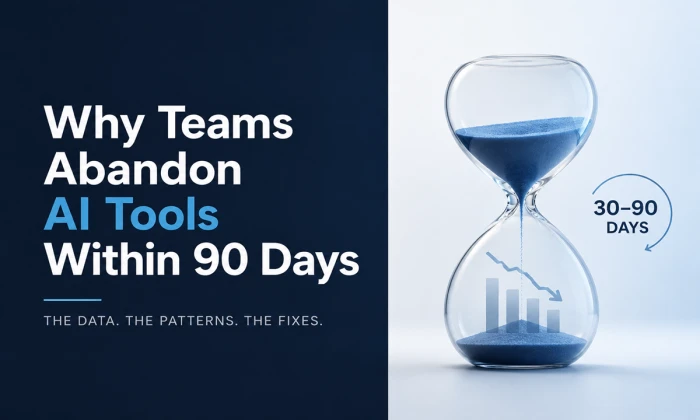
Most AI tool failures do not announce themselves. There is no crash, no angry email, no formal decision to stop. A team buys a promising tool, a handful of people try it, usage climbs for a week or two, and then it quietly fades. By the ninetieth day the licenses are still being paid for, but the logins have dried up. This pattern has become common enough that analysts now treat the first quarter after rollout as the make-or-break window for any AI deployment.
The numbers behind it are no longer anecdotal. According to S&P Global Market Intelligence, the share of companies that abandoned most of their AI initiatives climbed from about 17 percent to 42 percent in roughly two years, a swing documented in its 2025 Voice of the Enterprise survey. Independent analyses put the associated writedown at an estimated 18 billion dollars of enterprise AI investment in about 18 months. The tools mostly worked. The organizations around them did not.
| Figure | What it measures | Source |
| 42% | Companies that abandoned most AI initiatives by early 2025 | S&P Global Market Intelligence |
| 95% | Enterprise GenAI pilots with no measurable P&L impact | MIT Project NANDA (2025) |
| 30 to 90 days | Typical window in which abandonment happens after rollout | AI Smart Ventures |
| 93% vs 57% | Regular tool use among trained vs untrained employees | LSE and Protiviti |
| 6% | Organizations that qualify as AI high performers | State of AI in Business 2025 |
| ~$18B | Enterprise AI investment written off in about 18 months | S&P Global analysis |
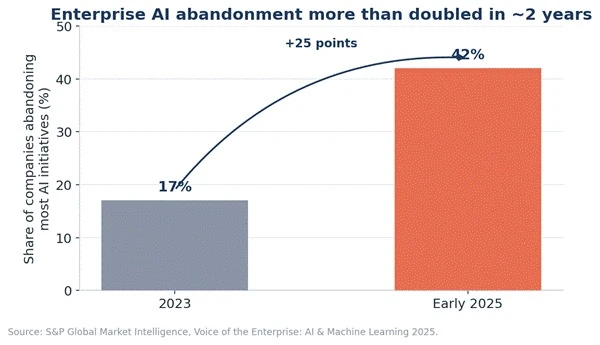
Figure 1. Enterprise AI abandonment more than doubled in about two years, from roughly 17 percent to 42 percent of companies walking away from most initiatives. The rise is not about worse technology; models improved across the same period. It reflects more organizations moving past the excitement of a pilot into the harder work of daily use, and deciding to quit rather than push through.
Adoption figures look strong on the surface, which is part of the trap. Surveys synthesized under the State of AI in Business 2025 banner, drawing on McKinsey and Menlo Ventures data, show that roughly 78 percent of organizations now use AI in at least one function and about 74 percent report some first-year return. The problem sits further down the chain. Only around 39 percent trace a measurable impact to enterprise earnings, and just 6 percent qualify as genuine high performers who tie AI to durable financial results.
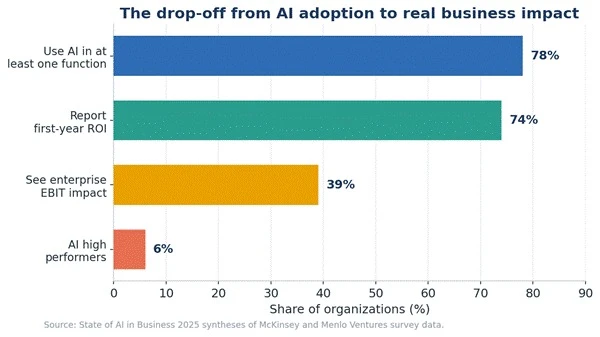
Figure 2. Each step down this ladder represents teams that adopted a tool, saw early promise, and never converted it into anything the business could measure. The gap between the top bar and the bottom bar is where most 90-day abandonment lives.
Practitioners who track this closely describe a consistent shape. AI Smart Ventures, which reports working with close to 1,000 mid-sized organizations, places typical abandonment inside a 30 to 90 day window after deployment. Adoption specialists at MeltingSpot describe a recognizable dip in weeks three and four, once the launch event is over and the novelty has worn off. Habit research supports the timing: behavioral change usually needs anywhere from three weeks to several months of consistent reinforcement, which means a single training session rarely survives contact with a busy quarter.
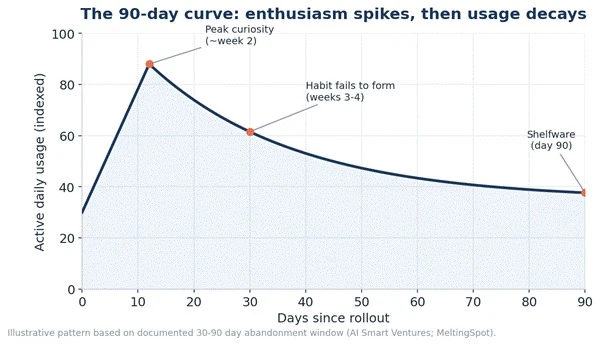
Figure 3. The curve is a stylized pattern rather than one measured dataset, but its shape is well documented. Interest peaks around week two, erodes through weeks three and four as the new habit fails to set, and settles into shelfware by day 90 unless something actively pulls users back.
The failure modes recur across industries and tool categories. They are organizational far more often than technical, which is why swapping vendors seldom helps. Six patterns account for most early abandonment.
The most cited research here comes from MIT's Project NANDA, whose 2025 report The GenAI Divide analyzed 300 public deployments alongside 150 leader interviews and a survey of 350 employees. Its headline finding is stark: about 95 percent of enterprise generative AI pilots delivered no measurable profit-and-loss impact, while only 5 percent of deeply integrated systems created significant value. The report stresses that this is not primarily a model-quality problem. Generic chatbots reached roughly 83 percent adoption for simple, low-stakes tasks, then stalled the moment a real workflow demanded context, memory, and customization.
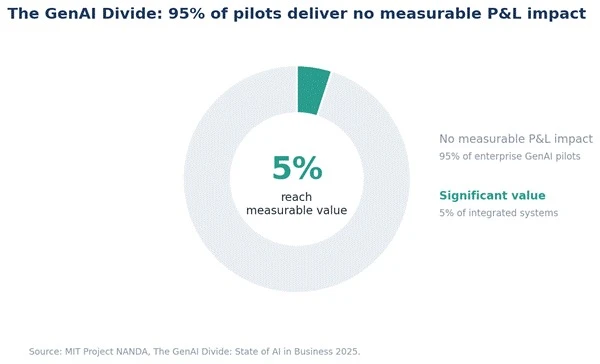
Figure 4. The 5 percent that succeed share a profile: they embed AI into a specific, high-value workflow rather than layering it on top of whatever people already do. The 95 percent tend to buy a general-purpose tool, run an impressive demo, and never redesign the underlying process, so the tool has nowhere durable to live.
The single largest lever on sustained use is not the tool, it is what happens after it arrives. Research from the London School of Economics and Protiviti found that 93 percent of employees who received AI training used the tools regularly, compared with only 57 percent of those who did not. A separate synthesis by BCG found that more than 85 percent of employees remain at early stages of adoption, using AI mainly for basic lookups, while fewer than 10 percent reach the point where it is central to their core work.
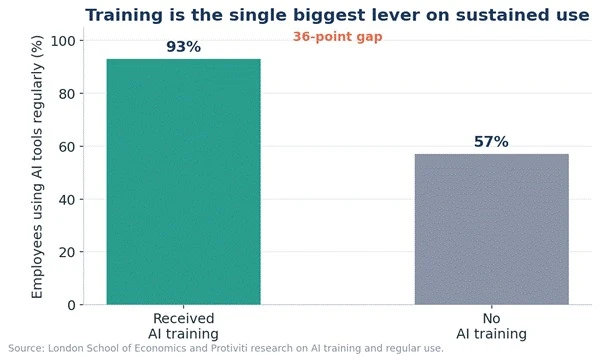
Figure 5. A 36-point gap between trained and untrained users is enormous for a single intervention, yet most programs stop at an introductory session. A demo teaches people how the tool works, but not what to do with it the next morning, which is the moment abandonment usually begins.
Even before formal training, a product's own onboarding decides whether users ever reach a first win. SaaS onboarding research cited across the industry suggests that roughly 75 percent of users abandon an AI product within the first week when onboarding feels confusing, with unclear guidance mattering more than raw model accuracy. AI products tend to present everything at once, the features, predictions, automations, and dashboards, which overwhelms first-time users and breaks a basic principle: people should feel progress, not pressure.
This reason is subtle and often missed. Research from MIT Sloan on scaling generative AI across teams found that the main reason employees abandon a new tool is not resistance to change. It is that the tool solves a problem the employee does not experience as painful enough to justify altering an established habit. A dashboard shows 74 percent activation, the lunch-and-learn is over, and within three weeks half the team has quietly returned to the old process, not out of hostility but because the old way was good enough.
How a tool is built and sourced strongly predicts whether it survives. MIT's NANDA data shows that pilots blending internal specialists with external expertise reached roughly a 67 percent success rate, against about 22 percent for IT-only internal builds. Related analysis found specialized vendors succeeding near 67 percent of the time by focusing on workflow fit, while purely internal builds land closer to a third, largely because teams underestimate the cost of integration and stall in the pilot stage.
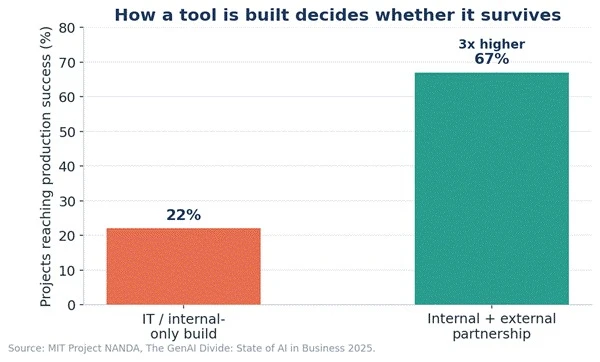
Figure 6. The three-fold difference is not about talent. Internal teams often understand the business better than any vendor. They tend to lose on integration, maintenance, and the unglamorous work of keeping a tool aligned with a moving workflow, which is where partnerships and specialized vendors earn their keep.
Money followed visibility rather than value. According to MIT's analysis, more than half of 2025 enterprise AI budgets went into sales and marketing pilots, the flashy and board-friendly use cases, even though the strongest returns showed up in back-office functions such as document review, procurement, and risk. Gartner has forecast that 30 percent of generative AI projects would be abandoned after proof of concept by the end of 2025, and that 60 percent of projects lacking AI-ready data would be dropped through 2026.
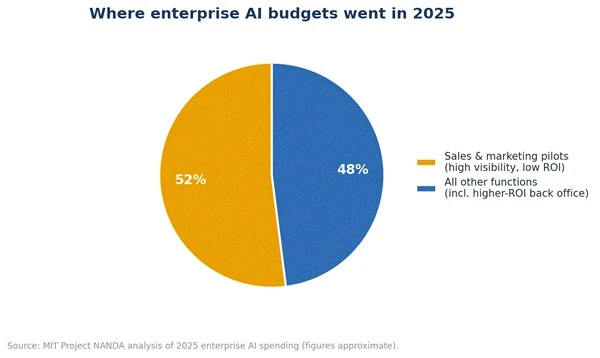
Figure 7. When budget concentrates on high-visibility pilots designed to impress leadership, the tools that would quietly save money never get funded. Back-office deployments are less exciting to demo, but MIT's case studies attribute annual savings of 2 to 10 million dollars to them, mostly by replacing outsourced support and document review.
Beyond the survey data, qualitative feedback from users is remarkably consistent. Executives interviewed for the MIT report repeatedly pointed to memory as a breaking point. One summarized the frustration plainly, noting that a tool “doesn’t retain knowledge of client preferences or learn from previous edits” and repeats the same mistakes each session. Others describe what Forbes contributors have called a verification tax: when an AI system is confidently wrong, employees spend more time checking its output than they save, and that hidden cost quietly erodes any return.
The teams that recover tend to lean on people rather than features. Peer learning, where a few skilled users coach their colleagues, has proven effective at companies including ServiceNow, Morgan Stanley, and HubSpot, because a peer can demonstrate the exact workflow a role uses. On the onboarding side, Infosys built one of the earliest large-scale examples in the Indian market with its Lex platform, which the company reports has crossed 270,000 users, using adaptive learning paths rather than dumping the full library on every new joiner.
The organizations that keep AI tools alive past 90 days share a small set of habits:
● They pick the workflow before the tool, mapping the process they want to change instead of buying software and hunting for a use case.
● They scope narrowly, aiming a first deployment at one painful, repeatable task rather than a broad, board-pleasing showcase.
● They treat adoption as a project in its own right, with a named owner, a 30-day practice period, and role-specific prompt libraries so the first independent session is not a blank screen.
● They measure the right thing, replacing license counts and activation dashboards with metrics that track real workflow change.
The maturity data backs this up. Cisco's AI Readiness Index found that only 13 percent of organizations qualify as pacesetters who reliably move pilots to production, and MIT maturity research found that 45 percent of high-maturity organizations keep AI projects running for three years or more, against just 20 percent of low-maturity peers. The difference is almost entirely in how adoption is handled after launch.
The failure patterns above map cleanly onto a fix. The point is not to do everything at once, but to sequence the work so that a first win comes early, a habit forms in the middle, and the tool is embedded in the workflow before the quarter ends.
| Phase | What to fix | Concrete moves |
Days 0 to 30 Prove one win | Reach a first real result fast, before novelty fades. | Ship to one painful, repeatable task; pre-build role-specific prompts; run in-person training with at least five hours of structured practice. |
Days 30 to 60 Build the habit | Turn early use into routine before it slips. | Schedule a 30-day practice period; appoint peer champions; keep a live Q&A channel; watch for the week three to four dip and intervene early. |
Days 60 to 90 Make it stick | Embed the tool so the old workaround disappears. | Redesign the process around the tool, not beside it; retire the legacy step; measure workflow change, not logins; report results to leadership. |
The 90-day cliff is not a technology problem, and switching vendors rarely fixes it, because the causes tend to be organizational rather than technical. The data across MIT, S&P Global, BCG, and the London School of Economics points to the same conclusion from different angles: tools survive when they are aimed at a genuinely painful task, supported by real training, built with the right partners, and measured by whether the work actually changed. An AI system a team does not use is not a failed experiment in artificial intelligence. It is an expensive decoration, and the first 90 days decide which one it becomes.
Share your thoughts about this article.
Be the first to post a comment!
The same tool can be a 4.7 on one site and a 3.9 on another. Here is what is rea...
Nitin1 month ago
Here is the number worth pinning above your budget: in Gartner Digital Markets r...
Deepak Mehra1 month ago

What Artlist AI is in 2026Artlist began as a royalty-free music library. By 2026...
Deepak Mehra1 month ago

The best AI image generator in 2026 is Nano Banana 2 for speed, FLUX.2 for photo...
Parveen Verma1 month ago

“Useful” is a slippery word for a coding assistant. A tool can be brilliant at o...
Sakshi Dhingra1 month ago
How this comparison was builtEvery price, limit, credit rule and feature stateme...
Sakshi Dhingra1 month ago