Helping my cousin prepare for NEET last year gave me an unexpected look into how modern students actually study for competitive exams in India. Despite the enormous number of coaching institutes, test series, and online courses available today, the biggest challenge students still face is not the lack of study material but the lack of direction. Many students spend months solving questions without knowing which topics actually require attention.
This curiosity led me to examine Abhyas AI in depth. Instead of approaching it purely as a reviewer, I explored the platform while observing how a real student interacts with the system during exam preparation. I navigated the learning interface, examined the documentation provided in the official Abhyas platform guide, explored experimental tools in the Abhyas AI lab environment, and analyzed how the system structures its learning paths.
What emerged was a clearer understanding of what the platform actually does, what parts genuinely rely on AI-driven analytics, and where the system still behaves like a developing ed-tech product rather than a fully mature learning ecosystem.
Quick Verdict: Is Abhyas AI Worth It?
Review Factor
Verdict
Best for
JEE, NEET, JEE Advanced and AP EAPCET students focused on practice and revision
Not ideal for
Students who need extensive one-to-one concept teaching
Strongest feature
Large practice database combined with performance analytics
Biggest limitation
Complete pricing is still difficult to find publicly
Question bank
3+ lakh questions claimed by Abhyas
Previous papers
600+
Topics
860+
Tutor support
Ask-a-Tutor support is available
Learning style
Better for structured practice, revision and performance analysis
Overall rating
7.4/10
Bottom line: Abhyas AI makes the most sense for students who already have some understanding of their syllabus but need more structure around practice, testing and identifying weak areas.
The Scale of Educational Content Available on Abhyas AI
One of the first things that stands out about Abhyas is still the size of the academic material behind it.
The platform currently says its subject experts have researched and organised more than 3 lakh questions for JEE and NEET preparation.
That number alone does not automatically make a question bank good, but for competitive-exam students, having enough variation matters.
Repeatedly solving exactly the same type of question can create the impression that a chapter has been mastered when the student has actually only become familiar with a particular pattern.
Abhyas also advertises access to 860+ topics and more than 600 previous examination papers.
Real exam questions reveal things that ordinary practice sets sometimes miss: how questions are worded, where common traps appear, how difficulty changes between sections, and what concepts examination setters repeatedly return to.
Instead of keeping previous papers completely separate from the learning system, Abhyas integrates practice and testing into the platform.
That means performance on actual exam-style questions can become part of the broader progress picture.
Abhyas AI Features at a Glance
Adaptive Learning Paths The platform analyzes student performance and dynamically adjusts the order of topics, prioritizing weak areas while reducing repetition in subjects that students already understand.
Large Competitive Exam Question Bank The system hosts more than 300,000 practice questions, along with 600+ previous year exam papers, allowing students to practice using real exam formats rather than simulated problems.
Interactive Video Learning Library More than 1,000 hours of recorded video tutorials are integrated with practice exercises, covering roughly 860 academic topics across engineering and medical entrance exam syllabi.
Predictive Learning Analytics The platform’s analytics engine attempts to identify why students make mistakes by categorizing errors into conceptual gaps, calculation mistakes, and careless errors.
Trap Question Identification The system highlights question patterns that historically cause negative marking, helping students recognize and avoid common mistakes during competitive exams.
Ask-a-Tutor Academic Support Students can send questions to subject experts through the integrated tutor messaging system when automated explanations are insufficient.
AI-Guided Study Time Optimization Instead of encouraging repetitive practice across the entire syllabus, the platform attempts to focus study time on topics that remain unmastered.
Structured Exam Preparation Modules The platform organizes practice and revision around specific entrance exams such as JEE Main, JEE Advanced, NEET, and AP EAPCET
Reported Student Outcomes and University Admissions
Abhyas currently reports 53,085 students enrolled, alongside more than 41,000 admissions at national-level institutions.
The website also describes having more than 20,000 online students and 40,000 achievers.
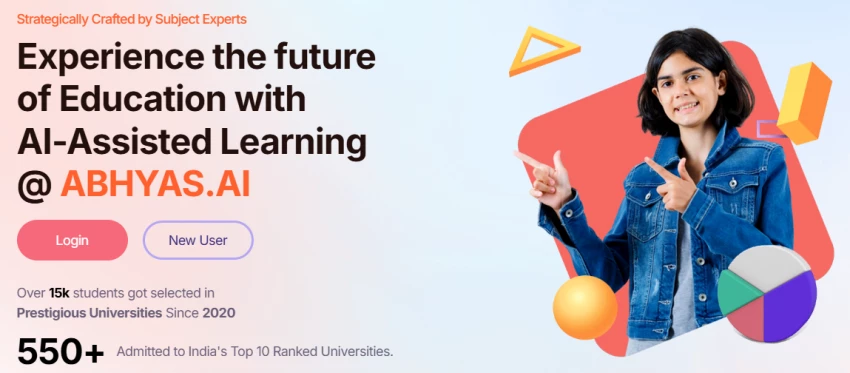
Another prominent claim states that more than 15,000 students have been selected in prestigious universities since 2020, with more than 1,000 gaining admission to India's top-ranked universities.
The platform currently lists exam-specific selection figures including:
Exam
Selections Reported
AP EAPCET
900
JEE Main
600
NEET
454
JEE Advanced
432
Abhyas has also started displaying 2026 results prominently.
Among the profiles currently shown on the website are students with JEE Advanced AIR 4, AIR 11, AIR 40 and AIR 90.
Those numbers certainly look impressive, but there is an important distinction students and parents should keep in mind.
These are figures reported by Abhyas itself.
Competitive-exam students frequently use multiple resources at the same time: school, coaching, test series, books, YouTube, private tuition and online platforms.
Because of that, it is difficult to establish exactly how much of an individual student's result should be attributed to one platform.
How the Adaptive Learning System Works in Practice
What differentiates Abhyas AI from traditional coaching systems is its attempt to personalize learning through adaptive sequencing.
When exploring the study workflow through the Abhyas beta student environment, the platform initially follows a structured syllabus path similar to most coaching programs. However, after several practice sessions the system begins adjusting study priorities.
During my testing period, topics where repeated mistakes occurred started appearing more frequently in the recommended study schedule. Conversely, subjects where the student consistently answered questions correctly gradually appeared less often in the study plan.
This behavior reflects the predictive learning analytics engine described in the Abhyas AI platform documentation. Instead of simply marking answers as right or wrong, the system attempts to classify errors into categories such as conceptual misunderstanding, calculation mistakes, or careless errors.
The idea is to guide students toward the areas that need improvement rather than encouraging repetitive practice across the entire syllabus.
Identifying “Trap Questions” in Competitive Exams
Another interesting feature visible during testing is the system’s attempt to detect what it calls trap questions.
Competitive entrance exams frequently include questions designed to exploit predictable student mistakes. These may involve misleading wording, hidden unit conversions, or calculations that appear straightforward but contain subtle traps.
Abhyas AI analyzes how large numbers of students answer similar questions. When a question type repeatedly leads to incorrect answers, the system flags it as a potential trap and introduces additional exercises that train students to avoid those mistakes.
This feature is not unique to Abhyas AI, but integrating it into the learning path can help students recognize patterns that lead to negative marking during exams.
Academic Partnership Behind the Platform
An important aspect of Abhyas AI is its partnership with Aditya Educational Institutions, an academic organization established in 1984 in Andhra Pradesh.
This partnership means that the platform’s question bank, curriculum design, and lectures are developed by educators associated with Aditya rather than generated entirely by algorithms. The AI system then organizes and delivers that material through adaptive study paths.
This hybrid approach, combining traditional academic expertise with algorithmic learning analytics, appears to be the core design philosophy behind the platform.
Pricing Transparency and Platform Accessibility
Pricing is one of the weakest areas of Abhyas AI.
At the time of review, clear public pricing was not easily visible on the main website. This makes it difficult for students and parents to compare Abhyas AI with other coaching platforms, test series, or mock-test apps before signing up.
This does not automatically mean the platform is expensive or bad. But pricing transparency is important, especially in the education market.
Before paying, students or parents should confirm:
Course price
Plan duration
What exams are included
Number of mock tests
Tutor support limits
Refund policy
Whether videos are included
Whether previous-year papers are included
Whether mobile and desktop access are both available
Pricing note: Pricing information was not clearly available on the public website at the time of review. Always verify the latest pricing directly on the official Abhyas AI platform before purchasing.
What Independent Reviews Say About Abhyas AI
Abhyas AI reviews should be read carefully because most visible feedback comes from the official website, student testimonials, and third-party AI tool listing pages. The platform appears useful for structured JEE/NEET preparation, but public independent reviews are still limited.
Review Summary
Area
Review
Overall impression
Useful for structured exam practice and revision
Best use case
JEE, NEET, JEE Advanced, and AP EAPCET preparation
Main strength
Study planning, practice questions, analytics, and tutor support
Main concern
Pricing and plan details are not clearly public
Trust level
Promising, but many claims are platform-reported
Best for
Students who already know the basics and need better practice
Not best for
Beginners who need full concept teaching from zero
What Students Like
Positive Point
Why It Matters
Structured study plan
Helps students avoid random preparation and follow weekly goals
Large question bank
Useful for repeated JEE/NEET practice
Performance analytics
Shows weak areas, mistakes, and progress patterns
Previous-year papers
Helps students understand real exam patterns
Ask-a-Tutor support
Gives human help when automated explanations are not enough
Exam-focused design
Built around Indian competitive exams instead of general learning
Common Review Concerns
Concern
What It Means for Students
No clear public pricing
Students may need to sign up or contact the platform before knowing the cost
Not a full coaching replacement
Better for practice and revision than complete concept teaching
Limited independent reviews
Many positive claims are from the platform or review sites
Interface may feel basic
Some students may prefer more polished edtech apps
Tutor support may vary
Response time and depth may depend on plan or availability
Requires consistency
AI recommendations work better only when students use the platform regularly
Review by Student Type
Student Type
Should They Use Abhyas AI?
Reason
JEE/NEET student with basic concepts clear
Yes
Good for practice, revision, and performance tracking
Student preparing seriously for exams
Yes
Weekly planning and analytics can support disciplined preparation
Beginner with weak fundamentals
Use with support
May still need teachers, textbooks, or coaching
Student looking only for free mock tests
Maybe not
National Test Abhyas may be more suitable for free mock practice
Parent comparing edtech tools
Check first
Pricing, plan duration, refund policy, and tutor access should be confirmed
Student needing one-to-one teaching
Not as primary tool
Abhyas AI is better as a study companion than a full tutor replacement
Abhyas AI Review Verdict
Factor
Rating
Practice support
8/10
Study planning
8/10
Analytics
7.5/10
Tutor support
7/10
Beginner friendliness
6.5/10
Pricing transparency
5/10
Overall value
7.3/10
Final takeaway: Abhyas AI looks useful for students who need structured JEE/NEET practice, weekly planning, analytics, and doubt support. However, it should be used as a study companion, not as a complete replacement for coaching or teacher-led learning. Its biggest improvement area is clear public pricing.
Practical Limitations Observed During Platform Use
Despite its interesting technology, several practical limitations became noticeable during extended use.
The adaptive learning system relies heavily on consistent student behavior. If students skip practice sessions or answer questions randomly, the data collected by the algorithm becomes unreliable, which can lead to inaccurate study recommendations.
Another limitation involves conceptual depth. Although the platform includes extensive video lectures, the learning format still resembles traditional coaching material delivered digitally. Students who struggle with deeper conceptual understanding may still require direct mentorship from experienced teachers.
Tutor support is helpful but limited in scale. With a relatively small number of subject experts supporting the platform, response times and explanation depth can vary depending on demand.
The interface also shows signs of being a developing system. Certain areas of the beta environment require multiple steps to access practice modules, and analytics dashboards can sometimes appear overly technical for students who simply want clear progress indicators.
Finally, the success statistics published by the platform are difficult to verify independently because competitive exam preparation usually involves multiple resources simultaneously.
Pros and Cons of Abhyas AI
Pros
Cons
Large question bank for exam practice
Pricing is not clearly public
Useful for JEE, NEET, JEE Advanced, and AP EAPCET
Not ideal for absolute beginners
AI-based weak-area tracking
Needs regular use to give better recommendations
Includes video lessons and previous-year papers
Tutor response may vary
Helps identify mistake patterns
Independent reviews are still limited
Can support structured revision
Should not replace coaching completely
Independent Evaluation Based on Practical Testing
After spending time exploring the system and observing how it functions during real study sessions, the platform can be evaluated across several practical categories.
Category
Rating
Evaluation
Content Depth
8/10
Large question bank and lecture library covering competitive exam syllabi
Adaptive Learning
7.5/10
Personalized study paths help identify weak areas
AI Analytics
7/10
Useful insights but sometimes lack deeper explanation
Tutor Support
7/10
Human help exists but response depth varies
Interface & Usability
6.5/10
Functional but parts of the platform feel unfinished
Pricing Transparency
6/10
Pricing not clearly listed before registration
Overall Value
7/10
Useful supplementary tool but not a full coaching replacement
Abhyas AI Compared With Traditional Coaching
Area
Abhyas AI
Traditional coaching
Study schedule
Can adapt to recorded performance
Usually follows a batch timetable
Question practice
Potentially available on demand
Often provided through scheduled sheets and tests
Feedback speed
Automated feedback can be immediate
Teacher feedback may take longer
Human explanation
Depends on tutor availability
Direct classroom access is usually stronger
Flexibility
Can be used at different times
Fixed classes are common
Accountability
Requires self-discipline
Attendance and teachers provide external pressure
Personalisation
Based on platform data
Depends on batch size and teacher attention
Pricing visibility
Currently limited publicly
Usually available through counselling or centre pricing
Social learning
Limited
Peer interaction is generally stronger
Best role
Supplementary practice and analysis
Concept teaching, mentoring and accountability
Abhyas AI should not automatically be viewed as a substitute for coaching. For many students, the better approach may be to use teachers or textbooks for concept development and use Abhyas AI for planning, practice and revision analysis.
How to Evaluate Abhyas AI Before Paying
Ask for a live demonstration using the exact examination you are preparing for.
During the demonstration, check whether the platform can:
Create a realistic study plan based on your available hours
Show how it identifies a weak chapter
Explain why an answer was marked incorrect
Provide a recent previous-year question
Display the qualifications of a tutor answering doubts
Show the difference between free and paid access
Explain how personal data can be deleted
Provide written pricing and refund terms
Show whether access works on multiple devices
Explain how content errors are reported and corrected
Do not judge the platform only by the size of its content library. Judge it by how quickly it helps you make a better study decision.
Conclusion
Abhyas AI appears to be a legitimate, actively maintained learning platform connected with Aditya Educational Institutions. Its official Android app has more than 50,000 Google Play downloads, and the platform has a visible audience in India.
Its strongest proposition is not simply that it offers a large content library. The more useful benefit is the attempt to connect study planning, practice, testing and weak-area analysis.
However, students should distinguish between product features and proven outcomes.
The company publishes impressive figures relating to selections, achievers, experts and students, but GeniusFirms could not independently verify those totals or determine how much of the reported success can be attributed specifically to the Abhyas AI platform.
Pricing transparency, independent student reviews and data-safety disclosure also need improvement.
For students who already understand the fundamentals and need more structured practice, Abhyas AI may be worth testing. For beginners who require deep explanation, close mentoring or strong classroom accountability, it is unlikely to be sufficient on its own.
The safest decision is to request a demonstration, obtain written pricing, test the teaching quality and compare the platform against at least two alternatives before purchasing.
Frequently Asked Questions
Is Abhyas AI legitimate?
Abhyas AI is connected with Aditya Educational Institutions and has an official Android application listed on Google Play. The application currently shows more than 50,000 downloads. However, this does not independently validate every result or selection figure advertised by the platform.
Is Abhyas AI free?
The official terms describe the application as freemium. Some services may be accessible without full payment, while additional features may require a paid plan. Users should request current pricing directly because a complete public pricing comparison is not prominently available.
Is Abhyas AI good for JEE preparation?
It may be useful for JEE students who need study planning, topic practice, test analysis and weak-area tracking. Students who require complete concept instruction may still need textbooks, teachers or coaching.
Is Abhyas AI useful for NEET?
Its exam-focused practice and analytics may support NEET revision. Students should verify that the biology, physics and chemistry content follows the latest syllabus and official examination pattern.
Does Abhyas AI guarantee selection?
No learning platform can reasonably guarantee selection. Exam outcomes depend on prior knowledge, preparation time, consistency, examination difficulty, health and many other factors.
My experience with it was frustrating. I had issues with screen rotation and navigation, and sometimes it felt like the app was working against me during study sessions. The tests were also very basic and some questions not upto the updated syllabus of JEE.
It helped me a lot to prepare for NEET. The combination of concept videos, practice questions, and test-style preparation worked well for me. I especially liked having previous exam-style papers and topic-wise practice in one place, because it saved time during revision. The Ask-a-Tutor option also made the platform feel more supportive when I got stuck on difficult questions.
I used Abhyas AI mainly for JEE preparation, and the biggest benefit for me was structure. Before using it, I was jumping between YouTube lectures, random PDFs, and coaching notes without a clear plan. Abhyas helped me break the syllabus into smaller weekly targets, which made preparation good.
I found it helpful, I think, admin needs to work on the website speed, abhyas.ai works really slow most of the time. Also please work on the interface, it could be better.
The question bank is massive and very exam-focused. I used it for JEE practice and it covered almost everything. It saves time compared to jumping between different resources.
What I liked is how structured everything feels. You’re not randomly studying topics, the platform kind of pushes you toward what you actually need to work on. It feels more like a guided system than just another test series
I used it mainly for mock tests, but the analytics surprised me. It shows patterns like whether you’re making conceptual mistakes or just calculation errors. That level of breakdown is something I didn’t get from other platforms