Quick answer To rank in Google AI Overviews: first get into the organic top 10 (76% of cited pages already rank there), then restructure your content into self-contained, quotable passages of 40–80 words that answer one specific sub-question each. Target long-tail question queries, keep pages in the 1,000–2,000 word band, cite primary sources, refresh regularly, and stop over-investing in FAQ schema and author bios, because 2026 citation data shows they don't move AIO selection. |
Here's the uncomfortable truth about most "how to rank in AI Overviews" advice: it's recycled featured-snippet advice from 2019 with the word "AI" pasted on top. Add FAQ schema. Write author bios. Publish 5,000-word ultimate guides. The problem? When researchers actually crawled thousands of pages winning AI Overview citations in 2026, those exact tactics correlated with losing, not winning.
This playbook is different. Every recommendation below traces to a specific study with a named methodology, and where the data contradicts standard SEO advice, I'll show you the numbers and let you decide. Then we'll turn it into a realistic 90-day plan you can actually execute.
Google's AI Overviews reach more than 2.5 billion monthly users, and by Q1 2026 they appear in somewhere between 25% and 48% of US searches depending on whose panel you trust rising to roughly 65% of question-based searches, which is exactly the territory informational content was built to win. The citation slots inside that answer box are the new position zero.
The cost of ignoring this is now well measured. Ahrefs' December 2025 analysis of 300,000 keywords found that when an AI Overview appears, the top-ranking page's CTR drops 58% up from a 34.5% drop just eight months earlier. Pew Research, tracking the real browsing behavior of 900 US adults, found users click any traditional result in only 8% of searches with an AI summary, versus 15% without one.
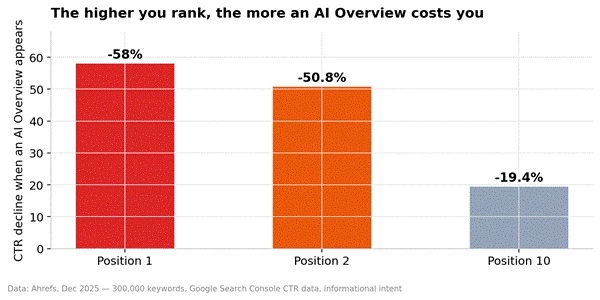
Figure 1: CTR decline by position when an AI Overview is present. Ranking #1 no longer protects you — it exposes you the most.
So is chasing citations even worth it? Yes, with realistic expectations. Seer Interactive's analysis of 25.1 million impressions found that being cited inside an AI Overview delivers 35% more organic clicks than not being cited (0.70% CTR vs 0.52%). It doesn't restore pre-AIO traffic, nothing does, but it cushions the fall, and the clicks you keep skew higher-intent. There's also a brand play: your name inside the answer box is exposure even without the click.
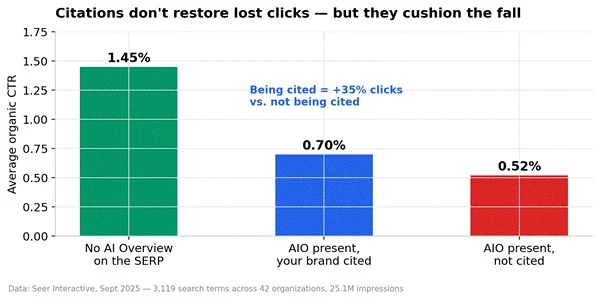
Figure 2: The three CTR realities of 2026. The gap between cited and not cited is the prize this playbook targets.
Before tactics, three mechanical facts that shape everything:
• Same index, no separate AI crawler. AI Overviews are grounded in Google's regular web index. If Googlebot can't crawl and index you, or you're blocked from snippets, you're ineligible. There is no secret AI ranking system to optimize for separately.
• Query fan-out. Gemini breaks the user's query into multiple sub-queries, retrieves passages for each, and synthesizes an answer. This is why a page ranking #6 can get cited over the #1 result: it answered one specific sub-question better. You're not competing for the query, you're competing for a sub-question inside it.
• Passages, not pages. The system extracts short, self-contained passages. A brilliant answer buried in paragraph 14 of a meandering intro loses to a mediocre answer that sits alone under a clear question heading.
Rankings still matter as the entry ticket: Ahrefs' study of 1.9 million citations found 76% of cited pages ranked in the organic top 10 (later analyses put the overlap lower, closer to 40%, as Google pulls from a wider pool, the exact figure is contested and declining, but the direction holds). Meanwhile, ranking #1 only gives you about a 33% chance of being cited. Translation: organic ranking is necessary leverage, not a guarantee. The gap between ranking and citation is where this playbook lives.
In May 2026, Seer Interactive ran the most rigorous citation study to date: 8,500 stratified keywords across 30 industries, 7,225 AI Overviews captured, and 6,354 winning pages crawled for on-page signals. They expected schema, author bios, and long-form content to win. Here's what actually happened:
| Common advice | What the citation data shows |
| Add FAQ + HowTo schema everywhere | Publishers with 69% FAQ schema coverage underperformed ~10x. Reddit (0% schema) dominates. Article + Breadcrumb schema appears sufficient. |
| Author bios and credentials build trust | Inverse correlation: the cohort with the highest author-bio rate (76%) had the lowest citation share (1.94%). Reddit, with zero bios, took 20.4%. |
| Write 5,000-word ultimate guides | Skyscraper-length guides captured only 4.4% of definitional slots. Winners are bimodal: under 250 words (dictionary-style) or 1,000–2,000 words (focused explainers). |
| Target high-volume head terms | AIO winners averaged ~6,100 monthly searches; keywords with no AIO averaged ~178,000. Head terms trigger AIOs ~30x less than long-tail. |
| Big-brand authority wins | Eight major news outlets (NYT, WSJ, BBC, Reuters, etc.) combined for 0.6% of first citations. Domain authority's correlation with citations is weakening. |
| Only the first citation matters | AIOs cite a mean of 11.4 sources per query (median 11). Positions 2–11 are real, trackable exposure. |
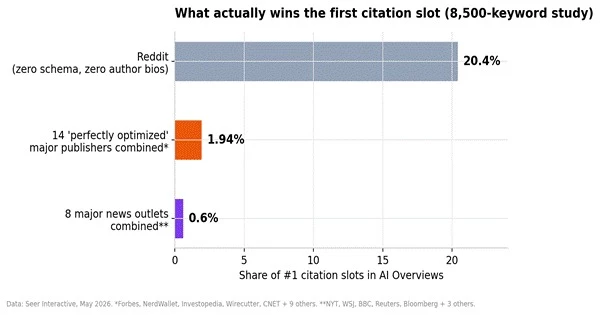
Figure 3: The finding that broke SEO Twitter. Reddit alone captures 10x more first-citation slots than fourteen textbook-optimized publishers combined.
One honest caveat before you delete your schema plugin: this measures the first-citation slot in one May 2026 snapshot, US/English only, and AIO behavior shifts. Google's own optimization guide still recommends structured data for other search features, and FAQ schema costs nothing to keep. The takeaway isn't “schema is dead”, it's "schema won't earn you AIO citations, so stop treating it as the strategy."
Here's the part most guides skip: an actual sequence. This assumes one person working part-time on an existing site with some indexed content. Adjust the pace, not the order.
| Phase | Timeline | What you do | Output |
| 1. Audit & target | Weeks 1–2 | Find where you already rank top 10 AND an AIO appears. These are your only realistic near-term targets. | Priority list of 20–30 query/page pairs |
| 2. Restructure | Weeks 3–6 | Rewrite target pages into extractable, answer-first passages. One sub-question per section. | 20–30 pages rebuilt for extraction |
| 3. Authority & entity | Weeks 5–10 | Internal links, primary-source citations, entity consistency, and a genuine presence where AIOs already cite your niche (often Reddit/YouTube). | Stronger link graph + off-site footprint |
| 4. Measure & iterate | Weeks 8–90+ | Track citation share weekly, refresh stale winners, expand to adjacent queries. | Citation tracking dashboard + refresh cadence |
Start from the intersection of three things: queries where you already rank top 10, queries that trigger an AI Overview, and queries where the current citations are beatable. Pull your top-10 rankings from Search Console or your rank tracker, then check each SERP manually or with a tool that tracks AIO presence (Ahrefs, Semrush, and most enterprise platforms now report "AIO position" as a metric).
Prioritize by intent shape. The trigger rates aren't equal: definitional, how-to, and comparison queries trigger AIOs at 95–98% rates in Seer's data, and Pew found question-phrased searches trigger summaries 60% of the time versus 8% for one-to-two-word queries. Long-tail questions are the battlefield.
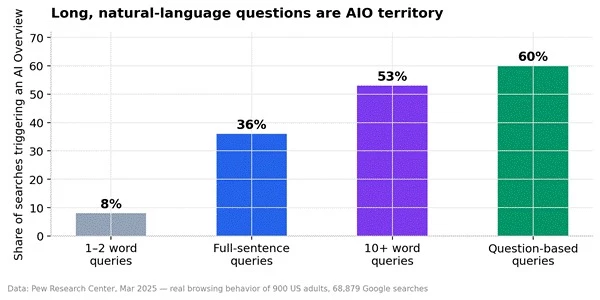
Figure 4: AIO trigger rates by query type. If your keyword list is short head terms, you're optimizing for a fight that mostly isn't happening.
One more filter worth applying: industry concentration. Some verticals are effectively locked — personal finance (Fidelity holds 39% of first citations), health (Cleveland Clinic, 30%), DIY (YouTube, 32%). Meanwhile logistics, career, fitness, pets, energy, and manufacturing have no incumbent above 20%. If you have any topical flexibility, aim where the door is open.
This is the highest-leverage work in the entire plan. For each target page:
• Lead every section with the answer. Question-phrased H2, then a direct 40–80 word answer in the first sentence or two, then supporting detail. The passage must survive being lifted out alone — no "as mentioned above," no dangling pronouns like "this approach."
• One sub-question per section. Query fan-out means Google is hunting for sub-answers. Map the sub-questions (People Also Ask boxes and the AIO's own structure tell you what they are) and give each its own clean, self-contained block.
• Aim for the 1,000–2,000 word band. That's where the biggest share of non-dictionary winners sits. If you have a 5,000-word guide, consider splitting it into focused pages rather than trimming, each split page can win its own sub-question.
• Put numbers and named sources in the passage itself. AIO winners cite roughly 2x more .gov/.edu sources outbound than losers. Specific, verifiable claims ("58% CTR drop, per Ahrefs' 300K-keyword study") are more quotable than vague ones ("traffic declines significantly").
• Keep tables and lists for genuinely structured data. Comparisons and step sequences extract well as structured blocks, but only where the content is actually tabular. Don't force it.
What not to spend these weeks on: mass-adding FAQ schema, writing elaborate author bio pages, or padding word count. The data above is clear on all three. Article and Breadcrumb schema, a crawlable site, and snippet eligibility cover the technical baseline.
Authority didn't stop mattering, the signals just shifted from decoration to substance:
• Internal linking. Definitional winners average significantly more internal links than losers (the exact magnitude is cohort-sensitive, but the direction is robust). Link every restructured page from your related content with descriptive anchors, hub-and-spoke style.
• Entity consistency. Consistent name, description, and details across your site, directories, LinkedIn, and third-party mentions strengthen how Google's Knowledge Graph understands who you are. Citation selection leans on entity recognition, especially post the March 2026 core update, which rewarded expert human-led content.
• Third-party presence where AIOs already look. Reddit captures 20.4% of first citations overall, and 15–33% in verticals like software, gaming, food, and e-commerce. In those spaces, a substantive answer under a real account in the right subreddit may earn more citations than another blog post. Same logic for YouTube in how-to verticals. This is participation, not spam — promotional drops get deleted and nuked by moderators, and burned accounts are worse than nothing.
• Digital PR over guest-post links. Brand mentions in industry publications and communities feed both entity strength and the training-data trail LLMs learn from. One genuinely quotable data point you publish (an original stat, a small study) earns more citations than ten generic backlinks.
Treat citation share like you treat rankings, a weekly metric, not a one-time win:
| What to track | How | Cadence |
| AIO presence on your target queries | Rank tracker with AIO detection (Ahrefs, Semrush, etc.) | Weekly |
| Your citation position (1–11+) | Same tools now report AIO position; AIOs cite ~11 sources per query on average | Weekly |
| CTR shifts on cited vs uncited pages | Search Console, segmented by query group | Monthly |
| Content freshness | Flag winners not updated in 90 days; refresh stats and dates with real changes | Monthly |
| Competitor citation movements | Spot-check who displaced you and what their passage does better | Monthly |
Expect citations to appear within days to weeks of a recrawl on queries where you already ranked, and months on competitive topics where you're building authority from behind. When a restructured page gets cited, don't stop, expand to the adjacent sub-questions in the same cluster while the topical authority is warm.
A realistic plan needs realistic math, so let's be blunt. If you rank #1, you have roughly a one-in-three chance of an AIO citation on that query. Citations lift CTR about 35% over not being cited, but the page still earns less than it would on a SERP with no AIO at all. And only about 1% of users click links inside the summary itself, per Pew's behavioral data.
So the win condition isn't "recover 2023 traffic", that era is gone. The win condition is: capture more than your share of the clicks that remain, be the name users see in the answer box (brand queries actually get a CTR boost when AIOs appear), and build the citation footprint that carries into AI Mode, ChatGPT, and Perplexity, which reward substantially the same extractable, well-sourced content. Teams that reframe from "how do I rank?" to "how do I get cited?" are the ones compounding right now.
Ranking in AI Overviews in 2026 comes down to five moves, in order: qualify by ranking top 10 on long-tail question queries in winnable verticals; restructure pages into self-contained, quotable 40–80 word answer passages in the 1,000–2,000 word band; back every claim with named, primary sources; build entity strength and a real presence on the platforms AIOs already trust; and track citation share weekly like the ranking metric it now is.
And spend zero additional effort on the things the data says don't move citations: FAQ schema farms, author-bio theater, and 5,000-word guides nobody asked for. The teams winning this aren't doing more SEO, they're doing more specific SEO, one sub-question at a time. Start with your top 20 queries this week.
Share your thoughts about this article.
Be the first to post a comment!
The same tool can be a 4.7 on one site and a 3.9 on another. Here is what is rea...
Nitin1 month ago
Here is the number worth pinning above your budget: in Gartner Digital Markets r...
Deepak Mehra1 month ago
What Artlist AI is in 2026Artlist began as a royalty-free music library. By 2026...
Deepak Mehra2 months ago
Most AI tool failures do not announce themselves. There is no crash, no angry em...
Nitin2 months ago

The best AI image generator in 2026 is Nano Banana 2 for speed, FLUX.2 for photo...
Parveen Verma2 months ago

“Useful” is a slippery word for a coding assistant. A tool can be brilliant at o...
Sakshi Dhingra2 months ago