Every week someone asks me the same thing. Should I keep paying for Quizlet, or is one of these new AI study apps actually worth switching to? Jungle AI is the name that comes up most often in that conversation right now, and for good reason. So I did the only sensible thing. I created accounts on both, fed them the same lecture PDFs, ran the same study sessions, and tracked what each one would cost me over a full academic year. This article is everything that came out of that experiment, with real numbers, real limits, and a verdict I am comfortable standing behind.
Pick Jungle AI if your study material lives in lecture slides, PDFs, and YouTube videos, and you want an app that turns those into practice questions for you.
Pick Quizlet if you rely on its enormous library of ready-made study sets, or if your teacher already runs the class through Quizlet.
That is the whole comparison in two sentences, but the details underneath change the picture quite a bit depending on your subject, your budget, and how heavy your semester is. Stay with me, because a few of those details surprised me.
Here is the thing most comparison articles skip. Jungle and Quizlet are not really the same category of product wearing different logos. They start from opposite ends of the studying problem.
Quizlet started in 2005 as a flashcard website and grew into a study platform sitting on more than 500 million user-created study sets. Its core assumption is that either you will type your cards in yourself, or someone somewhere has already made a set for your topic. The AI features it has added over the years, things like Q-Chat, Magic Notes, and AI practice tests, sit on top of that foundation, and almost all of them now live behind the paid plans.
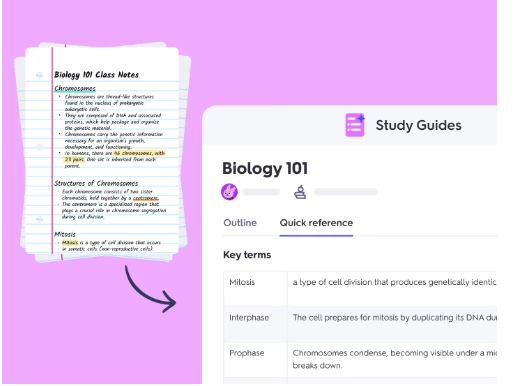
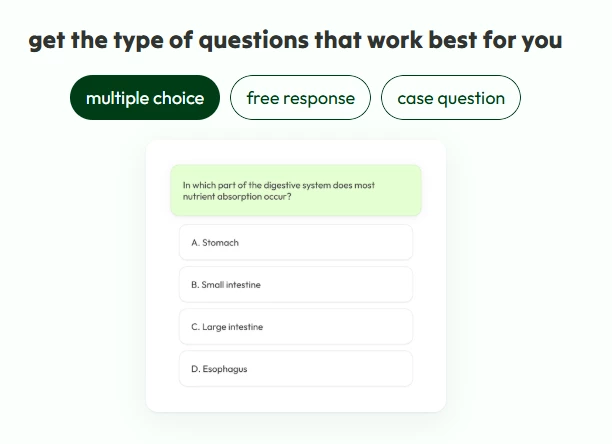
Jungle flips that assumption on its head. It assumes you will never type a flashcard again. You upload your lecture slides, a PDF chapter, a Word doc, or paste a YouTube link, and the AI generates the flashcards, multiple choice questions, free response prompts, and even diagram-based questions for you. The company itself describes the app as what you would get if Quizlet and Duolingo had a baby, and after two weeks inside it, that line is more accurate than most marketing copy I read for a living. Over a million students use it now, and its Play Store rating sits at 4.8, which is unusually high for a study app.
Keep that difference in mind as we go, because every section below flows from it. Quizlet is a library with study tools attached. Jungle is a question-generation engine with a game attached.
My test material was deliberately unfair to both apps. I used a dense 28-page economics lecture deck, a scanned PDF with a few diagrams, and a 25-minute YouTube explainer. The kind of messy, mixed-format material real students actually study from.
Jungle chewed through all three. From the slide deck alone it produced a bank of well over 40 questions, and this matches what other reviewers keep reporting, with typical output landing between 30 and 80 targeted questions from a single deck. More importantly, the questions were not just definition-flipping. Several were application-style problems that forced me to use the concept, not just recognise it. When I answered wrong, the built-in AI tutor explained the mistake in context, and I could chat with the document directly when a concept still felt fuzzy.
The feature that genuinely impressed me was the answer grading. You do not need to reproduce the answer word for word. If your phrasing captures the meaning, Jungle marks it correct. Anyone who has rage-quit a study app because it rejected a synonym will understand why this matters.
Quizlet, on the free plan, simply cannot enter this race. Uploading notes and having AI convert them is a Magic Notes feature, and Magic Notes requires a paid subscription. On the free tier, my three files were worth nothing. I would be typing every card by hand, the same way students did in 2010. Quizlet's own smart grading exists too, but it also sits behind the paywall.
Now let me argue the other side properly, because this is where a lot of pro-AI reviews get lazy. Quizlet's library of more than 500 million study sets is a real, compounding advantage that no AI generator can copy overnight.
If you are studying NEET biology, a US history AP course, German vocabulary, or nursing pharmacology, there is almost certainly a battle-tested Quizlet set for your exact syllabus, refined by thousands of students before you. Searching, previewing, and studying those sets costs nothing. For subjects where the material is standardised, this can honestly beat generating your own questions, because the community sets already reflect what examiners actually ask.
The classroom angle matters too. Teachers assign Quizlet sets, run Quizlet Live in class, and share folders with students. Jungle has nothing comparable on the collaboration front yet. If your study life is organised around a class rather than around your own notes, Quizlet's ecosystem is doing work that Jungle simply does not attempt.
The catch, and it is a big one, is that the free experience around that library has been shrinking year after year. Learn mode and Test mode now carry daily caps on the free plan, ads interrupt sessions, and features that were free before 2024, including unlimited Learn rounds and practice tests, have moved behind the subscription. That paywall creep is the main reason Quizlet's Trustpilot score has sunk to a brutal 1.4 out of 5, and it is worth stressing that the anger is about pricing decisions, not about the product being broken.
Both apps understand that flipping cards is passive and active recall is what actually moves marks. They just gamify it very differently.
Jungle runs a daily spaced repetition review, similar in spirit to Anki, that resurfaces the questions you struggled with and spaces out the ones you have mastered. Wrapped around that engine is the game layer. You pick an animal character, you grow a tree as you answer questions, and after each session your character canoes further down a river to find new trees. I expected to find this childish. By day four I was doing an extra review session because I did not want my tree to stall, so I have to concede the psychology works. It is the Duolingo streak effect, transplanted into studying.
Quizlet's Learn mode remains excellent when you have full access to it. It sequences questions from recognition to recall, adapts to your misses, and the Match game is still a genuinely fun sixty seconds. The problem in 2026 is access. On the free plan you hit the daily Learn and Test caps quickly, and on the standard Plus plan you still only get 20 rounds of Learn questions and 3 practice tests per month. Only Plus Unlimited removes the meters entirely. Studying with a fuel gauge is a strange feeling, and it changed how I used the app. I found myself rationing sessions instead of studying when I needed to.
An AI question generator is only as good as its worst hallucination. Ten perfect questions do not compensate for one confidently wrong answer memorised the night before an exam. So I checked Jungle's output line by line against my source material.
The results were better than I expected. Across roughly 60 generated questions, I found no factual inventions, two slightly awkward phrasings, and one question that leaned on a footnote I would have skipped. That tracks with the wider consensus, where reviewers consistently rate Jungle's generation accuracy around 9.5 out of 10 and note fewer nonsense outputs than general-purpose chatbots produce when asked to make flashcards. It has clearly been tuned for dense academic material, which is why medical, nursing, and law students have become its loudest fan base. The AI image occlusion feature, which automatically hides labels on diagrams so you can test yourself on anatomy figures or flowcharts, is something Quizlet does not offer at any price.
Quizlet's accuracy question is different in shape. Its community sets are human-made, so the risk is not hallucination but variable quality. A set made by a top student is gold. A set made by someone guessing their way through the course transfers their mistakes straight into your memory. There is no reliable way to tell which one you have opened until you know the subject well enough to spot errors, which is exactly when you no longer need the set.
On paper, Quizlet looks cheaper. In practice, the answer depends entirely on how you bill and which caps you can live with. Here is the full 2026 pricing picture for both apps:
| Plan | Monthly billing | Annual billing | The catch |
| Quizlet Free | $0 | $0 | Daily caps on Learn and Test, ads, no AI features. |
| Quizlet Plus | $7.99/mo | $35.99/yr | Only 3 practice tests, 20 Learn rounds, 3 textbook solutions per month. |
| Quizlet Plus Unlimited | Not offered | $44.99/yr | Annual commitment only, 7-day trial auto-renews. |
| Jungle Free | $0 | $0 | 10 AI generations per month, 30 pages per document. |
| Jungle Mega Mind | $7.99/mo | Varies | More generations, still capped. |
| Jungle Super Learner | $12/mo | About $72/yr | Unlimited generations, diagram questions, Anki export. |
Table 1. Full pricing structure of both platforms as of July 2026. Jungle's annual Super Learner price reflects its current 50 percent annual discount.
Two things jump out of that table. First, Quizlet's annual plans are the cheapest paid options in this comparison, and Plus Unlimited at $44.99 per year is legitimately good value if the library plus unlimited Learn mode is what you want. Second, Jungle costs more because it is doing more expensive work. Every upload burns real AI compute, and unlimited generation is the entire product.
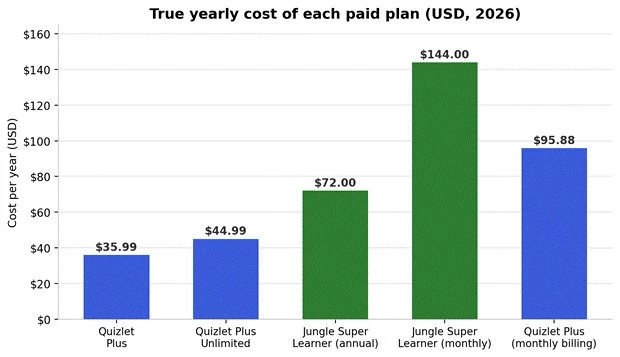
Figure 1. True yearly cost of each paid option. Monthly billing quietly triples Quizlet's effective price and doubles Jungle's, which is exactly how both companies want it.
The billing trap deserves its own warning. Quizlet Plus at $7.99 per month sounds harmless until you realise ten months of a school year costs $79.90 against $35.99 billed annually. Jungle's gap is just as wide, $144 monthly against roughly $72 annual. If you know you will study all year, annual billing is not a discount, it is the real price, and monthly is the penalty rate.
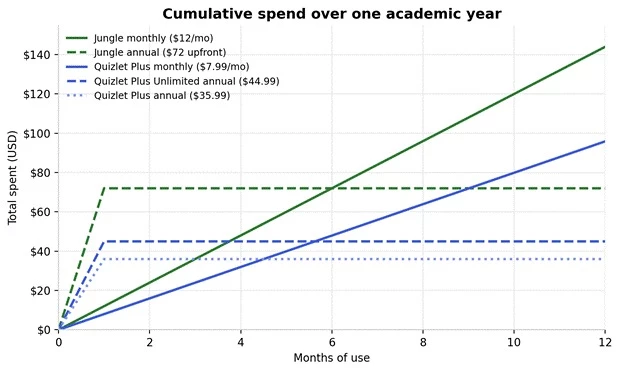
Figure 2. Cumulative spend across an academic year. The monthly-billing lines cross their annual equivalents within four to six months on both platforms.
Most students reading this will never pay for either app, so the free tiers deserve an honest audit rather than a footnote.
Jungle's free plan gives you 10 AI generations per month, with each document capped at 30 pages and each video at 30 minutes, plus 4 advanced question types, 1 diagram question, and 8 AI explanations or chats per hour while reviewing. That sounds tight, and during exam season it is. One heavy week of classes can drain all ten generations. But here is the part that matters: those ten generations are the full product. The AI quality, the smart grading, the spaced repetition, and the tree all work exactly the same as they do for paying users, and the app carries no ads on any tier.
Quizlet's free plan gives you unlimited manual flashcard creation and access to the public library, which is genuinely valuable, alongside daily caps on Learn and Test modes and ad interruptions. What it gives you of Quizlet's AI features is simpler to state. Nothing. Q-Chat, Magic Notes, AI practice tests, and smart grading all require Plus. The free plan in 2026 is best understood as a demo of the library plus a basic card flipper.
My reading of this chart is simple. If you refuse to pay, Jungle gives you a small but real slice of an AI study workflow every month, while Quizlet gives you a huge library with the smart features switched off. Which trade suits you depends on whether your course material is standard enough to already exist in Quizlet's library.
For everyone who scrolled straight here, this table condenses the two weeks of testing into one view.
| Capability | Jungle AI | Quizlet |
| AI generation from PDFs, slides, videos | Core feature, free quota included | Paid only, via Magic Notes |
| Question variety | MCQ, free response, case-based, diagram, image occlusion | Flashcards, Learn, Test, Match |
| Pre-made content library | None | 500M+ community study sets |
| Spaced repetition | Built-in daily review, Anki-style | Adaptive Learn mode, capped on Plus |
| Flexible answer grading | Free on all tiers | Paid feature |
| Ads | None on any plan | Present on free plan |
| Classroom and teacher tools | Not offered | Mature, widely adopted |
| Anki export | Yes, on Super Learner | No official export |
| Known weak spots | Occasional lag and freezing, no summaries or podcasts | Paywall creep, variable set quality, 1.4 Trustpilot score |
Table 2. Head-to-head capability comparison based on hands-on testing and verified 2026 plan documentation.
Let me be precise about Quizlet's remaining territory, because it is bigger than the AI crowd admits.
Anyone who values a decade-plus of platform stability over new features will find Quizlet the safer bet, since it is a mature product that is not going anywhere.
Content-heavy programs like medicine, nursing, law, and engineering, where your material is unique lecture decks rather than standard textbooks, are exactly what Jungle was tuned for.
The one question that decides this comparison is where your study material comes from.
If your material is your own, meaning lecture slides, professor PDFs, recorded classes, and YouTube explainers, Jungle AI is the better tool and it is not particularly close. It removes the most tedious step in studying, its accuracy holds up under scrutiny, its free tier includes the real product, and its annual price of roughly $72 buys unlimited use of something Quizlet cannot do at all. The performance hiccups are annoying and the analytics could go deeper, but neither changed my results.
If your material is everyone's, meaning standard courses where excellent community sets already exist, Quizlet Plus Unlimited at $44.99 per year remains a strong, cheaper purchase, and the free plan remains the best zero-cost library in education. Just walk in with clear eyes about the caps, the ads, and the fact that the features being advertised hardest are the ones you have not paid for yet.
My own setup after this experiment, for whatever it is worth, is Jungle for generating questions from my reading, exported to Anki for long-term retention, with Quizlet's free library kept around as a reference for standardised topics. The apps are different enough that the smartest answer might be refusing to choose.
Share your thoughts about this article.
Be the first to post a comment!
The same tool can be a 4.7 on one site and a 3.9 on another. Here is what is rea...
Nitin1 month ago
Here is the number worth pinning above your budget: in Gartner Digital Markets r...
Deepak Mehra1 month ago

What Artlist AI is in 2026Artlist began as a royalty-free music library. By 2026...
Deepak Mehra2 months ago
Most AI tool failures do not announce themselves. There is no crash, no angry em...
Nitin2 months ago

The best AI image generator in 2026 is Nano Banana 2 for speed, FLUX.2 for photo...
Parveen Verma2 months ago

“Useful” is a slippery word for a coding assistant. A tool can be brilliant at o...
Sakshi Dhingra2 months ago