ChatGPT is owned by OpenAI, a San Francisco-based artificial intelligence company. But "who owns OpenAI" is one of the most unusual ownership stories in business history. No single person or company owns it. As of the October 2025 restructuring, the last officially disclosed cap table, the equity of the operating company splits three ways: the nonprofit OpenAI Foundation holds about 26% (and controls the board), Microsoft holds about 27% as the largest outside shareholder, and the remaining ~47% belongs to current and former employees and a long roster of investors including SoftBank, Amazon, Nvidia and major venture funds.
And here's the fact that surprises almost everyone: Sam Altman, OpenAI's co-founder and CEO, holds no direct equity in the company he runs. The man fronting an $852 billion enterprise does not own a disclosed piece of it. The rest of this article unpacks how that came to be, who actually holds the power, and what the pending IPO changes.
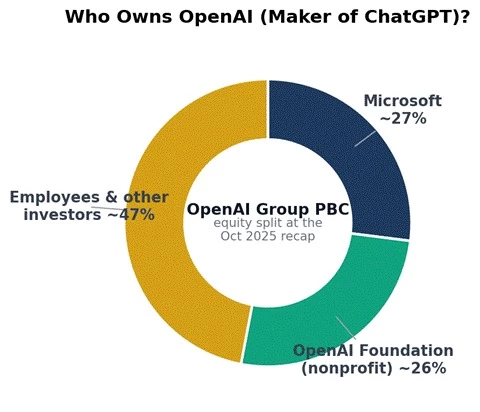
Figure 1: Equity split of OpenAI Group PBC as disclosed at the October 2025 recapitalization. The March 2026 funding round diluted these figures; no fully updated cap table has been published.
OpenAI was founded in December 2015 as a nonprofit research organization with a mission to ensure artificial general intelligence (AGI) benefits all of humanity. The founding group included Sam Altman, Elon Musk, Greg Brockman, Ilya Sutskever, Wojciech Zaremba and John Schulman, with early backers, Musk prominent among them pledging over $1 billion.
Pure nonprofit research turned out to be catastrophically expensive. Training frontier AI models costs billions in compute, so in 2019 OpenAI created a "capped-profit" subsidiary that could raise investment while limiting investor returns to 100x, and Microsoft wrote its first $1 billion check that same year. Then came November 2022: ChatGPT launched, reached 100 million users in about two months (the fastest-adopted consumer app in history at the time), and turned OpenAI from a research lab into the center of the global economy's biggest technology shift.
The capped-profit structure couldn't carry the capital requirements that followed. In October 2025, OpenAI completed a landmark recapitalization: the 100x return cap was eliminated, the operating business became OpenAI Group PBC , a public benefit corporation, and the nonprofit, renamed the OpenAI Foundation, took a 26% equity stake plus ironclad governance control. That structure is what exists today.
Think of OpenAI as two entities stacked on top of each other:
• OpenAI Foundation (the nonprofit): the control layer. It holds roughly 26% of the equity, a stake worth about $130 billion at recent valuations, but more importantly it holds special governance rights: it appoints the entire board of the operating company and can remove directors. Money doesn't control OpenAI; the Foundation does.
• OpenAI Group PBC (the operating company): the money layer. This public benefit corporation builds and sells ChatGPT, the API, Codex and everything else. Investors like Microsoft own economic stakes here, shares in profits and value, but not control. A PBC is also legally required to balance shareholder returns against its stated public mission.
This is why the question "does Microsoft own ChatGPT?" has a precise answer: no. Microsoft owns roughly 27% of the economics of OpenAI's operating company, plus deep commercial rights, but zero board control. The nonprofit's grip on governance survived every restructuring, every funding round, and a courtroom challenge from Elon Musk.
| Stakeholder | Approx. stake | What they actually get |
| OpenAI Foundation (nonprofit) | ~26% | Full board control; appoints/removes all PBC directors; ~$130B equity value earmarked for mission (incl. $25B initial commitment to health & AI-safety work) |
| Microsoft | ~27% | Largest outside shareholder (as-converted diluted; down from ~32.5% pre-recap); model & Azure rights through 2032; no board seat control |
| Current & former employees | part of ~47% | Equity via stock grants; periodic liquidity through tender offers at rising valuations |
| SoftBank | part of ~47% | ~$40B committed across 2025-26, heavily tied to the Stargate data-center initiative |
| Amazon | part of ~47% | $50B total commitment: $15B invested plus $35B contingent on an IPO (reported by end-2028) or reaching AGI |
| Nvidia, Thrive, Khosla, a16z, others | part of ~47% | Financial stakes across multiple rounds; Nvidia doubles as critical chip supplier |
| Sam Altman (CEO) | No direct equity | Salary and control of operations, but no disclosed ownership stake |
Microsoft's position is the single most consequential investment of the AI era. It started with $1 billion in 2019, grew through a reported $10 billion commitment in January 2023 weeks after ChatGPT's launch, and totals more than $13 billion in direct investment, much of it delivered as Azure cloud compute rather than cash. Before the October 2025 restructuring, Microsoft's interest in the old capped-profit entity was estimated around 32.5%; the recapitalization converted it into a clean ~27% equity stake in the new PBC.
A new definitive agreement signed in late 2025 rewrote the partnership: it removed earlier fundraising constraints (clearing the path for the $500 billion valuation mark and beyond), extended Microsoft's IP and Azure rights through 2032, and loosened exclusivity, OpenAI can now use other clouds for some workloads, and Microsoft's IP rights notably do not extend to OpenAI's consumer hardware projects. The April 2026 revision loosened commercial terms further. The relationship is now best described as co-dependent rivals: Microsoft embeds OpenAI models across Copilot while simultaneously competing with OpenAI in consumer and enterprise AI, and stands to reap a windfall when OpenAI lists.
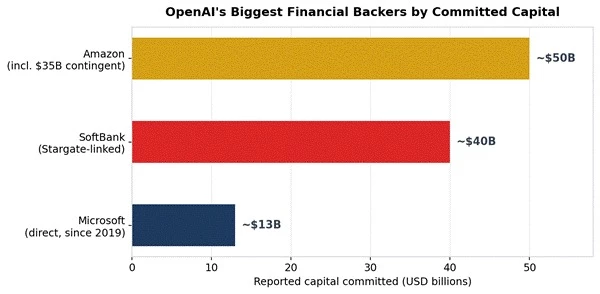
Figure 2: Largest reported capital commitments to OpenAI. Amazon's figure includes a $35B tranche contingent on an IPO or AGI milestone; Microsoft's direct investment excludes the value of its commercial partnership.
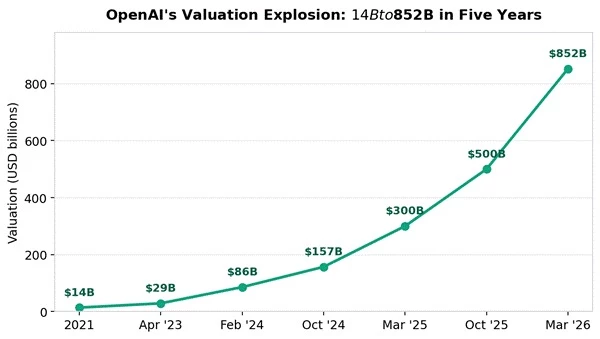
Figure 3: OpenAI's valuation at successive funding events and tender offers, 2021–2026.
Each step up this staircase came with new owners. The October 2024 round ($157B) brought in Thrive Capital and others. The March 2025 SoftBank-led round hit $300 billion. Employee tenders in late 2025 marked $500 billion. Then came the record-breaker: in March 2026, OpenAI closed a round with roughly $122 billion in committed capital at an $852 billion post-money valuation, the largest private financing in history, with Microsoft, SoftBank (~$30 billion of it), Nvidia and Amazon anchoring it. In total, OpenAI has raised more than $180 billion since founding.
One caveat worth stating plainly, because most articles skip it: the 26/27/47 ownership split is the official disclosure from the October 2025 recapitalization. The March 2026 mega-round diluted everyone, and OpenAI has not published a fully updated post-round cap table. Treat the percentages as the last confirmed snapshot, not a live figure. And for context on the competitive landscape: rival Anthropic's May 2026 round valued it at $965 billion, meaning OpenAI is, remarkably, no longer the most valuable AI company.
Sam Altman has led OpenAI since 2019 and co-founded it in 2015, yet holds no direct equity stake. This was originally a governance feature: a CEO without shares could sit on the nonprofit board without a conflict of interest. The arrangement famously did not prevent conflict in November 2023 the nonprofit board fired Altman, roughly 90% of employees threatened to resign, and he was reinstated within five days in one of the most dramatic corporate episodes in tech history. That crisis reshaped the board and set the stage for the 2025 restructuring. Whether Altman receives equity in a pre-IPO or post-IPO arrangement remains one of the most watched open questions in the S-1 process.
| Founder | Role then | Status in 2026 |
| Sam Altman | Co-founder | CEO since 2019; no disclosed equity |
| Elon Musk | Co-founder, early funder | Left board 2018; founded rival xAI (2023, since merged with SpaceX); sued OpenAI, lost at trial May 2026, appealing |
| Greg Brockman | Co-founder, CTO | President of OpenAI |
| Ilya Sutskever | Co-founder, Chief Scientist | Left 2024; founded Safe Superintelligence Inc. |
| John Schulman | Co-founder | Left 2024 (joined Anthropic, later Thinking Machines) |
| Wojciech Zaremba | Co-founder | Still at OpenAI |
No ownership story of OpenAI is complete without Elon Musk. He co-founded it, bankrolled its early years, left the board in 2018 after a failed bid to take control, and watched it become the most valuable startup on Earth without him. In 2024 he sued, alleging OpenAI defrauded him by abandoning its nonprofit founding mission for profit. In early 2025 a Musk-led consortium lobbed an unsolicited $97.4 billion takeover bid at the nonprofit's assets; Altman's public reply was "no thank you."
The case went to a fast-tracked jury trial in spring 2026 before Judge Yvonne Gonzalez Rogers in the Northern District of California. On May 18, 2026, after a three-week trial, the jury found Musk had simply waited too long to sue, the claims were dismissed on statute-of-limitations grounds, and the judge adopted the verdict. Musk called it a "calendar technicality" that never reached the merits and is appealing to the Ninth Circuit. But absent a new court order, the verdict removed the last major legal obstacle between OpenAI and the public markets — and the IPO paperwork followed within days.
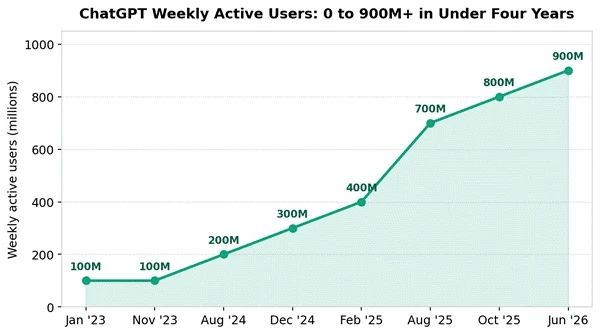
Figure 4: ChatGPT weekly active user milestones from launch to mid-2026 (company-reported).
ChatGPT now serves more than 900 million weekly active users, processing over 2.5 billion prompts per day. India is one of its largest markets with over 100 million weekly users. The business behind it generates roughly $2 billion in revenue per month, a $24 billion-plus annualized run rate as of early 2026, spanning ChatGPT subscriptions (Free, Go, Plus, Pro), enterprise deals, and API usage.
The other side of the ledger is equally historic: OpenAI is projected to post a net loss of roughly $40 billion in 2026. The gap is deliberate, the company has committed staggering sums to infrastructure, headlined by the $500 billion Stargate data-center initiative with Oracle and SoftBank, plus chip agreements with Nvidia, AMD and Broadcom. Every dollar of loss is a bet that owning the compute layer of the AI economy is worth more than near-term profit. This burn rate is precisely why the ownership keeps changing: OpenAI must keep selling pieces of itself to fund the buildout.
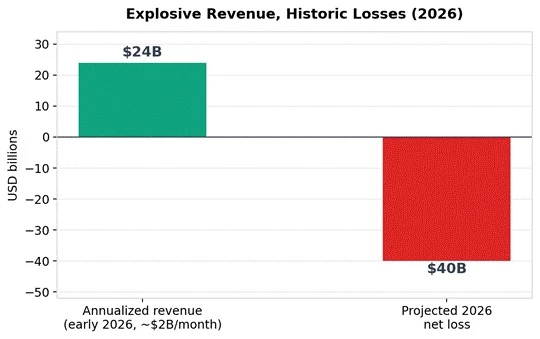
Figure 5: Annualized revenue versus projected 2026 net loss. The deficit funds the Stargate infrastructure buildout.
Days after the Musk verdict cleared the runway, OpenAI confidentially filed a draft S-1 registration statement with the SEC, kicking off the regulatory review for what could become the largest public listing in history, with bankers floating a $1 trillion-plus target and a debut as soon as Q4 2026. It is part of an unprecedented trio: Anthropic filed confidentially about a week earlier, and SpaceX (now merged with Musk's xAI) filed its public S-1 in the same window.
For the ownership question, the IPO changes everything and nothing. Everything, because the public will finally be able to own a slice of ChatGPT's maker, Microsoft's stake gets a public market price, and Amazon's contingent $35 billion likely triggers. Nothing, because the October 2025 architecture was explicitly designed to survive a listing: the OpenAI Foundation is expected to retain its board-control rights, meaning even public shareholders will own economics, not control. When the S-1 goes public, required at least 15 days before any roadshow, the disclosures to watch are the updated cap table, the Microsoft revenue-share terms, the Foundation's governance mechanics, and the path-to-profitability assumptions behind that $40 billion loss.
| Date | Event |
| Dec 2015 | Founded as a nonprofit by Altman, Musk, Brockman, Sutskever & others; $1B+ pledged |
| Feb 2018 | Musk leaves the board after failed bid to lead the company |
| Mar 2019 | "Capped-profit" subsidiary created (100x return cap); Microsoft invests $1B |
| Nov 2022 | ChatGPT launches; 100M users in ~2 months |
| Jan 2023 | Microsoft commits reported $10B; cumulative stake exceeds $13B |
| Nov 2023 | Board fires Altman; ~90% of staff revolt; he returns in 5 days |
| Oct 2024 | $6.6B round at $157B valuation |
| Mar 2025 | SoftBank-led round at $300B |
| Oct 2025 | Recapitalization: 100x cap removed; OpenAI Group PBC formed; Foundation 26% / Microsoft ~27% / employees & investors ~47% |
| Mar 2026 | Record ~$122B round at $852B post-money, largest private financing ever |
| May 18, 2026 | Jury dismisses Musk's lawsuit (statute of limitations); Musk appeals |
| May–Jun 2026 | OpenAI confidentially files S-1 with the SEC; IPO targeted as soon as Q4 2026 at $1T+ |
Share your thoughts about this article.
Be the first to post a comment!
A marketing team in 2023 that wanted a two-minute product explainer typically bo...
Sakshi Dhingra1 week ago
Two years ago, an AI presenter on screen was a talking point. Today it is a line...
Parveen Verma2 weeks ago
Quick answer: ChatGPT is owned and operated by OpenAI Group PBC, a for-profit pu...
Sakshi Dhingra2 weeks ago

Here is the exact moment most people end up asking this question. You have final...
Nitin3 weeks ago
A stolen password does not always look suspicious to a login system. If the user...
Deepak Mehra1 month ago
The short versionA Claude API key is created in the Claude Console at platform.c...
Harpreet Singh1 month ago