A code kata is a small exercise you repeat until the technique becomes instinct.
The term was coined back in 2003 by Dave Thomas, co-author of The Pragmatic Programmer, who borrowed it from Japanese martial arts, where a kata is a practiced sequence of movements. His original collection still lives at CodeKata, and the idea has since grown into an entire industry of practice platforms. Some stayed true to the original philosophy of deliberate, repeated practice. Others turned it into interview prep or competitive sport.
I compared six of the most-used kata platforms for this article, pulled live traffic and authority data from Ahrefs for each one, and matched the platforms to the goals they actually serve. Whether you want a daily 15-minute habit, mentored feedback on your code, or a FAANG offer, one of these six fits.
Here is the full field at a glance.
The 6 Best Kata Platforms at a Glance
Platform
Languages
Price
Community
Best for
Codewars
55+
Free (ads) / $9.99 a month
3M+ developers
Daily kata habit and language fluency
Exercism
82 tracks
100% free, nonprofit
1.9M+ users
Learning idiomatic code with human mentors
LeetCode
20+
Free / $35 a month Premium
26.3M monthly visitors
Technical interview preparation
HackerRank
50+
Free for developers
30M+ developers
Structured tracks and skill certifications
CodinGame
25+
Free for developers
2M+ developers
Learning through actual games and bot battles
Cyber-Dojo
Dozens
Free, nonprofit
Workshop and team focused
Pure TDD kata practice in groups
Community figures come from each platform's own published numbers and Wikipedia. LeetCode's figure is monthly visitors since it does not publish registered user counts.
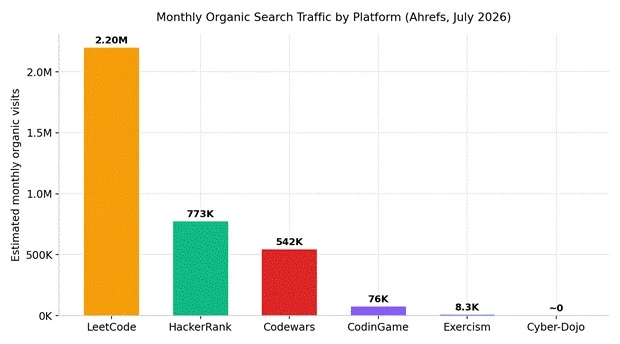
Figure 1: Estimated monthly organic search traffic per platform. Source: Ahrefs Batch Analysis, July 2026.
The traffic chart tells you where the crowds are, not where the quality is. LeetCode's 2.2 million monthly organic visits reflect the interview prep gold rush. Meanwhile Exercism, arguably the best pure learning platform here, pulls under 10,000 search visits because its 1.9 million users mostly arrive direct and stay logged in. Do not confuse popularity with fit for your goal.
Coding Kata vs Regular Coding Challenges
The term code kata comes from the idea of deliberately repeating a small exercise to improve technique. Dave Thomas helped popularize the concept in software development through CodeKata, describing coding kata as short exercises intended to create the kind of practice programmers rarely get during normal project work.
That is slightly different from simply solving as many algorithm questions as possible.
A traditional kata might involve solving the same problem again with cleaner code, trying another design, adding tests, or using a different programming language. The point is not necessarily to reach the answer once. The point is to improve the way you reach it.
Modern coding-practice websites have stretched the definition considerably. LeetCode focuses primarily on interview algorithms. HackerRank combines practice with assessment. CodinGame adds games and competition.
They are included here because someone searching for the best coding kata site is usually trying to achieve one of the same broader goals: write more code, improve problem solving, learn a language, or prepare for a technical interview.
The 6 Best Coding Kata Sites Compared
1. Codewars
The quick take
Codewars is the platform that made kata a household word among developers, and it remains the definitive kata site. More than 3 million developers train here on community-authored challenges across 55+ programming languages, ranked by the same kyu and dan grading system used in martial arts.
The kyu and dan system explained
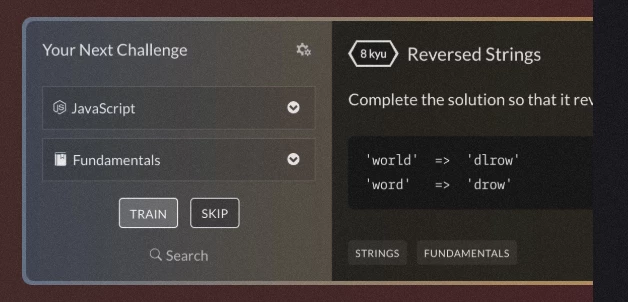
Every kata carries a difficulty rank from 8 kyu (beginner) up to 1 kyu, after which the dan ranks begin, exactly as they do in judo or Go. You start at 8 kyu, and each solved kata pushes your rank upward. The genius of the system is that difficulty always matches your level, so the next challenge is stretching but never crushing.
Beyond the ranking, three things keep Codewars sticky:
After you solve a kata, you can view everyone else's solutions, which is routinely described by users as the moment their code style leveled up.
Kata are authored, tested, and refined by the community itself, with over 10,000 approved challenges covering everything from string puzzles to esoteric algorithm work.
The built-in test cases encourage a test-driven workflow, which quietly trains a professional habit while you play.
Pricing and honest caveats
The free tier is fully functional with ads.
The honest caveat, echoed across nearly every 2026 review: strong Codewars performance does not reliably predict interview performance. Kata problem styles differ from the conversational, explain-your-reasoning format of real technical interviews. Use Codewars to build fluency and habit, and pair it with an interview-focused platform when a job hunt starts.
2. Exercism
The quick take
Exercism is the platform I recommend most often, and the least commercial of the six. Founded in 2013 by Katrina Owen as a tool for her own programming students, it is now a nonprofit, open-source platform with 1.9 million users and 82 language tracks. Everything on it is free, permanently, with no ads and no premium tier.
Human mentors, not just green checkmarks
The mentorship model is the whole story. You submit a solution and a volunteer mentor, usually an experienced developer in that specific language, reviews your code and tells you how to make it more idiomatic. Nothing else on this list comes close to a real professional code review for free.
The details that make the learning stick:
Each language track is a structured progression through concepts, so you build Rust or Go knowledge in a sensible order instead of randomly.
The focus is on writing good, idiomatic code rather than merely passing tests, which is precisely the skill gap that automated judges never address.
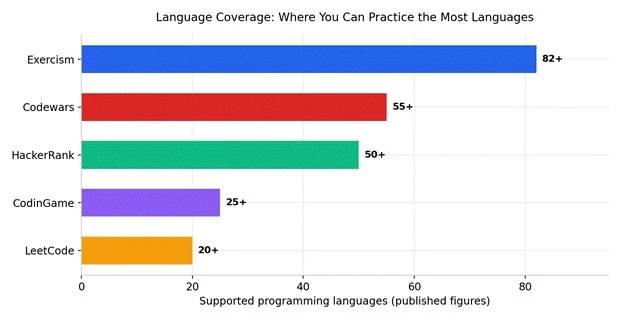
With 82 tracks, it covers more languages than any other platform in this comparison, including obscure ones like Prolog, COBOL, and Unison.
The data quirk worth knowing
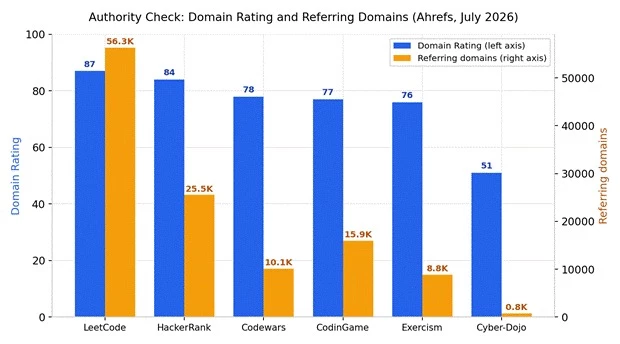
Ahrefs shows Exercism with a Domain Rating of 76 and nearly 8,900 referring domains, yet only around 8,300 monthly organic search visits. That is not weakness, it is a usage pattern. Exercism's audience bookmarks the site, works through the app and CLI, and returns direct. Judged by backlink authority, it sits shoulder to shoulder with Codewars and CodinGame. If your goal is learning a language properly rather than grinding puzzles, start here.
3. LeetCode
The quick take
LeetCode is technically an interview prep platform rather than a kata site, but no honest kata roundup can skip it. Founded in 2015 by Winston Tang, it now draws 26.3 million monthly visitors, hosts more than 3,000 problems, and generated 8 million dollars in revenue in 2024. In search terms it dwarfs everything else here, with a Domain Rating of 87 and 2.2 million monthly organic visits.
Built for one job, and ruthless about it
LeetCode problems mirror what companies actually ask in technical interviews, and that alignment is its entire value:
Problems are tagged by the companies known to ask them, including Google, Amazon, and Meta, though the full company tags sit behind Premium.
The community has produced canonical prep paths like the Blind 75 and NeetCode 150, which turn a 3,000-problem ocean into a swimmable pool.
Weekly contests give you timed pressure practice, which matters more than most candidates expect.
Pricing and the kata question
The free tier includes the majority of problems. Premium runs about 35 dollars a month and unlocks company tags, frequency data, and the debugger.
As a kata platform in the original Dave Thomas sense, LeetCode honestly fails. There is no repetition philosophy, no style feedback, and the grind culture around it burns people out. As an interview weapon, nothing else is even close. Know which game you are playing before you commit months to it.
4. HackerRank
The quick take
HackerRank claims the largest community on this list, with over 30 million developers. Its real business is selling assessment software to employers, which shapes the developer side of the platform in ways both useful and limiting. Ahrefs puts it second in this field for authority, with a Domain Rating of 84 and around 773,000 monthly organic visits.
Structured tracks and paper you can show
Where Codewars is a playground, HackerRank is a syllabus:
Preparation kits and domain tracks cover algorithms, SQL, regex, AI, and databases in a guided sequence, which suits people who dislike choosing their own path.
Free skill certifications in areas like Python, SQL, and problem solving give you a verifiable credential that recruiters on the platform actually recognize.
Because thousands of companies run their real hiring screens on HackerRank, practicing here means rehearsing in the exact exam hall you will later sit in.
Cost and the honest caveat
Everything on the developer side is free. The trade-off is that HackerRank's problem statements are famously wordy, wrapping simple tasks in long narrative setups, and the community energy of Codewars is missing. Treat it as the place you go to get certified and to rehearse company assessments, not the place you fall in love with programming.
5. CodinGame
The quick take
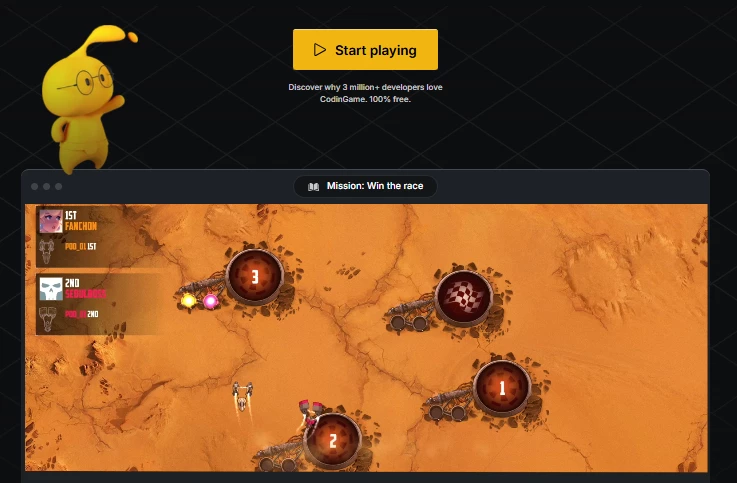
CodinGame answers a real question: what if practice did not feel like homework? You write code to control game characters, race bots, and battle other players' AI in more than 50 games across 25+ programming languages. Around 2 million developers use it, and it earns a Domain Rating of 77 with a notably strong 15,900 referring domains for its size.
Learning disguised as play
Puzzle games teach loops, pathfinding, and optimization while you watch your code play out visually on screen, which shortens the feedback loop in a way text output never does.
Bot programming battles pit your AI against other players in ongoing leaderboard seasons, and the jump from bronze to legend league is a genuine algorithms education.
Clash of Code offers five-minute multiplayer rounds in shortest-code or fastest-solve modes, which is the closest thing coding has to a pickup basketball game.
Cost and fit
Free for developers, funded by the hiring side of the business. CodinGame is the best answer on this list for lapsed practice habits. If you have abandoned three LeetCode streaks, the game format may be the trick that finally sticks. It is weaker for interview prep and for language breadth, so pair it rather than rely on it.
6. Cyber-Dojo
The quick take
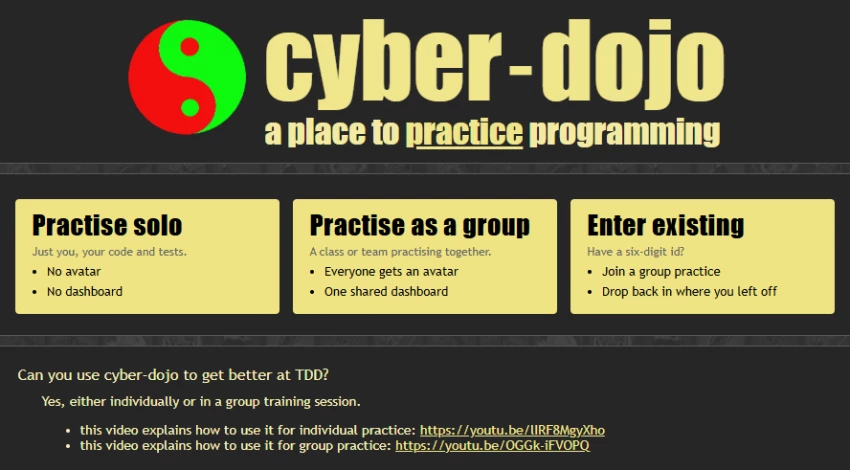
Cyber-Dojo is the purist's choice and the platform closest in spirit to Dave Thomas's original idea. Created by Jon Jagger and run as a nonprofit, it exists for practicing test-driven development, alone or in a group, with zero gamification. No points, no ranks, no leaderboards. Just you, a failing test, and the discipline of small steps.
Deliberately anti-shiny
Sessions run entirely in the browser with dozens of language and test-framework combinations, so a team can start a group kata in under a minute with nothing installed.
A traffic-light history records every test run as red, amber, or green, letting you review the shape of your practice afterward, which is the whole point of a kata.
It is the default tool of coding dojo meetups and corporate TDD training worldwide, which is why its Ahrefs footprint is nearly invisible while its influence is not.
Cost and fit
Free, donation-supported, and open source. Choose Cyber-Dojo if you run a study group, coach a team, or want to practice TDD the way the coding dojo movement intended. Skip it if you need motivation supplied by the platform, because it offers none on purpose.
The Numbers Behind the Rankings
Every domain in this article went through Ahrefs Batch Analysis in July 2026, and two findings shape how you should read the market.
First, search dominance maps to interview anxiety, not learning quality. LeetCode and HackerRank hold the top authority scores because millions of job seekers link to and search for them. The best pure learning platforms, Exercism and Cyber-Dojo, barely register in search because their communities arrive direct.
Figure 2: Domain Rating and referring domains for all six platforms. Source: Ahrefs, July 2026.
Second, language coverage varies more than most people realize. If your language is Elixir, OCaml, or COBOL, most platforms simply cannot help you, and Exercism becomes the only serious option.
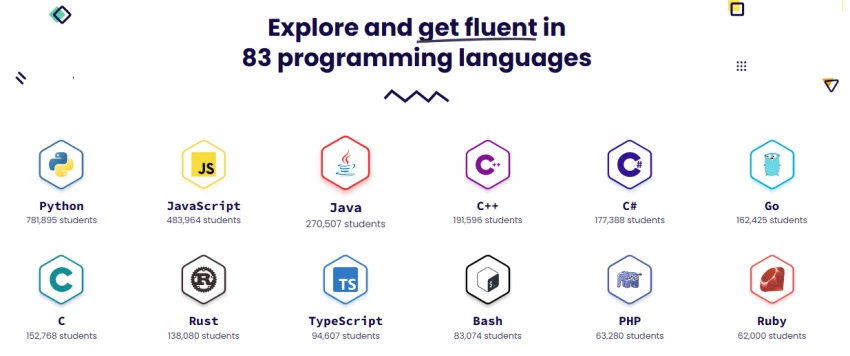
Figure 3: Published language support figures per platform. Cyber-Dojo is excluded because it counts language and test-framework combinations rather than languages.
Common Mistakes When Using Coding Practice Platforms
Coding practice platforms work best when they are used with a clear purpose. Simply completing more problems does not automatically make someone a better programmer. The quality of the practice matters more than the number beside a profile streak.
Solving Problems Without a Learning Goal
One of the most common mistakes is choosing random challenges every day. This may feel productive, but it often creates scattered knowledge. A learner might solve one string problem, one graph problem and one database query without developing confidence in any of them.
A better approach is to spend several days on one topic. For example, focus on arrays and loops before moving to recursion, data structures or dynamic programming. Platforms such as HackerRank and Exercism are particularly useful here because their structured tracks guide learners through concepts in a logical order.
Treating a Streak as the Main Achievement
Daily streaks can encourage consistency, but they can also become misleading. Solving an easy problem only to preserve a streak is not the same as improving.
A productive session should involve some level of difficulty, reflection or revision. On certain days, reviewing an old solution and rewriting it more clearly may be more valuable than completing a new challenge. The objective should be better reasoning and cleaner code, not merely keeping a counter active.
Copying Highly Ranked Solutions Too Quickly
Codewars and similar platforms allow users to view other submissions after completing a challenge. This is one of their strongest learning features, but it can become a shortcut.
Reading an elegant solution immediately and copying its style does not guarantee understanding. Before opening community answers, explain why your own solution works, identify its time and space complexity, and consider how it could fail. After viewing another solution, close it and try to reproduce the underlying idea without copying the exact code.
Ignoring Feedback and Code Quality
Passing every automated test does not mean the solution is well written. Code can produce the correct output while still being difficult to read, unnecessarily slow or dependent on fragile logic.
Learners should pay attention to naming, structure, duplication, edge cases and language-specific conventions. Exercism is especially valuable because its mentorship model focuses on writing idiomatic code rather than only receiving a green checkmark.
Starting LeetCode Before Learning the Basics
LeetCode is highly effective for technical interview preparation, but it can be overwhelming for beginners. Someone who is still learning loops, functions, arrays and basic data structures may spend hours memorising solutions without understanding the concepts behind them.
Beginners are usually better served by structured language tracks on Exercism or HackerRank, followed by regular Codewars practice. LeetCode becomes more useful once the learner can comfortably write programs, analyse basic complexity and recognise common data structures. The platform is designed primarily around interview-style problems rather than the original repetitive kata philosophy.
A 30-Day Coding Kata Practice Plan
This 30-day plan is designed to build consistency without turning coding practice into an exhausting daily grind. Most sessions should take between 20 and 40 minutes. The focus should remain on understanding, repetition and gradual improvement.
Days 1–7: Build the Foundations
Choose one programming language and stay with it for the entire month. Start with beginner-level exercises involving variables, conditions, loops, strings, arrays and functions.
Complete one or two easy problems each day on Codewars, HackerRank or Exercism. Do not worry about speed. After each exercise, write one sentence explaining the main idea used in the solution.
On Day 7, revisit two earlier problems and solve them again without looking at the original code. This reveals whether the method has actually become familiar.
Days 8–14: Create a Consistent Practice Habit
During the second week, continue with daily exercises but begin grouping them by topic. Spend two or three days on arrays, followed by strings, basic sorting or simple data structures.
Try one challenge slightly above your current level every two days. Struggling is expected, but set a limit of around 30 minutes before reading hints. When you do use a hint, return to the problem later and solve it independently.
By the end of Day 14, select your three weakest solutions and rewrite them with clearer names, smaller functions and less repeated code.
Days 15–21: Focus on Feedback and Code Quality
The third week should move beyond simply passing tests. Submit at least one Exercism exercise for mentor feedback, or ask a more experienced developer to review one of your solutions.
Compare your completed Codewars answers with well-rated community submissions. Look for differences in readability, performance and use of built-in language features. Avoid copying clever one-line answers unless they are genuinely easier to understand.
Use one session during this week for test-driven practice on Cyber-Dojo. Write a failing test, make the smallest change needed to pass it, and repeat. This helps build the discipline behind traditional coding kata.
Days 22–27: Introduce Timed Challenges
Once the fundamentals feel comfortable, add controlled time pressure. Choose one familiar problem type and give yourself 25 to 35 minutes to complete it.
Learners preparing for jobs can begin introductory LeetCode or HackerRank interview problems during this stage. Focus on explaining the approach before writing code. After finishing, record how long the problem took, where you became stuck and what pattern helped solve it.
Do not attempt several timed problems in one session. The review after the exercise is more important than the timer itself.
Days 28–30: Review and Measure Progress
Use the final three days to assess improvement rather than chasing new problems.
On Day 28, repeat a challenge from the first week and compare the two solutions. On Day 29, complete one unfamiliar problem under timed conditions. On Day 30, review the month and identify the topics that still require work.
A useful final record should include the number of problems completed, the concepts practised, recurring mistakes and the platform that best supported your goal.
The purpose of the plan is not to produce the largest problem count. It is to establish a repeatable routine that combines daily fluency, structured learning, feedback and interview preparation. This expands the article’s existing recommendation of regular Codewars practice, weekly Exercism feedback and interview-focused preparation when required.
A Practice Routine That Actually Works
Owning six gym memberships builds no muscle, so here is the routine I would actually run:
Daily, 15 to 30 minutes: one or two Codewars kata at your current kyu, plus one kata a rank above you when you feel brave.
Weekly: one Exercism exercise in the language you are learning, submitted for mentor review, with the feedback applied before you move on.
When interviews approach: switch the daily slot to LeetCode and work through the NeetCode 150 rather than random problems.
Monthly, with friends or colleagues: one group kata session on Cyber-Dojo, because explaining your steps out loud exposes gaps that solo practice hides.
Consistency beats platform choice every single time. A mediocre platform used daily will outperform the perfect platform used twice.
The Verdict
There is no single best coding practice website because the six platforms train different skills.
Codewars is the best overall coding kata platform for most developers who want regular short-form practice. It stays close to the kata idea, supports 55+ languages, has more than 12,000 community-created kata and makes comparing solutions genuinely useful.
Exercism is my pick for learning a programming language properly. Its 83 language tracks, structured exercises and mentoring model make it much stronger for learning idiomatic code than simply chasing accepted answers.
LeetCode wins for technical interviews, while HackerRank is better suited to structured skills practice, certifications and assessment preparation.
CodinGame is the easiest recommendation for someone bored by traditional coding challenges, and Cyber-Dojo is the specialist option for TDD and team practice.
If I were starting today without an interview deadline, I would use Exercism to learn and Codewars to practice.
That pairing costs nothing for the core experience and covers far more useful ground than trying to maintain accounts on six different coding platforms.