
Here is a small confession most security writers avoid making: you probably do not need to pay for antivirus anymore. The free options in 2026 have become good enough that in the latest independent lab tests, several of them sit shoulder to shoulder with paid suites costing $60 a year, and one of them is already sitting quietly inside your Windows PC doing its job without you ever having installed anything.
That does not mean every free antivirus deserves your trust. Some slow your laptop to a crawl, some nag you into upgrading twelve times a day, and one of the biggest names in the business was fined $16.5 million by the US Federal Trade Commission for secretly selling the browsing data of the very users it promised to protect. So this guide does two jobs at once. It ranks the genuinely good free tools using hard numbers from AV-Comparatives and AV-TEST, the two most respected independent testing labs, and it tells you the uncomfortable stories the download pages leave out.
For most people on Windows 11, the honest recommendation is the boring one: Microsoft Defender, the antivirus already built into your PC, now earns the highest award tier from independent labs and costs you nothing in money, installation, or nagging. If you want a third-party upgrade, Bitdefender Antivirus Free delivers the single best raw detection rate we found, and Avira Free Security packs in the most extras. Avast and AVG protect brilliantly but carry a privacy history you deserve to know about before installing. Here is the field at a glance.
| Product | Best for | The one-line truth |
| Microsoft Defender | Almost everyone on Windows | Built in, invisible, and now rated ADVANCED+ by AV-Comparatives, so doing nothing is a legitimate strategy |
| Bitdefender Free | Maximum protection, minimum fuss | Top detection rate of any product tested (99.97%) in a deliberately stripped-down, quiet package |
| Avast One Free | Feature seekers | Superb protection plus a free VPN and firewall, shadowed by a 2024 FTC fine for selling user browsing data |
| AVG AntiVirus Free | Avast's protection, different coat | Owned by the same company and running the same engine as Avast, so pick one, never both |
| Avira Free Security | Extras on a budget | VPN, password manager, and tune-up tools included free, but the heaviest system impact in recent lab tests |
| Malwarebytes Free | Second-opinion cleanup | No real-time protection at all in the free tier, so it is a cleanup tool, not a bodyguard |
Table 1: The six free antivirus tools this guide covers, and the honest one-line summary of each.
Antivirus reviews have a credibility problem, because most of them are written by sites earning commission on the paid product they eventually recommend. So this guide leans on two independent laboratories that infect real Windows machines with live malware for a living. AV-Comparatives in Austria runs its Real-World Protection Test continuously through the year, throwing hundreds of malicious URLs at 20 consumer products on fully updated Windows 11 systems. AV-TEST in Germany does the same and scores every product out of six points each for protection, performance, and usability. When both labs agree on something, you can take it to the bank.
There is also a secret about this industry that changes how you should read every ranking, including this one. Many antivirus brands are the same engine wearing different jackets. AV-Comparatives' own March 2026 disclosure confirms that AVG and Norton use the Avast engine, that F-Secure and TotalAV use the Avira engine, and that G Data and VIPRE run on Bitdefender's engine underneath. Once you know that, the market of thirty products collapses into roughly five detection engines, and choosing gets a lot simpler.
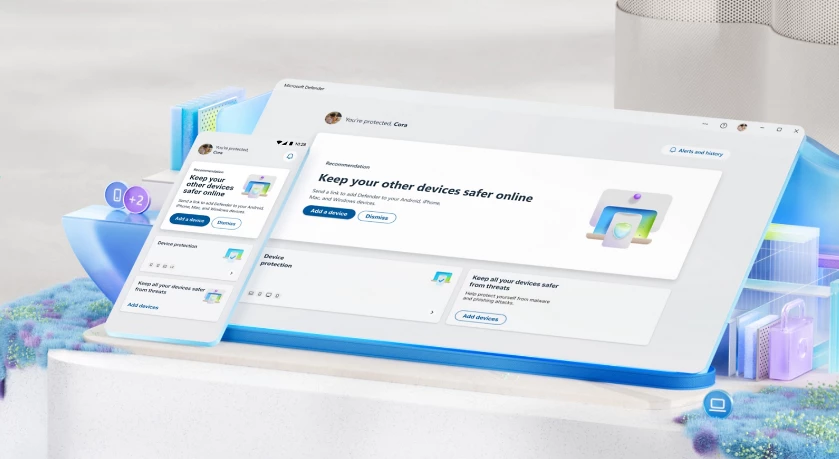
For years, the running joke was that Windows Defender existed mainly to protect your PC until you installed real antivirus. That joke has aged badly. Defender ships inside every copy of Windows 10 and 11, updates itself through Windows Update, and has quietly climbed the lab charts to the point where it now embarrasses products people pay for.
The numbers back this up from two directions at once. In AV-Comparatives' Real-World Protection Test covering February to May 2026, Microsoft was one of only seven vendors to earn the top ADVANCED+ award, standing alongside Bitdefender, Kaspersky, and Norton. In AV-TEST's January 2026 Windows evaluation, Defender scored a perfect 6 out of 6 in all three categories, with a 99.9% detection rate and the lowest false positive count in the test, as reported by IT Cares' 2026 roundup. It also plugs into things no third party can touch as deeply: SmartScreen for blocking malicious downloads, the built-in Windows Firewall, and controlled folder access for ransomware protection.
The trade-offs are real but small. Full scans run slower than the best third-party engines, the interface is scattered across Windows Settings rather than one friendly dashboard, and there is no bundled VPN, password manager, or web extension for non-Edge browsers.
Where third-party engines edge it out is the last fraction of a percent: in AV-Comparatives' March 2026 malware test with 10,000 live samples, Defender's 99.89% online protection trailed Bitdefender's 99.97% by exactly 8 samples in 10,000. You can decide for yourself how much those eight files keep you up at night.
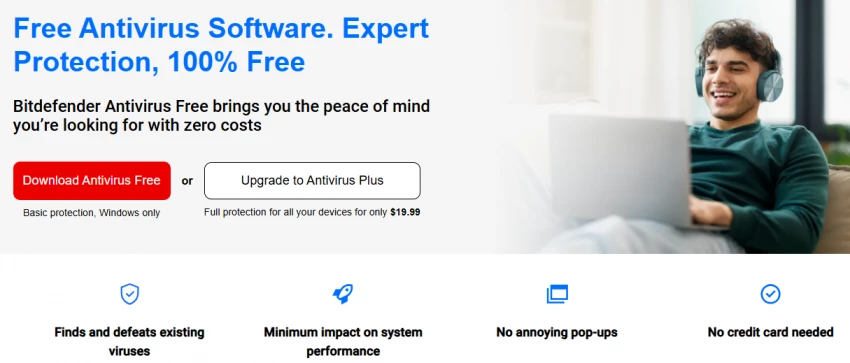
If Defender is the sensible default, Bitdefender Antivirus Free is the enthusiast's free pick. Bitdefender's engine posted the highest protection rate of all 20 products in AV-Comparatives' March 2026 malware test at 99.97%, ahead of ESET at 99.95% and Kaspersky at 99.94%, and the company took home another ADVANCED+ award in the February to May real-world test. This is the same core engine that G Data, VIPRE, and Total Defense license for their own paid products, which tells you what the industry itself thinks of it.
The free version is deliberately minimal, and that is its charm. You get real-time malware protection, web attack prevention, and anti-phishing, wrapped in an interface so quiet you will forget it is there, with one of the lightest system footprints of any third-party antivirus.
You do not get the ransomware remediation, firewall, VPN, or banking protection from the paid tiers, and the app will occasionally remind you they exist. But if your definition of antivirus is a tool that catches the most malware while bothering you the least, this is the strongest free third-party option on the market, and reviewers at SafetyDetectives and IT Cares independently reached the same number one or number two ranking in 2026.
Judged purely on protection, Avast belongs at the very top of this list. Avast One Free Antivirus earned ADVANCED+ in the February to May 2026 real-world test and again in the March malware test, and its free tier is the most generous in the industry, bundling a firewall, ransomware shield, and even a VPN with a 5GB weekly data allowance, features every competitor locks behind a paywall. On merit alone, it would fight Bitdefender for first place.
The complication is history. In February 2024, the US Federal Trade Commission fined Avast $16.5 million and banned it from selling browsing data for advertising. The FTC found that from 2014 to 2020, Avast collected detailed browsing data through the very software that promised to block tracking, and sold it to more than 100 third parties through its Jumpshot subsidiary, including data revealing users' health concerns, religious beliefs, and finances. Avast shut Jumpshot down in January 2020 after journalists exposed the practice, paid a separate $14.9 million GDPR fine in the Czech Republic, and is now legally bound to a comprehensive privacy program with annual certification.
So where does that leave you in 2026? The selling stopped six years ago, the company is under active regulatory supervision, and the labs confirm the protection is elite. Plenty of users have made peace with that and enjoy the richest free feature set available. Others reasonably conclude that an antivirus company monetizing user browsing histories crossed a line that no settlement un-crosses. Both positions are defensible, and this guide simply refuses to hide the story the way most download pages do.
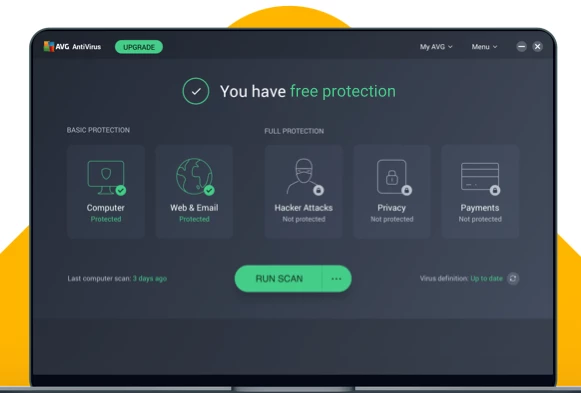
AVG deserves its own entry mostly so you understand why it does not really deserve its own entry. Avast acquired AVG back in 2016, and AV-Comparatives formally confirms that AVG runs the Avast engine underneath. That is why the two products march through lab tests in lockstep: AVG AntiVirus Free earned the same ADVANCED+ awards in both the February to May real-world test and the March malware test that Avast did.
The differences are packaging. AVG's free tier covers real-time protection, web and email shields, and basic ransomware protection, but skips the VPN and firewall that Avast One includes, while presenting a slightly simpler interface that some people prefer. The FTC case covered AVG-branded products too, since the same parent collected the data, so the privacy calculus is identical. The only genuinely useless move is installing both, because you would be running one engine twice and paying for it in performance. Pick whichever interface you like and move on.
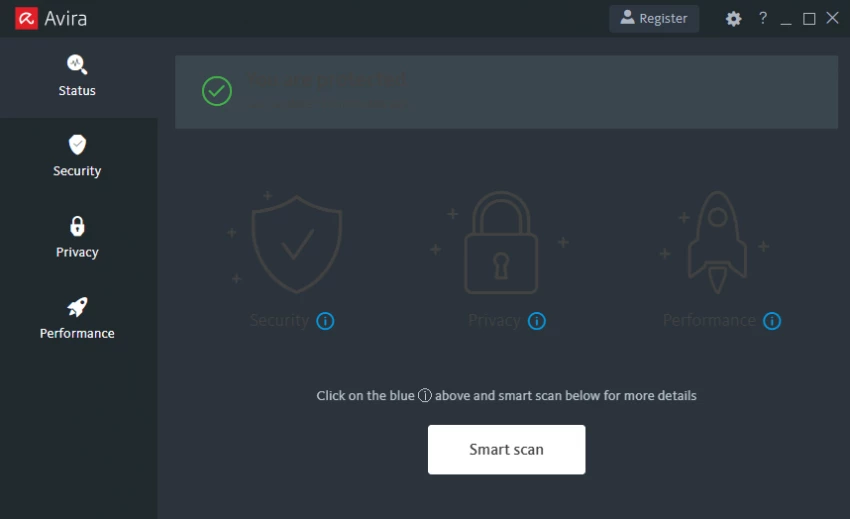
Avira plays a different game from everyone above. Rather than competing purely on detection, its free tier throws in the extras: a VPN with 500MB of monthly data, a basic password manager, a software updater, and PC tune-up tools, making it the closest thing to a free all-in-one security suite. Its German-built engine is respected enough that F-Secure, Fortect, and TotalAV all license it for their own products, and its detection scores have historically hovered near the top of the pack.
The catch showed up in recent performance testing. In the quarterly lab analysis compiled by Bits From Bytes from Q1 2026 data, Avira's 4.5 out of 6 performance score was the most meaningful outlier among major products, indicating measurable slowdown that users on mid-range or older hardware are likely to notice.
That is an awkward look for a product many people install precisely on aging laptops. If your machine is reasonably modern and you value the bundled VPN and password manager, Avira remains a genuinely rich free package. If your PC already feels slow, Bitdefender or Defender will treat it more kindly.
Malwarebytes earns its place on this list with an asterisk the size of a billboard: the free version includes no real-time protection whatsoever. It will not stop malware from arriving, it will only find and remove what is already there when you manually run a scan. Treating it as your only antivirus is like hiring a cleanup crew instead of a security guard.
Used correctly, though, it is excellent at its actual job. Its scanner has a strong reputation for digging out adware, browser hijackers, and potentially unwanted programs that traditional engines sometimes wave through, which makes it the perfect second-opinion tool to run alongside Defender or Bitdefender once a month or whenever something feels off.
Since it does not install a real-time engine in the free tier, it coexists peacefully with your main antivirus instead of fighting it. The premium version adds real-time protection and scored well in AV-Comparatives' 2026 tests, but as a free product, think of it as the specialist you call in, not the guard at the door.
Sharp-eyed readers will notice Kaspersky scoring near the top of every lab chart in this article, including an ADVANCED+ award in the 2026 real-world test and a 99.94% detection rate in March, and wonder why it is not ranked. The answer is availability, not quality. In June 2024, the US Commerce Department banned the sale of Kaspersky software to US customers over national security concerns tied to its Russian headquarters, and existing US installations stopped receiving updates in September 2024, which makes an antivirus effectively useless there. If you live outside the affected regions, Kaspersky's free tier remains technically excellent and the labs keep confirming it. If you are in the US, it is simply not an option anymore, and this guide ranks what you can actually install.
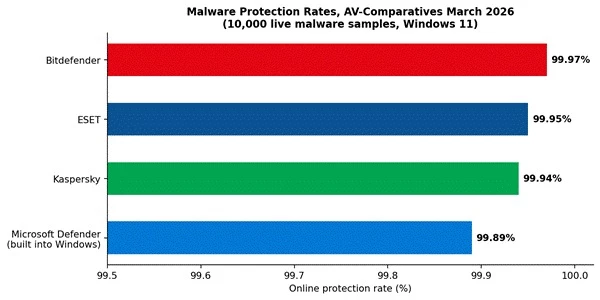
Figure 1: Online protection rates from AV-Comparatives' March 2026 Malware Protection Test using 10,000 live samples. The entire spread from first to fourth place is 0.08 percentage points, which is why factors beyond raw detection should drive your choice.
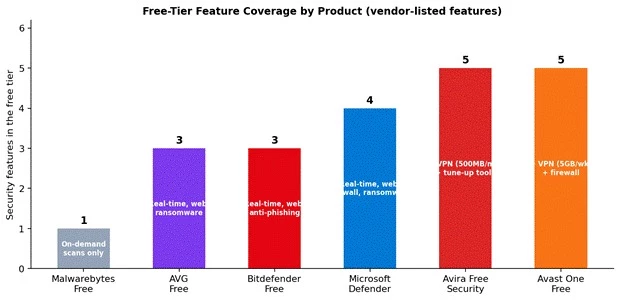
Figure 2: Security features included in each free tier, based on vendor-listed capabilities as of July 2026. Avast One and Avira lead on bundled extras, while Malwarebytes Free offers scanning only.
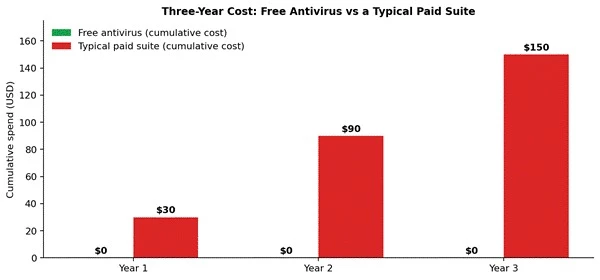
Figure 3: Cumulative three-year spend comparing free antivirus against a typical paid suite with a $30 introductory year and roughly $60 annual renewals. The renewal jump after year one is the part the checkout page rarely mentions.
| Product | Real-time protection | Lab standing (2026) | The catch |
| Microsoft Defender | Yes, always on | ADVANCED+ real-world; AV-TEST 18/18 | Slower full scans, settings scattered across Windows |
| Bitdefender Free | Yes | 99.97% detection, ADVANCED+ | Minimal features, occasional upgrade prompts |
| Avast One Free | Yes, plus VPN and firewall | ADVANCED+ in both 2026 tests | 2024 FTC fine for past sale of user browsing data |
| AVG Free | Yes | ADVANCED+, same engine as Avast | Identical engine to Avast, same privacy history |
| Avira Free | Yes, plus VPN and extras | Strong detection, 4.5/6 performance | Heaviest system impact among major free products |
| Malwarebytes Free | No, scans only | Premium tier tested well | Cleanup tool only, never a standalone defense |
Table 2: The details that actually separate the six products once you know detection rates are nearly identical.
The flip side of free security is that malware authors know you are searching for it. Fake antivirus remains one of the oldest scams on the internet, and a few honest rules will keep you out of trouble.
• Download only from the vendor's own website or an official app store, because sponsored search ads for antivirus have repeatedly been used to distribute lookalike installers carrying the exact malware you were trying to prevent.
• Be suspicious of unknown brands with no independent lab results, since SafetyDetectives' 2026 testing specifically flags products like Wolfram Antivirus as outright malware in disguise, and a legitimate product will always appear in AV-Comparatives or AV-TEST reports.
• Never run two real-time antivirus engines at once, because they scan each other's operations in an endless loop that slows your PC and can create genuine security gaps.
• Treat aggressive scare popups as a red flag in themselves, since reputable free tools upsell politely while scam tools manufacture fake infection panics to force a purchase.
The genuinely surprising conclusion of all this research is that the best free antivirus for most people is the one requiring zero effort. Microsoft Defender's climb from industry punchline to ADVANCED+ award winner means a fully updated Windows 11 PC with sensible browsing habits is already well protected, and the eight-in-ten-thousand detection gap to the very best engine is smaller than the difference your own clicking habits make.
If you do install something, Bitdefender Antivirus Free is the cleanest upgrade: the industry's best detection engine with nothing bolted on. Avast One Free and AVG offer elite protection with more toys for those who accept the company's past, Avira rewards modern hardware with the biggest free bundle, and Malwarebytes Free earns a permanent spot as everyone's second-opinion scanner. Whatever you choose, the era of needing to pay for good antivirus is over, and the only truly bad choice left is downloading something no independent lab has ever heard of.
Share your thoughts about this article.
Be the first to post a comment!

Choosing growth software in 2026 means finding five winners inside a catalog of...
Sakshi Dhingra1 month ago

The short version, for anyone who does not want to read 5,000 wordsCopper is a C...
Sakshi Dhingra2 months ago
If you've spent any time around tax professionals in the United States, you've h...
Harpreet Singh2 months ago

The short versionQuicken sells two entirely separate things. Quicken Classic is...
Harpreet Singh2 months ago
The photo editing software market has been shaken harder in the past eighteen mo...
Sakshi Dhingra2 months ago

A code kata is a small exercise you repeat until the technique becomes instinct....
Harpreet Singh2 months ago