If you've spent any time around tax professionals in the United States, you've heard the name Drake. Maybe from a solo CPA who swears by it. Maybe from a firm owner grumbling that their fancy enterprise software costs six times as much and crashes twice as often. Either way, Drake Software has a reputation and it's a surprisingly good one for a product that has never tried to be flashy.
Here's the short version before we go deep: Drake Software is a professional tax preparation platform built for tax preparers, CPAs, EAs, and accounting firms not for individuals filing their own taxes. It's been around since 1977, it's used by more than 70,000 tax professionals, and it processes over 36 million federal and state returns every single year. It is, by a comfortable margin, the most beloved tax software among sole practitioners in America, and it wins that crown mostly on three things: price, reliability, and customer support that actually picks up the phone.
In this article, we're going to take the whole thing apart the history, the product ecosystem, the features, the real pricing, the market share data, what actual users say (the good and the ugly), how it compares to Lacerte, UltraTax, and ProSeries, and who should genuinely buy it in 2026. There are charts. There are tables. Grab a coffee.
Before we get into the story, here's the cheat sheet, the facts you'd want if you only had thirty seconds:
| Attribute | Details |
| Founded | 1977, by Phil Drake |
| Headquarters | Franklin, North Carolina, USA |
| Parent company | Taxwell (also owns TaxAct); majority stake held by PE firm Cinven since 2021 |
| Flagship product | Drake Tax (desktop, web, and hosted versions) |
| User base | 70,000+ tax professionals / accounting firms nationwide |
| Annual volume | 36+ million federal and state returns processed per year |
| Forms supported | 4,300+ federal and state tax forms; all 50 states included |
| Starting price | $379.99 (Pay-Per-Return, 10 returns) for tax year 2026 |
| Survey rating | 4.4/5 overall — highest of the 7 major products (2025 AICPA survey) |
| Sweet spot | Solo practitioners and small firms (1–5 preparers) |
Drake's origin story is genuinely charming. Back in 1977, Phil Drake was just trying to automate payroll checks for his family's tax preparation office in small-town North Carolina. He built a program that worked, realized other preparers might want it too, and started selling his software door-to-door. That's it. That's the founding of what became one of the biggest names in professional tax software.
It wasn't a smooth ride. In 1981, the IRS in a twist of irony that tax pros still chuckle about threatened to shut the company down over outstanding payroll taxes, forcing Drake into bankruptcy. But the company kept its customers, clawed its way back, and repaid its debts in full. Then came the pivotal moment: in 1985, when the IRS announced its first venture into electronic filing, Drake jumped on it early and built a program to handle e-filing. That program evolved into Drake Tax, the flagship product that gets a new version every year to keep pace with federal and state tax code changes.
Two modern milestones matter. In February 2021, London-based private equity firm Cinven acquired a majority stake in the company. Then in May 2023, Drake Software and TaxAct (the DIY consumer tax product) were brought together under a new parent company called Taxwell with both brands continuing to operate separately. So today, when you buy Drake, you're buying from a PE-backed company that has more than doubled its customer base over the past decade. Legally, the entity operates as Taxwell DBA Drake Software LLC, with dual operations across North Carolina and South Carolina and around 600+ employees.
People say "Drake Software" when they usually mean Drake Tax, but the company actually sells a whole family of connected products. Understanding the ecosystem helps explain why small firms rarely leave once they're in it. Here's the lineup:
• Drake Tax — the core professional tax prep engine. Prepare, review, and e-file federal and state returns for individuals (1040), corporations (1120, 1120S), partnerships (1065), fiduciaries, estates, and non-profits. Available as classic Windows desktop software, as Drake Tax Online (web-based), or hosted in the cloud through third-party providers.
• Drake Accounting — bookkeeping, payroll, and accounting add-on for firms that want write-up work in the same family.
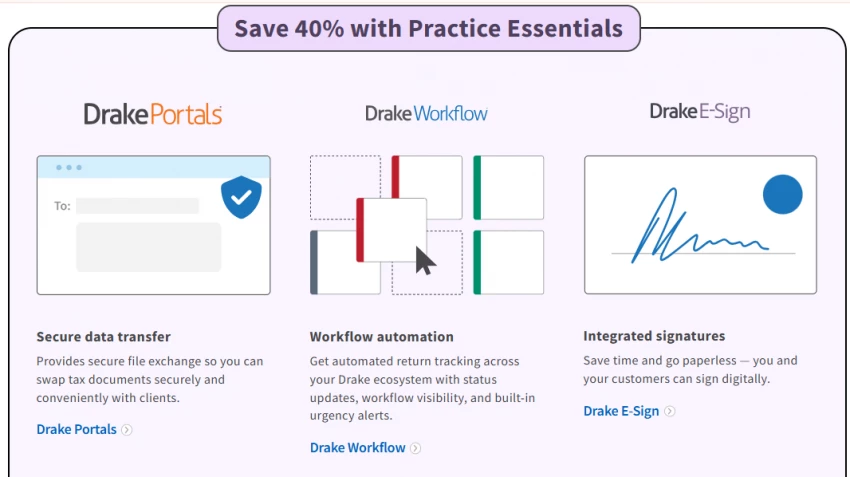
• Drake Portals (SecureFilePro) — a secure, web-based client file exchange. Clients upload W-2s and 1099s, sign documents, and receive their returns without anyone printing, faxing, or emailing sensitive PDFs. Priced separately at roughly $349.95/year or $49.95/month. There's even a taxpayer mobile app.
• Drake E-Sign — electronic signatures integrated directly into the workflow, so clients can sign engagement letters and e-file authorizations digitally.
• Drake Pay — integrated payment processing, so firms can collect fees without leaving the software.
• Drake HUB & Drake Workflow — newer practice-management layers that unify client information and office workflow across the Drake suite, with a single sign-in experience rolling out for tax year 2026.
The strategy is obvious once you see it: Drake wants to be the entire operating system for a small tax practice, intake, prep, signature, payment, delivery, all inside one reasonably priced bundle. And judging by the retention numbers and the twenty-year loyalists in the review sections, the strategy works.
Let's be honest about what Drake Tax is and isn't. It is not the prettiest software you'll ever use. The interface is famously utilitarian, a forms-and-fields data entry system that looks like it was designed by tax people, for tax people, because it was. But under that plain exterior sits a genuinely deep feature set. Here's what stands out:
Drake's data entry system is built around keyboard-driven speed. Experienced preparers fly through returns using shortcut keys and macros, and the software uses double-entry cross-referencing to catch typos before they become errors. Calculations update in real time as you type, and you can jump from any data entry field straight to the calculated form view. Firms report that this workflow, once learned, cuts average return preparation time by 25–40% which is exactly why high-volume 1040 shops love it.
Before you e-file, Drake runs extensive diagnostic scans that flag missing information, calculation inconsistencies, and omissions, then tells you what to fix. Combined with return archiving, calculation error messages, and a rejection rate historically under 1.5%, this is the unglamorous stuff that keeps firms out of trouble during crunch time.
You get access to 4,300+ federal and state forms, individual, corporate, partnership, fiduciary, estate, gift, and non-profit returns with all 50 states included in the flagship packages at no extra per-state charge. Multi-state returns can be prepared, compared, and e-filed within the same platform, and you can even print forms in Spanish. One caveat we'll return to later: coverage is broad, but the depth of guidance on very complex or international forms lags the premium platforms.
E-filing is where Drake built its name, and it shows. Fast turnaround, real-time acknowledgments posted as they land, batch processing for firms filing hundreds of returns, and the ability to e-file directly from the View/Print screen. Federal and all 50 states, including messy multi-state situations.
Drake includes tax planner tools for running what-if scenarios, comparing tax outcomes across multiple years and multiple states, amortization schedules, depreciation calculators, and estimated payment planning. Reviewers consistently single out the asset manager as one of the best in its class, it handles group and bulk asset sales gracefully, which is a quiet superpower for preparers with rental-heavy or small-business clients.
Through Drake Portals, E-Sign, and the built-in Drake Documents manager (which auto-creates a client folder structure whenever you add a new client), the software supports a genuinely paperless office. Clients upload documents through the portal or mobile app, sign electronically, review their return, and pay, all without a single stamp.
Drake has historically been a conservative, slow-and-steady developer, but the 2026 cycle brought real movement. The company is rolling out an AI-powered chatbot inside Drake Tax Desktop that provides conversational, context-aware help directly in the application.
Bigger deal: AI-driven data extraction now lets clients upload W-2s, 1099s, and K-1s through the secure portal, with fields auto-populated into the return after a review-and-validate workflow including bulk review for high-volume firms and admin dashboards to track extraction status. For a product whose users' biggest gripe has always been manual data entry, this is the most meaningful roadmap item in years.
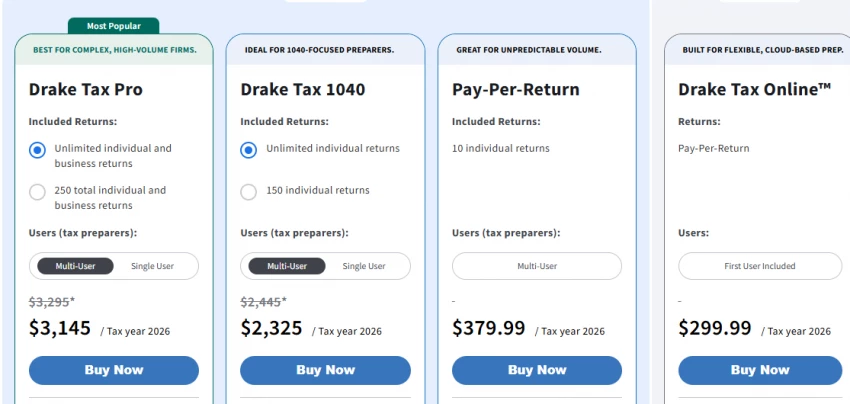
Let's not dance around it , price is Drake's superpower. While competitors gate features behind tiers and charge per-state, per-module, per-everything, Drake structures its pricing around volume, not features. You pick how many returns you file, and you get the full toolkit. For tax year 2026, the lineup looks like this:
| Plan | Price (TY2026, approx.) | Best For |
| Pay-Per-Return | $379.99 for 10 returns; buy more as needed | New preparers & very low-volume practices |
| Drake Tax 1040 | ~$1,775 – $2,195 / year | Individual-focused practices (1040 shops) |
| Drake Tax Pro | ~$2,245 – $2,995 / year | Full practices doing entity + individual returns |
| Drake Portals (add-on) | $349.95 / year or $49.95 / month | Client document exchange & e-signatures |
A few practical notes on pricing. Each line comes in single-user and multi-user variants, with unlimited and capped-return editions, and the top of the range runs to about $3,145/year for the biggest multi-user configurations. Drake typically runs promotional pricing through the end of November before retail rates kick in on December 1, so renewing early genuinely saves money. Free data conversion from competing software is included, which removes the single biggest switching cost. And critically: all 50 states are in the box on the main packages. No per-state nickel-and-diming.
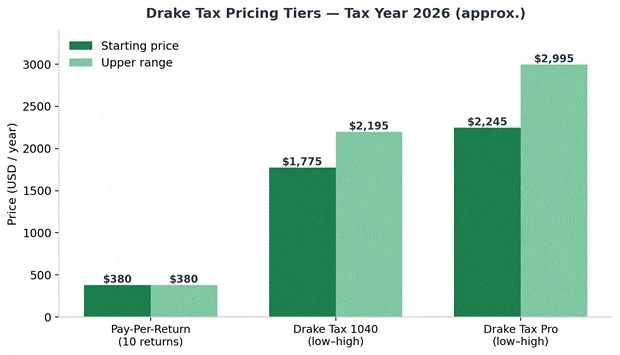
Figure 1: Drake Tax pricing tiers for tax year 2026. Even the top-end Pro multi-user package costs less than entry-level configurations of most enterprise competitors, which commonly run $5,000–$15,000+ per year.
What does this chart actually tell you? Two things. First, the on-ramp is tiny, $379.99 gets a brand-new preparer ten real professional returns, which is why Drake dominates the startup-practice segment. Second, the gap between the cheapest and most expensive Drake configuration is only about $2,600. Compare that with the Intuit or Thomson Reuters ecosystems, where moving up-market can multiply your bill several times over. Drake's pricing curve is nearly flat, and small firms love flat.
Every year, the AICPA's Tax Adviser and Journal of Accountancy survey their members in tax practice right after busy season. It's the closest thing the industry has to a census, and the 2025 edition (2,011 CPA respondents who prepared 2024 returns for a fee) tells a very clear story about where Drake stands.
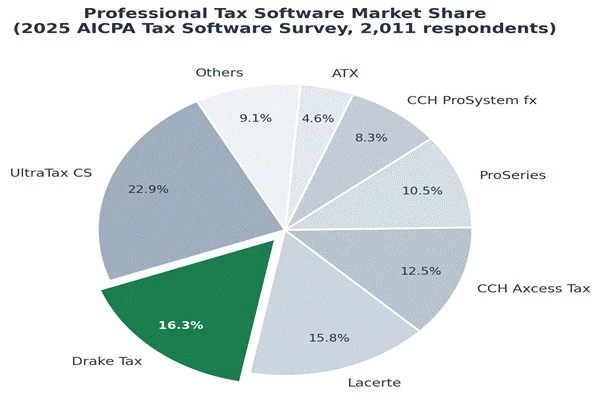
Figure 2: Share of respondents using each professional tax product, 2025 AICPA Tax Software Survey. "Others" combines ProConnect Tax, TaxAct, GoSystem Tax RS, TaxSlayer Pro, TaxWise, TurboTax and unlisted products.
Reading the pie: Drake Tax holds 16.3% of surveyed CPAs, second only to Thomson Reuters' UltraTax CS at 22.9%, and ahead of Intuit's Lacerte (15.8%) and ProSeries (10.5%), and Wolters Kluwer's CCH Axcess Tax (12.5%). Even better for Drake, it was one of only two major products to gain share year over year (+0.4 points), while CCH ProSystem fx and ProSeries both slipped.
But the aggregate number actually undersells Drake's dominance in its home turf. Slice the data by firm size and the picture sharpens dramatically:
Add the company-level numbers, 70,000+ firms, 36+ million returns a year, roughly $136 million in estimated annual revenue, and you get a clean strategic read: Drake isn't trying to be everything to everyone. It is the category king of the small American tax practice, and it keeps quietly compounding.
Here's where it gets fun, because Drake's review profile is one of the most distinctive in all of professional software. Start with the headline: in the 2025 AICPA survey, Drake Tax led all seven major products with a 4.4/5 overall rating. On third-party review platforms the story is consistent, Capterra and G2 reviewers rate it highly, with twenty-year veterans writing things like "I will never use any other software as long as Drake Tax is available."
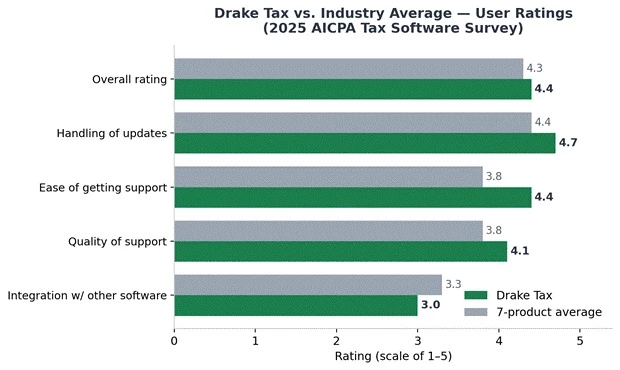
Figure 3: Drake Tax vs. the seven-product industry average across key rating dimensions, 2025 AICPA Tax Software Survey (scale of 1–5).
Walk through the bars and you can see Drake's whole personality. It beats the field on overall satisfaction (4.4 vs 4.3), crushes it on handling mid-season software updates (4.7 vs 4.4, the best of any product), and blows the doors off on support: 4.4 vs 3.8 for ease of reaching support, 4.1 vs 3.8 for support quality tops in the industry on both. Then look at the last bar: integration with accounting and other software, 3.0 against a 3.3 average. That's Drake's soft underbelly, and it's the honest trade-off of a closed, keep-it-simple ecosystem.
Now the chart that explains Drake's retention better than anything else, the price sentiment data:
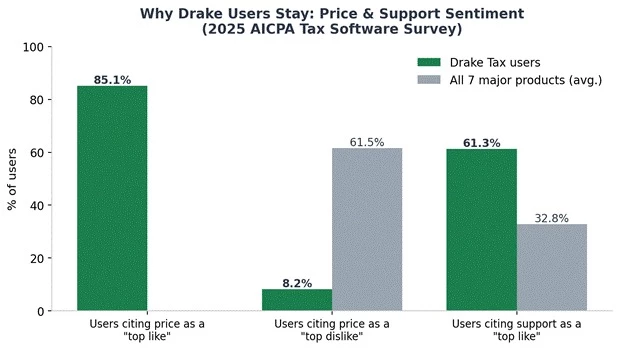
Figure 4: Percentage of users citing price and support among their top likes/dislikes, 2025 AICPA Tax Software Survey.
This one deserves a slow look. Across all seven major products, price is the single biggest complaint in professional tax software, 61.5% of users flag it as a top dislike. Among Drake users? Just 8.2%. Flip it around: a staggering 85.1% of Drake users name price as a top like, far more than any other product's users, and 61.3% name support as a top like against a 32.8% average. When your customers' two favorite things about you are the two things everyone else's customers hate about them, you've found a moat. It also explains the survey's most practical finding: 94.8% of Drake users say it's suitable for a starting tax practice, the highest endorsement of any product.
No fair review skips the complaints, and Drake has real ones. Recurring themes from Capterra, G2, and Software Advice reviewers:
The professional tax software market is more consolidated than it looks, the seven "major" products come from just four companies. Wolters Kluwer owns ATX, CCH Axcess, and ProSystem fx; Intuit owns Lacerte, ProSeries, and ProConnect; Thomson Reuters owns UltraTax CS and GoSystem; and Taxwell owns Drake and TaxAct. Here's how the head-to-head shakes out:
| Product | Rough Positioning | Strengths vs. Drake | Where Drake Wins |
| Drake Tax | Value benchmark; small firms & solos | — | — |
| UltraTax CS | Mid/large firms; quote-only pricing | Deeper forms, complex & multi-entity work, big-firm workflow | Price (often 2–4x cheaper), support, simplicity |
| Lacerte | Intuit's premium desktop | Stronger guidance & diagnostics on complex returns | Dramatically lower cost, no per-return REP fee shock |
| ProSeries | Intuit's mid-market desktop | Friendlier forms-based UI; Intuit ecosystem | Unlimited-return value ($2,605 for unlimited 1040s at ProSeries vs. Drake Pro's all-entity coverage), support ratings |
| CCH Axcess | Cloud enterprise platform | True cloud, deep business/multi-state returns | Price, ease of use, solo-firm fit |
| ATX | Wolters Kluwer's small-firm value line | Similar audience & pricing philosophy | Higher overall rating, better e-file & ecosystem |
The pattern across every credible comparison is the same: if you can afford UltraTax, ProSystem, or Lacerte and you regularly prepare genuinely complex returns, international, consolidated corporate, heavy multi-state, the premium platforms earn their premium. For everyone else, and that's most of the market by firm count, Drake delivers 90% of the capability at 30–50% of the cost, with better support. Even the survey's ratings back the value read: Drake at 4.4–4.5 overall, ProSeries around 4.3, with the industry average at 4.3.
Drake Software is what happens when a company decides to be excellent at a specific job for a specific customer and simply refuses to get distracted for fifty years. It is not the most beautiful tax software, nor the most powerful, nor the most cloud-forward. What it is, measurably, per the industry's own annual survey is the best-rated, best-supported, and best-value professional tax platform in America for the small practices that make up the bulk of the profession.
The 2026 cycle makes the case stronger, not weaker. AI-powered document extraction attacks Drake's oldest weakness (manual data entry), the unified sign-in and Drake HUB/Workflow rollout modernizes the practice-management layer, and pricing remains a fraction of the enterprise alternatives. The risks are equally clear: prices are creeping up under PE ownership, the interface remains stuck in another decade, and the complex-return ceiling is real.
But here's the number that settles it: only 8.2% of Drake users complain about price, in an industry where 61.5% of everyone else does. People don't just use Drake. They're grateful for it. In professional software, that's about the highest compliment there is.
Share your thoughts about this article.
Be the first to post a comment!

Choosing growth software in 2026 means finding five winners inside a catalog of...
Sakshi Dhingra2 weeks ago

The short version, for anyone who does not want to read 5,000 wordsCopper is a C...
Sakshi Dhingra1 month ago

The short versionQuicken sells two entirely separate things. Quicken Classic is...
Harpreet Singh1 month ago

Here is a small confession most security writers avoid making: you probably do n...
Deepak Mehra1 month ago
The photo editing software market has been shaken harder in the past eighteen mo...
Sakshi Dhingra1 month ago

A code kata is a small exercise you repeat until the technique becomes instinct....
Harpreet Singh1 month ago