
Choosing growth software in 2026 means finding five winners inside a catalog of 15,505 martech products. This guide narrows the field to a lean, affordable stack for early-stage teams, with verified pricing, current market data, and a transparent scoring framework behind every pick.
Startups rarely die from a shortage of software. The State of Martech 2026 report counts 15,505 marketing technology products on the market, and after fifteen years of relentless expansion the landscape grew just 0.79 percent this year. Analysts at chiefmartec are calling it peak martech. In other words, the buffet is fully stocked. The hard part is knowing which five plates actually feed a growing company.
Meanwhile, software sprawl quietly drains budgets. BetterCloud's 2026 State of SaaS report puts the average company at 118 SaaS applications, and roughly half of paid licenses across the industry sit unused. For a founder watching runway, that isn't a tooling strategy. That's a leak.
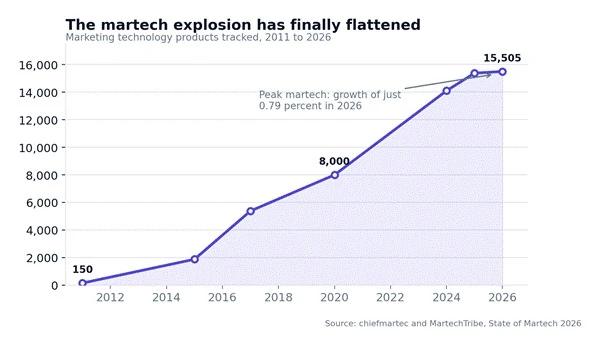
Figure 1: Marketing technology products tracked by chiefmartec, 2011 to 2026. The catalog exploded from 150 tools to 15,505, but annual growth has now collapsed to 0.79 percent, the flattest reading on record. The challenge has shifted from discovering tools to selecting the right few.
The stakes could not be higher. CB Insights analyzed 431 venture-backed startups that shut down after 2023. Seventy percent ran out of capital, but the firm is blunt that an empty bank account is the symptom, not the disease. The root causes sit upstream: 43 percent failed on poor product-market fit, 29 percent on bad timing, and 19 percent on unsustainable unit economics.
One more number worth staring at: the median company in that dataset shut down just 22 months after its final fundraise. Every week spent stitching spreadsheets together, guessing at funnel numbers, or copying leads between apps by hand is a week not spent finding product-market fit. The right stack doesn't guarantee survival, but it shortens the distance between a signal and a decision. That's exactly what the five tools below are built to do.
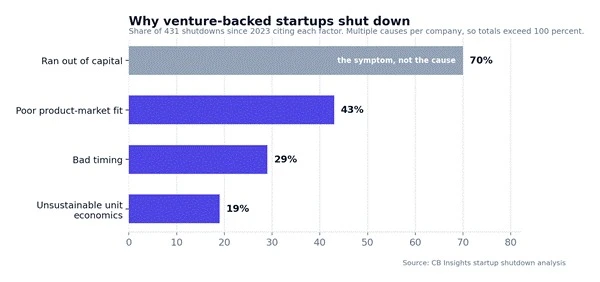
Figure 2: Share of 431 venture-backed shutdowns since 2023 citing each failure factor, per CB Insights. Companies cite multiple causes, so figures exceed 100 percent. Running out of cash tops the list, yet the analysis frames it as the final symptom of deeper product and market problems.
Every ranked list needs rules, so here are the rules. Each candidate was scored out of 10 across five pillars, for a maximum of 50 points. The method is called the S.C.A.L.E. framework, and it weighs exactly what an early-stage team cares about:
• Starting cost: generosity of the free tier and affordability of the first paid plan on annual billing.
• Core depth: whether the tool leads its category on capability and market adoption.
• Automation and AI: native AI features and workflow automation shipped through 2025 and 2026.
• Learning curve: how fast a two-person team reaches first value without a consultant.
• Ecosystem: integrations, templates, and community support that keep the whole stack connected.
Two extra filters applied. Only products with a meaningful free tier or an entry plan under $150 per month qualified, and each pick had to lead a distinct growth function, so the final five cover acquisition, conversion, retention, and operations without overlap.
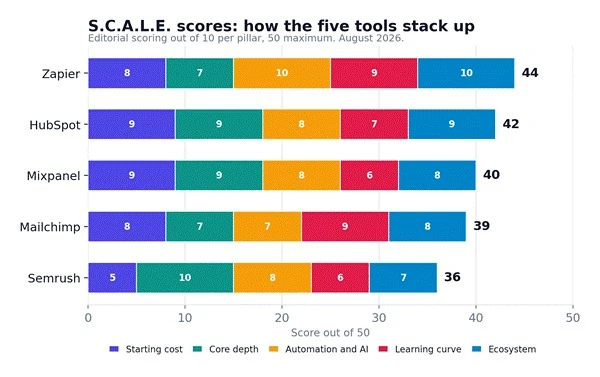
Figure 3: S.C.A.L.E. scores for the shortlisted tools, out of a maximum of 50. Zapier tops the table on automation strength and ease of use, while Semrush trades a higher entry price for unmatched depth in search intelligence.
| Tool | Growth job | Free plan | Entry paid plan (annual billing) | Score |
| Semrush | Search and AI visibility | Limited free account | $117.33 per month (Pro) | 36 / 50 |
| HubSpot | CRM and marketing hub | Free CRM, up to 5 core seats | $15 per seat per month (Starter) | 42 / 50 |
| Mailchimp | Email marketing | 250 contacts, 500 sends per month | $13 per month (Essentials) | 39 / 50 |
| Mixpanel | Product analytics | 1 million events per month | Usage-based, about $24 per month (Growth) | 40 / 50 |
| Zapier | Workflow automation | 100 tasks per month | $19.99 per month (Professional) | 44 / 50 |
Pricing reflects the entry paid tier on annual billing, verified August 2026 against vendor pages and independent pricing trackers.
Here's the shortlist in the order a customer actually meets it: first the company gets discovered, then the lead converts, then email nurtures the relationship, then analytics reveals what's working, and underneath it all the plumbing runs on autopilot.
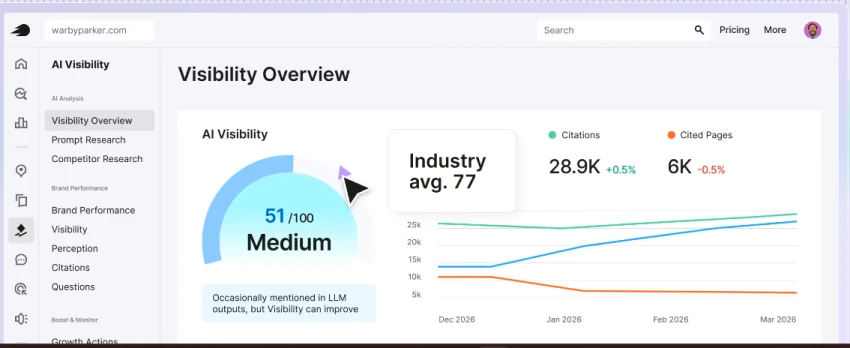
Figure 4: The 2026 startup growth stack visualized as a pipeline. Semrush drives discovery, HubSpot captures and manages demand, Mailchimp nurtures it, Mixpanel measures behavior, and Zapier connects every layer so data moves without manual work.
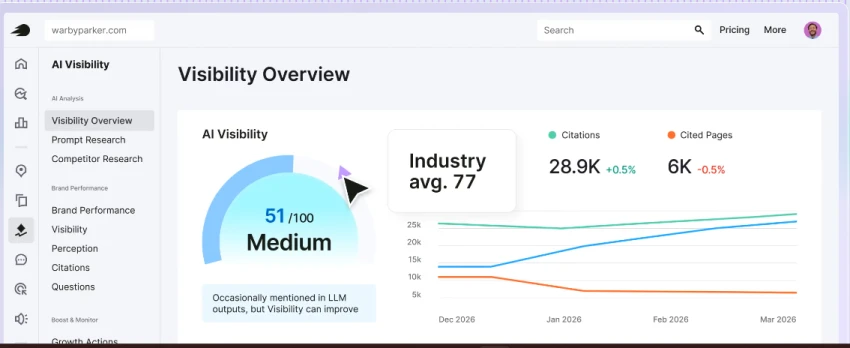
Organic discovery remains the cheapest durable growth channel, and Semrush is still the deepest toolkit for winning it. The platform covers keyword research, competitor analysis, backlink audits, rank tracking, and technical site health from one dashboard. The 2026 twist is AI visibility: with buyers increasingly asking ChatGPT and other assistants for recommendations, the Semrush One bundle, launched in October 2025, pairs classic SEO with an AI Visibility toolkit that tracks how often a brand appears inside AI-generated answers.
• Keyword Magic Tool with search intent data across a massive keyword database
• Site Audit that flags the technical issues holding rankings back
• Competitor gap analysis for keywords, backlinks, and content
• AI Visibility tracking for brand presence in assistant answers on Semrush One plans
A limited free account covers one project. The Pro plan costs $139.95 per month on monthly billing, or $117.33 per month on annual billing. Guru steps up to $249.95 per month, and Semrush One starts at $199 per month with AI visibility included.
Semrush is the priciest line in this stack, so it earns its keep once content becomes a genuine channel. For a startup publishing weekly and tracking competitors closely, the spend typically replaces an agency retainer several times its size. Watch out for seats and add-ons, which raise the bill quickly: start on Pro and upgrade only when limits actually bite.
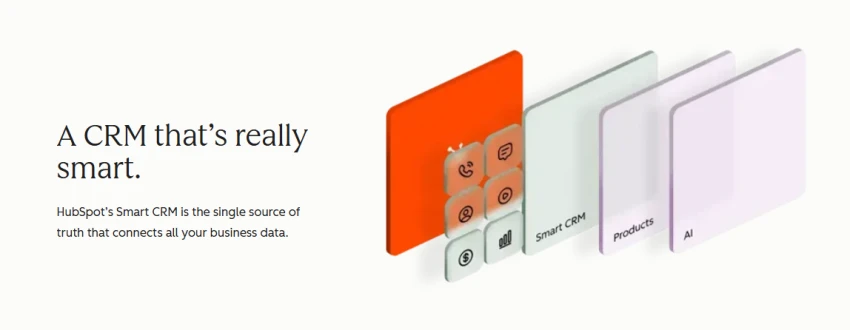
Spreadsheet CRMs collapse the moment two people share a pipeline. HubSpot fixes that with a genuinely free CRM covering contacts, deals, forms, live chat, and email, including up to five free core seats. The Starter Customer Platform then unlocks every hub (marketing, sales, service, content, and operations) at one low seat price, and current plans bundle Breeze AI credits for data enrichment and AI agents.
• Unified timeline of every email, call, form fill, and page visit per contact
• Drag-and-drop pipelines with automatic deal tracking
• Landing pages, forms, and email tools built on the same database
• Breeze AI agents and enrichment credits included in paid tiers
The free CRM costs nothing and stays free. Starter runs $20 per seat per month on monthly billing, or $15 per seat on annual billing, and covers all hubs at Starter level. The jump to Professional is steep: Marketing Hub Professional starts at $890 per month plus onboarding fees, so plan that milestone deliberately.
HubSpot is the system of record for the entire go-to-market motion, which is why it scores 42 out of 50 here. Watch out for contact tier overages and the Professional price cliff, the two costs that most often surprise teams. Tracking marketing contact counts from day one avoids both.
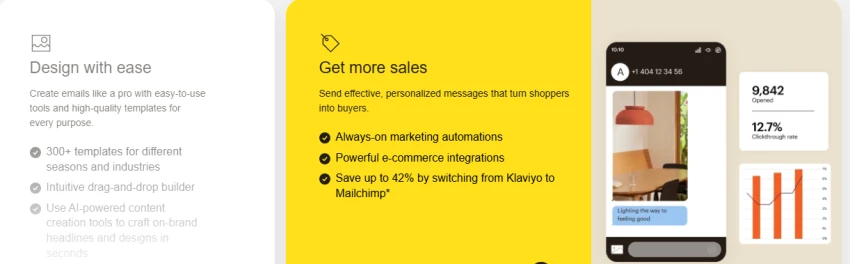
Email keeps topping channel ROI studies for one reason: the audience is owned, not rented from an algorithm. Mailchimp remains the most approachable way for a small team to run it, with hundreds of templates, reliable deliverability, and automations that fire from behavior. One caution on the free plan: as of January 2026 it covers just 250 contacts and 500 sends per month, so treat it as a trial rather than a strategy.
• Multi-step customer journeys with behavioral triggers on Standard and above
• Send-time optimization and delivery by time zone
• Generative AI writing and campaign suggestions
• More than 300 integrations, including HubSpot, Zapier, and major storefronts
Essentials starts at $13 per month for 500 contacts and 5,000 sends. Standard, at $20 per month, unlocks the multi-step automations most startups actually need, and Premium starts at $350 per month. Pricing scales with list size, and unsubscribed contacts count toward the total, so clean the list regularly.
Best for newsletters, onboarding sequences, and promotions during the first year or two. Watch out around the 5,000 contact mark, where the bill climbs toward $75 to $100 per month and comparing Klaviyo or Brevo becomes worthwhile.
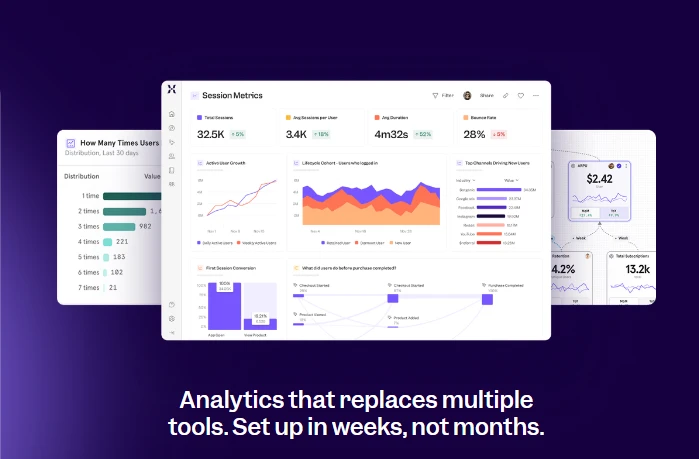
Google Analytics answers where traffic comes from. Mixpanel answers the question that decides survival: what do users do after they arrive? Funnels, retention cohorts, and user flows expose exactly where signups stall, which matters enormously when 43 percent of failed startups trace their collapse to poor product-market fit. In February 2026 the platform moved to event-based pricing, and its free tier is now arguably the most generous in product analytics.
• Funnel analysis that pinpoints the exact step where users drop off
• Retention cohorts separating sticky features from vanity metrics
• Spark AI natural language queries available on every plan
• Unlimited seats on every tier, including the free plan
The free plan covers up to 1 million events per month with unlimited seats. Growth is usage-based at roughly $0.28 per 1,000 events beyond the free allowance, which lands around $24 to $30 per month for a typical early-stage product, with about 30 percent off for annual commitment. Enterprise is custom.
Instrument it before launch, because retention data only exists if events were tracked from day one. Watch out for event volume, which compounds with success: keep the tracking plan lean and review it quarterly.
Every startup accumulates robot work: copying form fills into the CRM, posting new sales to Slack, syncing invoices to a sheet. Zapier automates all of it across more than 7,000 apps with zero code, which is why it posts the highest S.C.A.L.E. score in this lineup at 44 out of 50. Newer AI steps can draft, summarize, and route data inside a workflow, turning simple automations into small agents.
• More than 7,000 app integrations, the widest catalog in automation
• Multi-step Zaps with branching paths, filters, and webhooks
• AI-powered steps for drafting, extraction, and routing
• Thousands of prebuilt templates, including ones for HubSpot, Mailchimp, and Mixpanel
The free plan includes 100 tasks per month. Professional starts at $19.99 per month on annual billing for 750 tasks, with multi-step Zaps and premium apps, and Team runs $69 per month. Every action in a workflow consumes a task, so a five-step Zap firing 150 times burns the full 750.
Adopt it the moment anyone on the team repeats the same copy-paste twice a week. Watch out for task-based billing at scale: beyond a few thousand tasks per month, alternatives like Make deserve a cost comparison.
Nobody should buy five subscriptions on day one. A saner rollout for a pre-seed or seed-stage team looks like this:
Week 1: Mixpanel free and HubSpot free. Measurement and pipeline cost nothing, and both compound in value the earlier they start.
Month 2 to 3: Mailchimp Essentials, once the list passes a few hundred contacts and a welcome sequence is worth building.
Month 3 to 6: Semrush Pro, when content becomes a deliberate channel rather than an occasional blog post.
Whenever repetition appears: Zapier Professional, typically the fastest payback of the five.
The math is friendly. The full stack on entry paid plans totals roughly $189 per month on annual billing, and the free tiers alone can carry a team to its first few hundred users at $0. For context, BetterCloud pegs average SaaS spend at about $5,600 per employee per year, so a complete five-tool growth stack costs less than half of one employee's typical software budget.
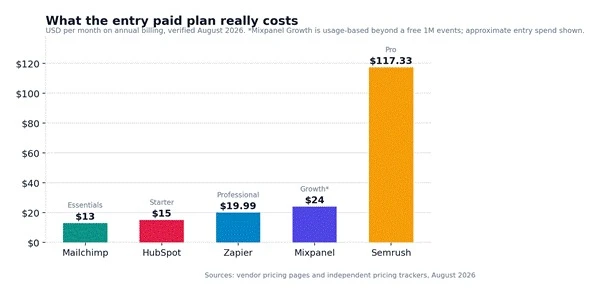
Figure 5: Entry paid plan pricing across the stack, in USD per month on annual billing, verified August 2026. Mixpanel's Growth tier is usage-based beyond a free 1 million events, so the bar shows an approximate typical entry spend. Semrush is the clear outlier, which is exactly why it sits later in the adoption sequence.
The martech catalog will keep churning: 1,488 products entered the landscape this year and 1,367 exited. A startup can't control that noise, but it can control its own signal. Pick one tool per job, start with the free tiers that compound, spend on Semrush only when content is a real channel, and let Zapier stitch the seams. Five logos, under $190 per month, covering the entire journey from first search to loyal customer. That isn't tool sprawl. That's a system.
Share your thoughts about this article.
Be the first to post a comment!

The short version, for anyone who does not want to read 5,000 wordsCopper is a C...
Sakshi Dhingra2 months ago

If you've spent any time around tax professionals in the United States, you've h...
Harpreet Singh2 months ago

The short versionQuicken sells two entirely separate things. Quicken Classic is...
Harpreet Singh2 months ago

Here is a small confession most security writers avoid making: you probably do n...
Deepak Mehra2 months ago

The photo editing software market has been shaken harder in the past eighteen mo...
Sakshi Dhingra2 months ago

A code kata is a small exercise you repeat until the technique becomes instinct....
Harpreet Singh2 months ago