Picture the last time you called a business after hours. You already know the sound: three rings, a slightly-too-cheerful recording, and then that fork in the road where you either mash zero until something happens or just hang up and try a competitor. Now flip it around. Somebody calls your business at 9:47 p.m., a voice picks up on the second ring, books the appointment, answers two follow-up questions, and the caller never once thinks, wait, is this a robot? That second version is what everyone is trying to buy right now. The tricky part is that a huge number of voice agents behave like version one while being sold like version two.
And the money is pouring in fast enough to make the hype hard to ignore. The AI voice agent market sat at roughly $2.54 billion in 2025 and is on track for about $35.24 billion by 2033, a compounding rate near 39% a year. Gartner expects conversational AI to shave around $80 billion off contact center labor costs in 2026 alone. When a category grows that quickly, two things happen at once: the good products get genuinely good, and a swarm of thin wrappers rush in to grab budget before anyone checks the fundamentals. Your job as a buyer is to tell those two apart before you sign anything.
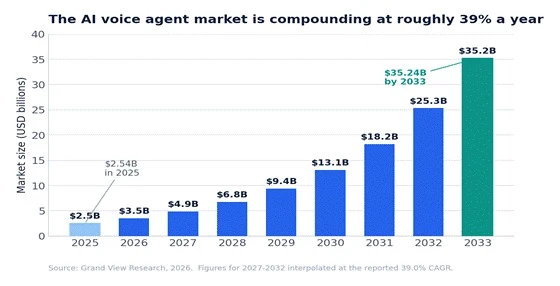
Figure. The AI voice agent market is projected to grow from about $2.54B in 2025 to roughly $35.24B by 2033, a near-39% annual rate. Steep growth curves attract both serious builders and thin resellers, which is exactly why buyer scrutiny matters.
Here is the encouraging news: you do not need to be an engineer to evaluate one of these tools well. You need to know which handful of numbers separate a smooth agent from an awkward one, and you need a simple way to test them yourself instead of trusting a demo that was quietly rigged to sound perfect. That is what the rest of this guide walks through: what to look for, and just as importantly, how to look.
An AI voice agent is not one thing. It is a little assembly line stitched together from four parts: speech recognition that turns the caller's words into text, a language model that decides what to say back, a text-to-speech engine that speaks the reply, and a telephony layer that carries the call. Most of the quality problems you will run into trace back to one weak link in that chain, which is why a slick front end can hide a clunky pipeline underneath.
Keep that assembly line in your head as you read on, because almost every buying criterion below is really a question about one of those four stages, or about how well the vendor glued them together.
If you only remember one metric from this entire guide, make it this one. Latency is the gap between the moment a caller stops talking and the moment your agent starts replying. Humans leave a gap of about 200 milliseconds between conversational turns, which is roughly the time it takes to blink. Anything close to that feels natural. Stretch it out and the caller's brain quietly registers that something is off, usually before they can even name why.
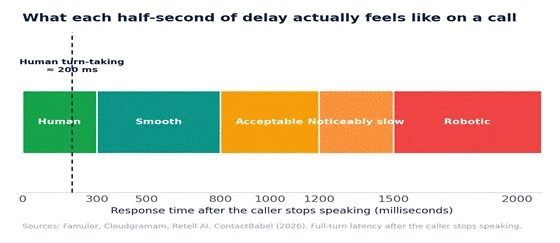
Figure. How response time actually feels on a live call. Under 300 ms reads as human, up to about 800 ms stays smooth, 800 to 1,200 ms is acceptable for business calls, and past 1,500 ms the caller realizes they are talking to a machine.
Here is the ladder in plain terms. Under 800 milliseconds, most callers experience the conversation as smooth. Between 800 and 1,200 milliseconds it is still fine for a business call, with a slight lag creeping in. Cross 1,500 milliseconds and an uncomfortable pause appears, the caller starts talking over the agent, and the whole thing tips into feeling robotic. The best agents in 2026 are landing full turns in the 300 to 800 millisecond band, with a few pushing toward 250.
The trap almost everyone falls into Vendors love to quote the latency of one fast component. A text-to-speech model might advertise around 75 milliseconds, which sounds incredible, except that number leaves out transcription, the language model, tool calls, and the phone network. In one independent fixed-stack test the same provider measured about 1.73 seconds for a complete turn. The lesson: only the end-to-end, full-turn number matters, and you want the p95 (the slow 5% of calls), not just the flattering average. |
Latency also has real revenue attached to it. Call abandonment sits around 4.2% when an agent answers within two seconds, and jumps to 23.7% when callers wait 30 seconds or more. Speed is not a vanity metric. It is the difference between a booked customer and a hang-up.
When an agent feels slow, buyers tend to blame the AI. Usually the culprit is turn detection or the language model's time-to-first-token, not the parts you would guess. It helps to see the budget laid out, because these stages run one after another, so their delays stack:
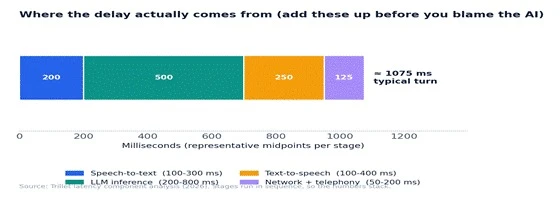
Figure. A representative latency budget. Speech-to-text, language model inference, text-to-speech, and network delivery each add time, and because they run in sequence the numbers add up. A well-tuned stack keeps the total under a second.
Two different questions hide inside this one, and both matter. The first is how well the agent understands your callers. The standard measure is Word Error Rate, and for most business use an acceptable range is roughly 5% to 10%. For healthcare or finance, where a misheard digit or drug name has real consequences, you want it lower. The catch is that vendor accuracy numbers are almost always measured on clean audio with tidy American accents. Your callers are on speakerphone in a car, with a toddler in the background, in the full range of accents your market actually has.
How to test this in ten minutes Call the demo agent yourself and deliberately make it hard. Mumble a little. Read out a long number like a booking reference or a card's last four digits. Throw in a regional accent or a non-English name it will genuinely encounter. Add some background noise. A good agent recovers gracefully and asks a natural clarifying question. A weak one either mishears silently or freezes. |
The second question is whether the voice sounds like a person or like a 2015 GPS unit. Modern text-to-speech is genuinely impressive, but quality varies a lot between vendors and even between the voices a single vendor offers. Listen specifically for how it handles the boring stuff: does it pause at commas, does it stress the right word in a question, does it stumble on numbers and email addresses? Those small tells are what make callers relax or tense up.
Real conversations are messy. People interrupt, change their minds mid-sentence, and answer a question before the agent finishes asking it. This is called barge-in, and it is one of the fastest ways to tell a serious product from a demo-ware one. When you talk over a weak agent, it either plows ahead reading its script while you are speaking, or it panics and loses the thread entirely.
Test it on purpose. Start answering before the agent finishes its sentence. Interrupt to change a detail. Say wait, actually, make that Thursday. A well-built agent stops talking the instant you start, actually listens, and adjusts. If it cannot handle a simple interruption in a demo, it will fall apart on your busiest, most impatient callers.
A voice that sounds human is worthless if the agent cannot actually do anything. This is where you separate a talking FAQ from a tool that moves your business forward. Walk through your three or four most common call types and ask the vendor to show each one working end to end, not on slides.
The agent needs to plug into the systems you already run: your calendar for booking, your CRM for looking up and logging customers, your telephony for actually routing calls, and whatever else your workflow depends on. Ask specifically whether the integration you need already exists or has to be custom-built, because custom means time, money, and something else that can break later.
No agent should handle everything, and the good ones know it. Around 87% of consumers say they get frustrated by clumsy customer-service transfers, so how the agent hands off to a person is not a footnote. When it hits something it cannot do, does it pass the call to a human smoothly with the context attached, or does it dump the caller into a dead end or a fresh queue where they have to repeat their whole story?
If your callers speak more than one language, confirm real support rather than a checkbox on a feature list. And remember that a big part of the value here is that the agent works nights, weekends, and holidays without complaint, which is also when a badly-built one will embarrass you with nobody around to notice.
This section is not glamorous, and it is exactly where rushed buyers get burned. If you handle health data you need HIPAA. If you take payments you need PCI-DSS. Most serious vendors should be able to show SOC 2 certification without hesitation. You also need to know where call recordings are stored, for how long, who can see them, and whether call-recording consent is handled correctly for the regions you operate in.
One specific thing to pin down: is compliance included, or is it an add-on? This matters more than it sounds, because compliance is a favorite hiding spot for surprise fees, which brings us neatly to the part of buying that trips people up the most.
Here is the uncomfortable truth about voice agent pricing. The number on the pricing page and the number on your invoice are usually different, and the gap is not small. Advertised platform rates often start around $0.05 to $0.15 per minute, but real all-in production cost typically lands at $0.12 to $0.25 per minute once you stack transcription, the language model, text-to-speech, and telephony on top. Some deployments run higher.
| Cost layer | What it is | Typical range |
| Platform fee | The vendor's base per-minute charge | $0.05 - $0.15 / min |
| Telephony | Carrying the actual phone call | $0.015 - $0.06 / min |
| Premium voice | Higher-quality text-to-speech add-on | $0.03 - $0.08 / min |
| Compliance | HIPAA or PCI as a monthly add-on | $500 - $2,000 / mo |
| Setup | One-time onboarding, more for enterprise | $2,000 - $50,000+ |
| All-in reality | What most production deployments pay | $0.12 - $0.25 / min |
Table. Common cost layers in AI voice agent pricing. Sources: Ringly, BitBytes, Kommunicate (2026).
Ask these four questions before you sign Do you bill for silence, hold time, and ringing? Many platforms charge for the whole call, so a two-minute call with 30 seconds of silence can cost you 25% more than you expected. Is HIPAA or SOC 2 included or an add-on? Compliance surcharges commonly run $500 to $2,000 a month, sometimes $36,000 a year before a single call connects. What are the overage rates? Going over your plan's minutes is often billed 20% to 50% above the standard rate. Can I get one straight all-in per-minute number? If a vendor cannot give you that, they are usually hiding a cost layer. |
None of this makes voice agents a bad deal. The economics are still striking: an AI agent handles a call for roughly $0.40 against $7 to $12 for a human agent, a 90 to 95% cut per automated interaction. The point is simply to budget on the all-in figure, not the headline, so the savings you promised your boss actually show up.
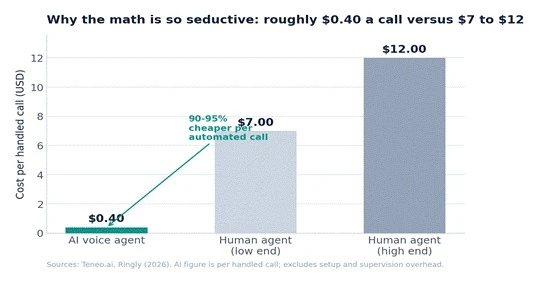
Figure. The cost gap that makes voice agents so appealing: about $0.40 per handled call versus $7 to $12 for a human agent. Real, but only if you budget on the all-in per-minute rate rather than the advertised one.
Vendor demos are theater. They are built on the happy path, with clean audio and questions the agent already knows how to answer. The way you protect yourself is to run your own small pilot on the paths that actually break. Here is a routine that takes an afternoon and tells you more than a month of sales calls.
Call it yourself, repeatedly. Not a scripted demo, a real call. Latency, voice quality, and interruption handling all reveal themselves in the first two minutes of a live call.
Break the happy path on purpose. Interrupt it. Change your mind. Give a wrong detail then correct it. Ask something slightly outside its script and watch whether it recovers or collapses.
Make the audio realistic. Test the accents, background noise, and long numbers your real callers bring. A car speakerphone is a fairer test than a quiet office.
Push it to the human handoff. Force an escalation and check that the transfer is smooth and carries context, rather than dumping the caller into a fresh queue.
Ask for the p95 latency, not the average. A good median with an ugly p95 means every twentieth caller gets an awkward pause. Get the number in writing.
Get the all-in price in writing. One number, every fee included, with overage and compliance spelled out.
The interest-versus-deployment gap, and why it exists Roughly 68% of small businesses now use AI regularly, but only about 14% of companies under 200 employees have an AI agent actually running in production. That gap is not because the tools do not work. It is because buyers who skipped the testing above got a version-one experience and quietly pulled the plug. A single afternoon of honest testing is what keeps you on the right side of that line. |
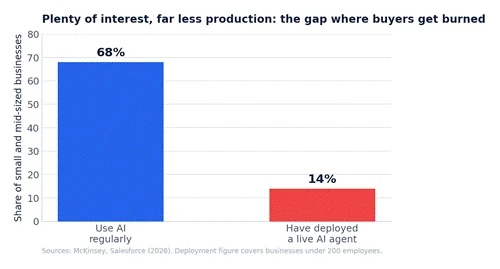
Figure. Interest is high but production deployment lags well behind. Most of that gap traces back to buyers who trusted the demo instead of testing the fundamentals, then abandoned an agent that never really worked on their calls.
Print this, or paste it into your notes app, and run every vendor through the same gauntlet. Same test for everyone is the only way to compare fairly.
| What to check | The good answer you want |
| End-to-end latency (p95) | Under about 800 ms, in writing, full turn |
| Understanding (Word Error Rate) | 5-10%, lower for health or finance |
| Voice naturalness | Handles numbers, pauses, and questions cleanly |
| Interruption handling | Stops instantly and adjusts when you barge in |
| Integrations | Your calendar, CRM, and telephony already supported |
| Human handoff | Smooth, with full context passed along |
| Compliance | SOC 2 shown on request; HIPAA or PCI if you need them |
| Pricing | One all-in per-minute number, fees spelled out |
| Silence and overage billing | Clear policy, no surprise multipliers |
| Analytics | Transcripts and call metrics you can actually see |
Table. A single-page evaluation checklist to run identically across every vendor you consider.
A good AI voice agent is genuinely one of the better operational bets a business can make right now. The savings are real, the technology has crossed the line from novelty to workhorse, and callers increasingly cannot tell the difference when it is done well. But when it is not done well is not a small failure. It is a caller hanging up on you at 9:47 p.m. and dialing a competitor instead.
So do not buy the demo. Buy the numbers, and test them yourself. Latency in the right band, accuracy that survives real accents, interruption handling that does not crack, integrations that fit your stack, compliance you can actually see, and one honest all-in price. Get those six things right and the version-two experience, the one where the caller never suspects a thing, is completely within reach. Skip the testing and you are just gambling that the demo was telling the truth. It usually is not.
Share your thoughts about this article.
Be the first to post a comment!
Software rarely gets removed. It accumulates. A team hits a snag, someone finds...
Deepak Mehra1 month ago
⚑ The short versionAn AI detector returns a probability, not a verdict. Th...
Sakshi Dhingra1 month ago
Here is the uncomfortable truth about buying an AI chatbot for customer support...
Harpreet Singh1 month ago
Cancelling a ChatGPT subscription takes less than two minutes, once you know whe...
Harpreet Singh1 month ago

AI assistants stopped being optional somewhere in the last two years. Four in fi...
Harpreet Singh2 months ago
Buying an AI tool after reading one polished review can be risky. Some reviews r...
Michael Hicklen3 months ago