AI assistants stopped being optional somewhere in the last two years. Four in five US students now use generative AI for schoolwork, 58% of small businesses use it in daily operations, and demand for AI-tagged freelance skills more than doubled year over year on Upwork's marketplace. The question has shifted from 'should I use an AI assistant?' to 'which one fits my work and my budget?'
RedeepSeek (redeepseek.io) positions itself as the all-in-one answer: an AI companion that generates content, writes and debugs code, analyzes documents and images, searches the web with cited sources, and works across 50+ languages from a free tier up to an $18/month Professional plan. But 'all-in-one' doesn't mean 'for everyone equally.' This guide breaks down exactly what RedeepSeek offers, then maps its features and plans against the three audiences it serves best, freelancers, students, and businesses, using each group's real 2026 adoption data and working needs. By the end you'll know whether it belongs in your stack, and precisely which plan to pick if it does.
RedeepSeek is a browser-based AI assistant platform built around a single conversational interface that combines several capabilities most tools sell separately. The platform reports over 5,000 active users, more than 1 million messages processed, support for 50+ languages, and 99.9% uptime. Getting started requires no credit card, a free tier with daily credits opens the door, and the platform advertises a ten-second signup.
Six capabilities form the core toolkit:
| Capability | What it does | Who leans on it most |
| AI Chat Assistant | Context-aware conversations for answers, brainstorming, and problem-solving | Everyone, the front door |
| Content Generation | Blog posts, emails, ad copy, social content, product descriptions in your brand voice | Freelancers, marketers, businesses |
| Code Assistant | Write, debug, and explain code across 30+ languages (50+ on Professional) | Developers, freelancers, students |
| Web Search Integration | Real-time answers with cited sources you can verify | Researchers, students, businesses |
| Image Understanding | Analysis, data extraction, and visual Q&A on uploads, documents, charts, screenshots | Businesses, researchers |
| Multi-Language Support | Translation, localization, and native-quality content in 50+ languages | Global freelancers, exporters |
The workflow is deliberately simple: sign up, describe what you need (or paste a document / upload an image), and refine the result conversationally, the assistant keeps context across the session, so 'now translate it to Spanish and French' just works.
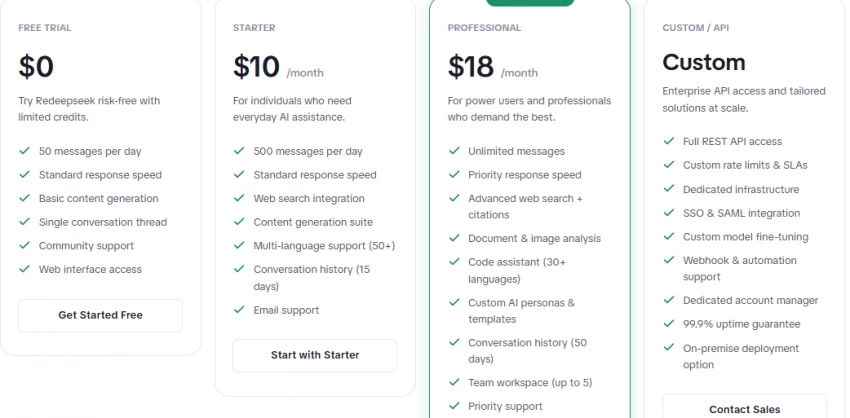
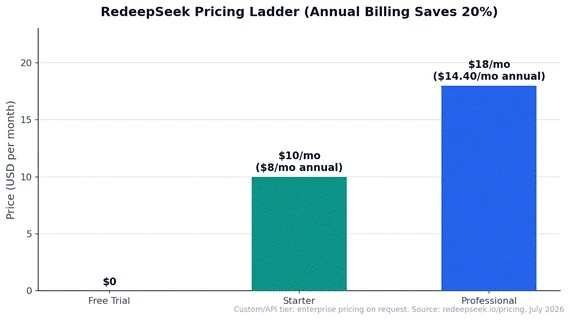
Figure 1: Three self-serve tiers plus a custom enterprise track. Annual billing cuts 20% off.
| Free Trial ($0) | Starter ($10/mo) | Professional ($18/mo) | Custom / API | |
| Messages | 50 per day | 500 per day | Unlimited | Custom rate limits |
| Response speed | Standard | Standard | Priority | Dedicated infra |
| Web search | — | Included | Advanced + citations | Included |
| Docs & image analysis | — | — | Included | Included |
| Code assistant | Basic | Included | 50+ languages | Included |
| Custom AI personas | — | — | Included | + fine-tuning |
| History retention | Session | 15 days | 50 days | Custom |
| Team features | — | — | Workspace up to 5 | SSO/SAML, SLAs, on-prem |
| Support | Community | Priority | Dedicated manager |
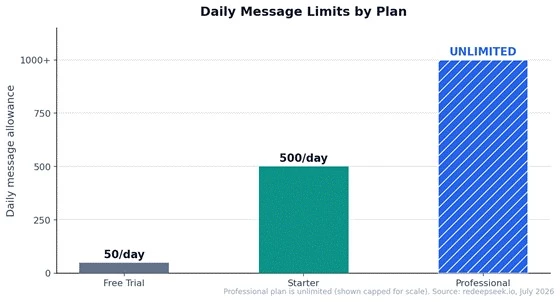
Figure 2: The message ladder, 50/day free, 500/day on Starter, unlimited on Professional.
On annual billing, Starter works out to $8/month ($96/year) and Professional to $14.40/month ($172.80/year). All plans include SSL encryption and GDPR compliance. That pricing sits noticeably below the $20/month standard set by mainstream AI subscriptions:
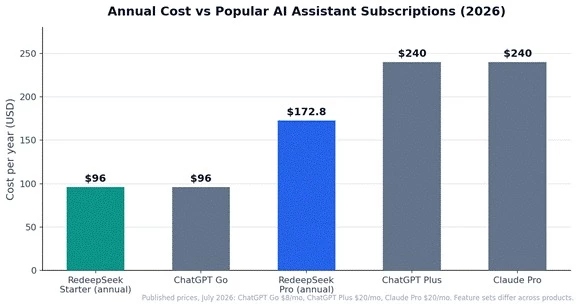
Figure 3: On annual billing, RedeepSeek Pro costs ~28% less per year than a ChatGPT Plus or Claude Pro subscription. Feature sets differ — this is a price comparison, not a capability score.
No group has adopted AI more aggressively than independent professionals. Upwork's 2026 Future Workforce Index found 41% of freelancers already use AI agents for autonomous task execution versus just 24% of full-time employees and demand for AI-tagged freelance skills grew 109% year over year, more than four times the growth of other in-demand skills. The economics explain why: 2026 productivity research found human-AI collaboration can boost project completion by up to 70%, and for a solo operator, every hour saved on drafting and admin is an hour billed elsewhere. Meanwhile roughly 48% of gig workers say AI already helps them deliver projects more efficiently.
• Client content at volume: the content suite covers the bread-and-butter deliverables, blog posts, email sequences, ad copy, product descriptions, social calendars, with tone control for matching different client brand voices.
• Proposals, outreach, and admin: first drafts of pitches, project scopes, follow-ups, and invoice notes are exactly the low-value-but-necessary work AI compresses best.
• Code and technical gigs: the code assistant (30+ languages, 50+ on Professional) handles debugging, explanation, and architecture guidance, useful both for developer freelancers and for content freelancers who occasionally need a script or a WordPress fix.
• Multilingual clients: 50+ language support turns one deliverable into localized versions for international clients without a separate translation tool, a genuine rate-card expander.
• Research with receipts: web search with cited sources means client-facing claims can be verified, increasingly a professional requirement, not a nicety.
Start on Starter ($10/month, or $8 annual): 500 messages a day comfortably covers full-time freelance use, and it unlocks web search and the full content suite. Upgrade to Professional when any of three things happen, you need document/image analysis for client files, you want custom AI personas to lock in each client's voice as a reusable template, or you're bumping message limits during crunch periods. At $172.80/year on annual billing, Professional still undercuts a single month-twelve of most $20/month rivals by a wide margin.
Students are the most saturated AI audience on earth: Stanford HAI's 2026 AI Index found four in five US high school and college students now use generative AI for school-related tasks, and Pew reports 64% of teenagers use AI chatbots, about 30% daily. The differentiators for students aren't adoption, they're cost and legitimacy: student budgets don't stretch to $20/month, and the useful applications are study support, explanation, summarization, practice, and research, rather than outsourced homework.
• A genuinely usable free tier: 50 messages a day at $0, no credit card, covers a realistic study session, concept explanations, practice questions, essay outlines, and quick checks without the artificial 5-message teasers common elsewhere.
• Cited research: web search with verifiable sources matters more for students than almost anyone, a claim you can cite is a claim you can submit. (79% of US college students report their instructors now discuss AI use and ethics in class; verifiable sourcing is how you stay on the right side of that conversation.)
• Language learning and international study: 50+ languages supports practice conversations, translation checking, and writing in a second language, including for the huge cohort studying abroad or in English-medium programs.
• Learning to code: the code assistant's explain-and-debug mode is effectively free tutoring for CS coursework, paste the error, understand the fix, rather than copy the answer.
• Document summarization: on Professional, uploading lecture slides, papers, or scanned pages for extraction and Q&A turns dense readings into study notes, though most students won't need this tier.
Stay free until it hurts. The 50-message daily allowance is enough for most coursework rhythms; the natural upgrade is Starter at $8/month on annual billing ($96/year less than a single textbook) when web search, longer history, and heavier daily use become routine, typically around thesis or capstone season. The honest caveat every student guide owes its readers: use AI to understand and draft, not to submit unedited output, institutional AI policies vary, detection tools exist, and the 79% ethics-discussion figure above means your instructors are paying attention.
Small business AI adoption has moved faster than any prior technology cycle: generative AI use jumped from 23% of small businesses in 2023 to 40% in 2024 to 58% in 2025 per the US Chamber of Commerce, and Salesforce reports 91% of small businesses using AI see measurable revenue increases. The average small business saves about 5.6 hours per week with AI, owners and managers over 7 hours. Yet the barriers that remain are confidence and cost-clarity, not access: only 27% of small firms feel confident adopting AI effectively, and many stall at the free-tier-toy stage without embedding AI into actual operations.
• Marketing and content operations: marketing is the #1 SMB use of AI (Intuit QuickBooks, 2025). The content suite plus custom personas on Professional lets a business define its brand voice once and generate on-message emails, product pages, ads, and social content repeatedly.
• Document and image workflows: Professional's document and image analysis handles the unglamorous operational load, extracting data from invoices and forms, interpreting charts and reports, summarizing contracts before the lawyer sees them.
• A team on one bill: the Professional plan includes a team workspace for up to five seats, squarely aimed at the micro-business and agency-pod size where per-seat enterprise pricing stings most.
• Global customers: multi-language generation and localization supports serving customers across markets without a translation vendor, relevant to the e-commerce and export SMBs driving much of Asia-Pacific's AI growth.
• A path to production: the Custom/API tier adds REST API access, SSO/SAML, custom rate limits and SLAs, webhook automation, fine-tuning, and even on-premise deployment, meaning a business that starts with five chat seats can graduate to embedding the same AI in its own products and workflows without switching vendors.
Professional ($18/month, $14.40 annual) is the business default, unlimited messages, priority speed, document analysis, personas, and the five-seat workspace make it a complete small-team deployment for under $175 a year. Move to Custom/API when you need programmatic access, single sign-on, contractual uptime, or more than five seats. The decision math is friendly: against the 5.6 hours per week the average AI-using small business saves, even the annual Professional price pays for itself in the first week or two of use.
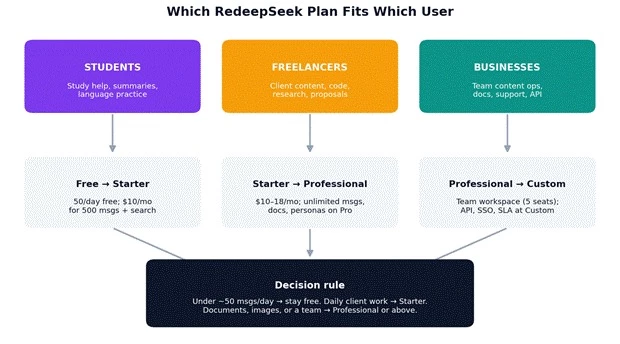
Figure 4: The plan-fit map — free for light study use, Starter for daily individual work, Professional for documents and teams.
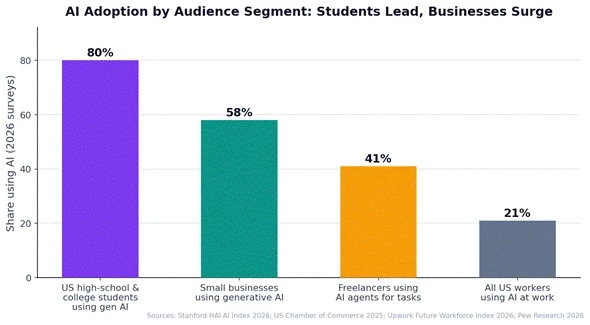
Figure 5: Every RedeepSeek audience is already deep into AI adoption, the platform's bet is serving all three at below-market prices.
| You are | Best plan | The deciding feature | Annual cost |
| A student with regular coursework | Free → Starter | 50 free msgs/day; web search when you upgrade | $0–96 |
| A freelancer with daily client work | Starter | 500 msgs/day + full content suite | $96 |
| A freelancer handling client files & voices | Professional | Doc/image analysis + custom personas | $172.80 |
| A solo founder / micro-business | Professional | Unlimited msgs + brand personas | $172.80 |
| A small team (2–5 people) | Professional | Shared workspace on one bill | $172.80 |
| A company needing API, SSO, or 6+ seats | Custom / API | REST API, SLAs, on-prem option | Custom |
An honest fit assessment cuts both ways. RedeepSeek is a weaker match for three groups. Heavy specialist users, a developer living in an IDE all day, or a design team needing image generation, will still want purpose-built tools (AI coding agents, dedicated design platforms) alongside or instead of a general assistant. Large enterprises with strict vendor-security review processes will want to run the Custom tier's SSO, SLA, and deployment options through procurement before committing, as they would with any younger platform. And users who specifically want a particular frontier model's behaviour, a specific ChatGPT, Claude, or Gemini capability they've built workflows around, should weigh that RedeepSeek is its own platform experience; the draw here is breadth-per-dollar, not access to one branded model.
RedeepSeek's clearest strength is fit-to-price across its three core audiences. Students get a real free tier and a $96/year upgrade path in a world where 80% of them already use AI for school. Freelancers, the fastest AI adopters in the workforce, get their whole deliverable stack (content, code, research with citations, 50+ languages) for less than half the going rate of mainstream assistants.
And small businesses get the features that actually map to SMB adoption data, marketing content, document handling, and a five-seat workspace with an API tier waiting when they outgrow chat.
If you're a heavy specialist or committed to a specific frontier model's ecosystem, look elsewhere; for everyone in the broad middle who wants one capable, affordable AI companion, RedeepSeek earns its place on the shortlist. The free tier makes testing that claim cost exactly nothing.
Share your thoughts about this article.
Be the first to post a comment!
Software rarely gets removed. It accumulates. A team hits a snag, someone finds...
Deepak Mehra1 month ago

⚑ The short versionAn AI detector returns a probability, not a verdict. Th...
Sakshi Dhingra2 months ago
Picture the last time you called a business after hours. You already know the so...
Pritam Singh2 months ago
Here is the uncomfortable truth about buying an AI chatbot for customer support...
Harpreet Singh2 months ago
Cancelling a ChatGPT subscription takes less than two minutes, once you know whe...
Harpreet Singh2 months ago
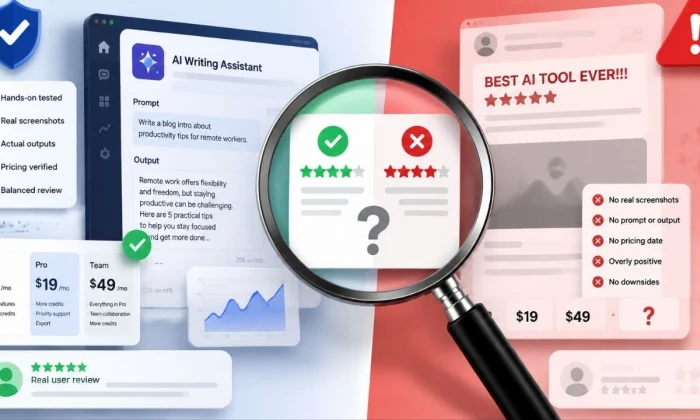
Buying an AI tool after reading one polished review can be risky. Some reviews r...
Michael Hicklen3 months ago